
Xiaomi Redmi K50i vs. Nothing Phone (1): A Deep Dive into Performance and Value
| Phones Images | |||||
|---|---|---|---|---|---|
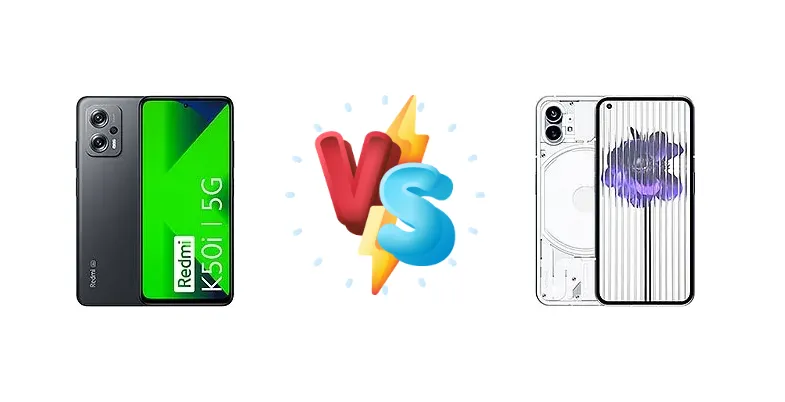
|
🏆 Quick Verdict
For users prioritizing gaming and demanding tasks, the Xiaomi Redmi K50i is the clear winner thanks to its significantly more powerful Dimensity 8100 chipset. However, the Nothing Phone (1) appeals to those seeking a stylish, distinctive device with a refined software experience and wireless charging.
| PHONES | ||
|---|---|---|
| Phone Names | Xiaomi Redmi K50i | Nothing Phone (1) |
| Network | ||
|---|---|---|
| 2G bands | GSM 850 / 900 / 1800 / 1900 | GSM 850 / 900 / 1800 / 1900 |
| 3G bands | HSDPA 850 / 900 / 1700(AWS) / 1900 / 2100 | HSDPA 800 / 850 / 900 / 1700(AWS) / 1900 / 2100 |
| 4G bands | 1, 2, 3, 4, 5, 7, 8, 20, 28, 38, 40, 41 | 1, 2, 3, 4, 5, 7, 8, 12, 17, 18, 19, 20, 26, 28, 32, 34, 38, 39, 40, 41, 66 |
| 5G bands | 1, 3, 5, 7, 8, 20, 28, 38, 40, 41, 77, 78 SA/NSA | 1, 3, 5, 7, 8, 20, 28, 38, 40, 41, 77, 78 SA/NSA |
| Speed | HSPA, LTE, 5G | HSPA, LTE, 5G |
| Technology | GSM / HSPA / LTE / 5G | GSM / HSPA / LTE / 5G |
| Launch | ||
|---|---|---|
| Announced | 2022, July 20 | 2022, July 12 |
| Status | Available. Released 2022, July 23 | Available. Released 2022, July 16 |
| Body | ||
|---|---|---|
| Build | - | Glass front (Gorilla Glass 5), glass back (Gorilla Glass 5), aluminum frame |
| Dimensions | 163.6 x 74.3 x 8.9 mm (6.44 x 2.93 x 0.35 in) | 159.2 x 75.8 x 8.3 mm (6.27 x 2.98 x 0.33 in) |
| SIM | Nano-SIM + Nano-SIM | Nano-SIM + Nano-SIM |
| Weight | 200 g (7.05 oz) | 193.5 g (6.84 oz) |
| Display | ||
|---|---|---|
| Protection | Corning Gorilla Glass 5 | Corning Gorilla Glass 5 |
| Resolution | 1080 x 2460 pixels (~407 ppi density) | 1080 x 2400 pixels, 20:9 ratio (~402 ppi density) |
| Size | 6.6 inches, 103.4 cm2 (~85.1% screen-to-body ratio) | 6.55 inches, 103.6 cm2 (~85.8% screen-to-body ratio) |
| Type | FFS LCD, 144Hz, HDR10, Dolby Vision, 500 nits (typ), 650 nits (HBM) | OLED, 1B colors, 120Hz, 1440Hz PWM, HDR10+, 500 nits (typ), 1200 nits (peak) |
| Platform | ||
|---|---|---|
| CPU | Octa-core (4x2.85 GHz Cortex-A78 & 4x2.0 GHz Cortex-A55) | Octa-core (1x2.5 GHz Cortex-A78 & 3x2.4 GHz Cortex-A78 & 4x1.9 GHz Cortex-A55) |
| Chipset | Mediatek Dimensity 8100 (5 nm) | Qualcomm SM7325-AE Snapdragon 778G+ 5G (6 nm) |
| GPU | Mali-G610 MC6 | Adreno 642L |
| OS | Android 12, upgradable to Android 13, MIUI 14 | Android 12, upgradable to Android 15, up to 3 major Android upgrades, Nothing OS 3.0 |
| Memory | ||
|---|---|---|
| Card slot | No | No |
| Internal | 128GB 6GB RAM, 128GB 8GB RAM, 256GB 8GB RAM | 128GB 8GB RAM, 256GB 8GB RAM, 256GB 12GB RAM |
| Main Camera | ||
|---|---|---|
| Dual | - | 50 MP, f/1.9, 24mm (wide), 1/1.56", 1.0µm, PDAF, OIS 50 MP, f/2.2, 114˚ (ultrawide), 1/2.76", 0.64µm, AF |
| Features | Color spectrum sensor, LED flash, HDR, panorama | LED flash, panorama, HDR |
| Triple | 64 MP, f/1.9, (wide), 1/1.72", 0.8µm, PDAF 8 MP, f/2.2, 120˚, (ultrawide) 2 MP (macro) | - |
| Video | 4K@30fps, 1080p@30/60fps | 4K@30fps, 1080p@30/60fps, gyro-EIS, live HDR |
| Selfie camera | ||
|---|---|---|
| Single | 16 MP, f/2.5, (wide) | 16 MP, f/2.5, (wide), 1/3.1", 1.0µm |
| Video | 1080p@30fps | 1080p@30fps |
| Sound | ||
|---|---|---|
| 35mm jack | Yes | No |
| Loudspeaker | Yes, with stereo speakers | Yes, with stereo speakers |
| Comms | ||
|---|---|---|
| Bluetooth | 5.3, A2DP, LE | 5.2, A2DP, LE |
| Infrared port | Yes | - |
| NFC | No | Yes |
| Positioning | GPS (L1), GLONASS (L1), BDS (B1I+B1c), GALILEO (E1), QZSS (L1) | GPS (L1), GLONASS (L1), BDS (B1I+B1c), GALILEO (E1), QZSS (L1) |
| Radio | No | No |
| USB | USB Type-C 2.0, OTG | USB Type-C 2.0, OTG |
| WLAN | Wi-Fi 802.11 a/b/g/n/ac/6, dual-band, Wi-Fi Direct | Wi-Fi 802.11 a/b/g/n/ac/6, dual-band |
| Features | ||
|---|---|---|
| Sensors | Fingerprint (side-mounted), accelerometer, proximity, gyro, compass | Fingerprint (under display, optical), accelerometer, proximity, gyro, compass |
| Battery | ||
|---|---|---|
| Charging | 67W wired, 50% in 15 min, 100% in 46 min | 33W wired, PD3.0, QC4, 50% in 30 min, 100% in 70 min 15W wireless 5W reverse wireless |
| Type | Li-Po 5080 mAh | Li-Ion 4500 mAh (17.42 Wh) |
| Misc | ||
|---|---|---|
| Colors | Phantom Blue, Stealth Black, Quick Silver | White, Black |
| Models | 22041216I | A063 |
| Price | About 320 EUR | $ 539.00 / £ 234.77 / € 249.95 / ₹ 17,990 |
| SAR | - | 1.29 W/kg (head) 1.09 W/kg (body) |
| SAR EU | - | 0.99 W/kg (head) 1.48 W/kg (body) |
Xiaomi Redmi K50i
- Significantly faster processor (Dimensity 8100)
- Much faster wired charging (67W)
- Potentially better value for money
- Display details are missing, potentially lower quality
- Camera specifications are unknown, likely less advanced
Nothing Phone (1)
- Unique and stylish design with Glyph interface
- Clean and refined software experience
- Wireless charging support
- Slower processor (Snapdragon 778G+)
- Slower wired charging (33W)
- Higher price point
Display Comparison
The Nothing Phone (1) boasts a measured peak brightness of 663 nits, which is respectable but doesn't specify the panel technology. The Redmi K50i’s display specifications are not provided, making a direct comparison difficult. However, given its price point, it likely utilizes an LCD panel. The Nothing Phone (1)'s OLED panel will offer superior contrast and color accuracy. The absence of refresh rate data for the K50i is a notable omission, while the Nothing Phone (1) is known to have a 120Hz panel. This impacts smoothness, particularly during scrolling and gaming.
Camera Comparison
Detailed camera specifications for both devices are limited. The Nothing Phone (1) emphasizes photo and video capabilities, but lacks specific sensor details. The Redmi K50i’s camera specs are also unavailable. Without knowing sensor sizes, apertures, or the presence of Optical Image Stabilization (OIS), a meaningful comparison is impossible. However, the Nothing Phone (1)'s focus on software processing and image quality suggests a more refined camera experience, while the K50i likely prioritizes affordability over advanced camera features.
Performance
The Redmi K50i’s Mediatek Dimensity 8100 (5nm) is a substantial step up in performance compared to the Nothing Phone (1)’s Qualcomm Snapdragon 778G+ 5G (6nm). The Dimensity 8100’s octa-core CPU, with its four high-performance Cortex-A78 cores clocked at 2.85 GHz, delivers significantly faster processing speeds than the Snapdragon 778G+’s configuration (1x2.5 GHz Cortex-A78 & 3x2.4 GHz Cortex-A78). The 5nm process node of the Dimensity 8100 also contributes to better thermal efficiency, potentially reducing throttling during sustained workloads. While the Snapdragon 778G+ is a capable chip, it’s geared towards efficient performance rather than outright speed.
Battery Life
The Nothing Phone (1) claims an endurance rating of 108 hours, suggesting good battery life. It supports 33W wired charging, reaching 50% in 30 minutes and 100% in 70 minutes, alongside 15W wireless and 5W reverse wireless charging. The Redmi K50i, with its 67W wired charging, significantly outperforms the Nothing Phone (1) in charging speed, achieving 50% in 15 minutes and 100% in 46 minutes. While the Nothing Phone (1) offers the convenience of wireless charging, the K50i’s faster wired charging is a major advantage for users who prioritize quick top-ups. The actual battery capacity of both phones is not provided, making a direct comparison of longevity difficult.
Buying Guide
Buy the Xiaomi Redmi K50i if you need uncompromising performance for gaming, video editing, or multitasking, and prioritize value for money. Buy the Nothing Phone (1) if you prefer a unique aesthetic, a clean software experience, and features like wireless charging, even if it means sacrificing some raw processing power.