
Redmi K50i vs Motorola Edge 30 Fusion: A Deep Dive into Mid-Range Power
| Phones Images | |||||
|---|---|---|---|---|---|
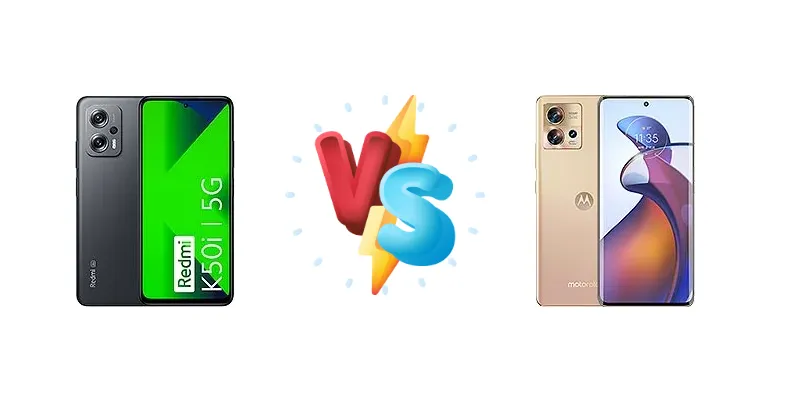
|
🏆 Quick Verdict
For most users, the Motorola Edge 30 Fusion emerges as the slightly better choice. While both phones offer comparable battery endurance (101h), the Fusion’s Snapdragon 888+ provides a performance edge, and its 68W charging is marginally faster, reaching 50% in just 10 minutes compared to the K50i’s 15 minutes.
| PHONES | ||
|---|---|---|
| Phone Names | Xiaomi Redmi K50i | Motorola Edge 30 Fusion |
| Network | ||
|---|---|---|
| 2G bands | GSM 850 / 900 / 1800 / 1900 | GSM 850 / 900 / 1800 / 1900 |
| 3G bands | HSDPA 850 / 900 / 1700(AWS) / 1900 / 2100 | HSDPA 850 / 900 / 1700(AWS) / 1900 / 2100 - International |
| 4G bands | 1, 2, 3, 4, 5, 7, 8, 20, 28, 38, 40, 41 | 1, 2, 3, 4, 5, 7, 8, 12, 13, 17, 18, 19, 20, 25, 26, 28, 32, 38, 39, 40, 41, 42, 43, 66 - International |
| 5G bands | 1, 3, 5, 7, 8, 20, 28, 38, 40, 41, 77, 78 SA/NSA | 1, 3, 5, 7, 8, 20, 28, 38, 40, 41, 66, 77, 78 SA/NSA - International |
| Speed | HSPA, LTE, 5G | HSPA, LTE, 5G |
| Technology | GSM / HSPA / LTE / 5G | GSM / CDMA / HSPA / CDMA2000 / LTE / 5G |
| - | 1, 2, 3, 5, 7, 8, 20, 28, 38, 41, 77, 78 SA/NSA - PRC | |
| Launch | ||
|---|---|---|
| Announced | 2022, July 20 | 2022, September 08 |
| Status | Available. Released 2022, July 23 | Available. Released 2022, September 08 |
| Body | ||
|---|---|---|
| Build | - | Glass front (Gorilla Glass 5), glass back (Gorilla Glass 5), aluminum frame |
| Dimensions | 163.6 x 74.3 x 8.9 mm (6.44 x 2.93 x 0.35 in) | 158.5 x 72 x 7.5 mm or 7.7 mm |
| SIM | Nano-SIM + Nano-SIM | · Nano-SIM· Nano-SIM + Nano-SIM |
| Weight | 200 g (7.05 oz) | 168 g / 175 g (5.93 oz) |
| - | Splash and dust resistant | |
| Display | ||
|---|---|---|
| Protection | Corning Gorilla Glass 5 | Corning Gorilla Glass 5 |
| Resolution | 1080 x 2460 pixels (~407 ppi density) | 1080 x 2400 pixels, 20:9 ratio (~402 ppi density) |
| Size | 6.6 inches, 103.4 cm2 (~85.1% screen-to-body ratio) | 6.55 inches, 103.6 cm2 (~90.8% screen-to-body ratio) |
| Type | FFS LCD, 144Hz, HDR10, Dolby Vision, 500 nits (typ), 650 nits (HBM) | P-OLED, 1B colors, 144Hz, HDR10+, 1100 nits (peak) |
| Platform | ||
|---|---|---|
| CPU | Octa-core (4x2.85 GHz Cortex-A78 & 4x2.0 GHz Cortex-A55) | Octa-core (1x2.99 GHz Cortex-X1 & 3x2.42 GHz Cortex-A78 & 4x1.80 GHz Cortex-A55) |
| Chipset | Mediatek Dimensity 8100 (5 nm) | Qualcomm SM8350 Snapdragon 888+ 5G (5 nm) |
| GPU | Mali-G610 MC6 | Adreno 660 |
| OS | Android 12, upgradable to Android 13, MIUI 14 | Android 12, upgradable to Android 14 |
| Memory | ||
|---|---|---|
| Card slot | No | No |
| Internal | 128GB 6GB RAM, 128GB 8GB RAM, 256GB 8GB RAM | 128GB 8GB RAM, 256GB 6GB RAM, 256GB 8GB RAM, 256GB 12GB RAM, 512GB 12GB RAM |
| - | UFS 3.1 | |
| Main Camera | ||
|---|---|---|
| Features | Color spectrum sensor, LED flash, HDR, panorama | LED flash, panorama, HDR |
| Triple | 64 MP, f/1.9, (wide), 1/1.72", 0.8µm, PDAF 8 MP, f/2.2, 120˚, (ultrawide) 2 MP (macro) | 50 MP, f/1.8, (wide), 1/1.55", 1.0µm, multi-directional PDAF, OIS 13 MP, f/2.2, 120˚ (ultrawide), 1.12µm, AF Auxiliary lens |
| Video | 4K@30fps, 1080p@30/60fps | 8K@30fps, 4K@30fps, 1080p@30/60/120fps, 720p@960fps, gyro-EIS |
| Selfie camera | ||
|---|---|---|
| Features | - | HDR |
| Single | 16 MP, f/2.5, (wide) | 32 MP, f/2.5, (wide), 1/2.8", 0.8µm, AF |
| Video | 1080p@30fps | 4K@30fps, 1080p@30fps |
| Sound | ||
|---|---|---|
| 3.5mm jack | - | No |
| 35mm jack | Yes | No |
| Loudspeaker | Yes, with stereo speakers | Yes, with stereo speakers |
| Comms | ||
|---|---|---|
| Bluetooth | 5.3, A2DP, LE | 5.2, A2DP, LE, aptX HD, aptX Adaptive |
| Infrared port | Yes | - |
| NFC | No | Yes |
| Positioning | GPS (L1), GLONASS (L1), BDS (B1I+B1c), GALILEO (E1), QZSS (L1) | GPS (L1+L5), GLONASS, BDS (B1I+B1c), GALILEO |
| Radio | No | No |
| USB | USB Type-C 2.0, OTG | USB Type-C 3.1, OTG |
| WLAN | Wi-Fi 802.11 a/b/g/n/ac/6, dual-band, Wi-Fi Direct | Wi-Fi 802.11 a/b/g/n/ac/6e, tri-band, Wi-Fi Direct |
| Features | ||
|---|---|---|
| Sensors | Fingerprint (side-mounted), accelerometer, proximity, gyro, compass | Fingerprint (under display, optical), accelerometer, gyro, proximity, compass |
| - | Ready For 3.5 support | |
| Battery | ||
|---|---|---|
| Charging | 67W wired, 50% in 15 min, 100% in 46 min | 68W wired, 50% in 10 min |
| Type | Li-Po 5080 mAh | Li-Po 4400 mAh |
| Misc | ||
|---|---|---|
| Colors | Phantom Blue, Stealth Black, Quick Silver | Neptune Blue, Cosmic Grey, Solar Gold, Aurora White, Viva Magenta |
| Models | 22041216I | XT2243-1 |
| Price | About 320 EUR | About 150 EUR |
| Tests | ||
|---|---|---|
| Battery life | - | Endurance rating 101h |
| Camera | - | Photo / Video |
| Display | - | Contrast ratio: Infinite (nominal) |
| Loudspeaker | - | -24.6 LUFS (Very good) |
| Performance | - | AnTuTu: 827929 (v9) GeekBench: 3458 (v5.1) GFXBench: 62fps (ES 3.1 onscreen) |
Xiaomi Redmi K50i
- Potentially better sustained performance due to Dimensity 8100’s thermal characteristics.
- Competitive pricing likely makes it a value-focused option.
- 5nm process contributes to improved power efficiency.
- Display brightness is likely lower than the Motorola Edge 30 Fusion.
- Camera specifications are unknown, potentially limiting image quality.
Motorola Edge 30 Fusion
- Brighter display (946 nits) enhances outdoor visibility.
- Faster 0-50% charging (10 minutes) provides convenience.
- Snapdragon 888+ offers a performance edge in bursty workloads.
- Snapdragon 888+ is prone to thermal throttling under sustained load.
- May be priced higher than the Redmi K50i.
Display Comparison
The Motorola Edge 30 Fusion boasts a significantly brighter display, reaching a measured 946 nits. While the Redmi K50i’s display specs are not provided, this brightness advantage benefits outdoor visibility for the Fusion. Both displays feature an 'infinite' contrast ratio (nominal), suggesting deep blacks. Without knowing the K50i’s panel technology (OLED vs LCD) or refresh rate, it’s difficult to assess color accuracy or smoothness, but the Fusion’s higher peak brightness is a clear win for users who consume content outdoors.
Camera Comparison
Both devices are listed as having 'Photo / Video' capabilities, but specific details are absent. Without sensor size, aperture, or OIS information, a direct comparison is impossible. It’s likely both phones target similar mid-range camera performance. The absence of details suggests neither phone is a standout camera performer, and reliance on software processing will be significant. We can assume both will include standard features like portrait mode and night mode, but image quality will depend heavily on the underlying hardware, which remains unknown.
Performance
The core difference lies in the chipsets. The Redmi K50i’s MediaTek Dimensity 8100 (5nm) features an octa-core configuration with 4x2.85 GHz Cortex-A78 cores and 4x2.0 GHz Cortex-A55 cores. The Motorola Edge 30 Fusion utilizes the Qualcomm Snapdragon 888+ 5G (5nm), with a 1x2.99 GHz Cortex-X1 prime core, 3x2.42 GHz Cortex-A78 cores, and 4x1.80 GHz Cortex-A55 cores. The Snapdragon 888+’s Cortex-X1 prime core offers a slight architectural advantage in single-core performance, while the Dimensity 8100’s core count and clock speeds provide strong multi-core capabilities. However, the 888+ is known to run hotter under sustained load, potentially leading to throttling, while the 5nm process of both chips offers improved efficiency compared to older generations. The K50i may benefit from better sustained performance in long gaming sessions.
Battery Life
Both the Redmi K50i and Motorola Edge 30 Fusion achieve an endurance rating of 101 hours, indicating comparable battery life. However, charging speeds differ slightly. The K50i supports 67W wired charging, reaching 50% in 15 minutes and 100% in 46 minutes. The Edge 30 Fusion offers 68W wired charging, achieving 50% in just 10 minutes and a full charge in an unspecified time. The Fusion’s faster 0-50% charging is a convenience advantage, especially for users who frequently top up their phones.
Buying Guide
Buy the Xiaomi Redmi K50i if you prioritize sustained performance in demanding applications and value a potentially cooler operating temperature due to the Dimensity 8100’s 5nm process. Buy the Motorola Edge 30 Fusion if you prefer a slightly more refined user experience, faster charging speeds, and a brighter display, even if it means potentially encountering some thermal throttling under prolonged heavy load.