
Xiaomi Redmi K50 Gaming vs Redmi K60 Pro: The Ultimate Showdown
| Phones Images | |||||
|---|---|---|---|---|---|
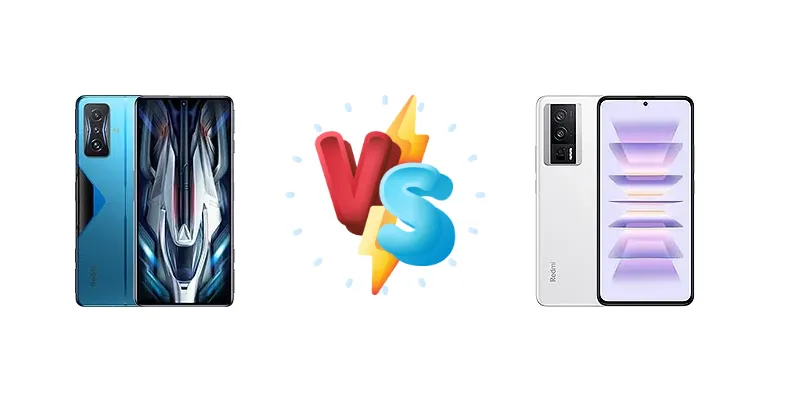
|
🏆 Quick Verdict
The Redmi K60 Pro is the clear winner, boasting the superior Snapdragon 8 Gen 2 chipset, improved camera capabilities, and the addition of wireless charging. While the K50 Gaming offers blazing-fast 120W wired charging, the K60 Pro's overall package is more compelling.
| PHONES | ||
|---|---|---|
| Phone Names | Xiaomi Redmi K50 Gaming | Xiaomi Redmi K60 Pro |
| Network | ||
|---|---|---|
| 2G bands | GSM 850 / 900 / 1800 / 1900 | GSM 850 / 900 / 1800 / 1900 |
| 3G bands | HSDPA 850 / 900 / 1700(AWS) / 1900 / 2100 | HSDPA 800 / 850 / 900 / 1700(AWS) / 2100 |
| 4G bands | 1, 2, 3, 4, 5, 7, 8, 18, 19, 26, 34, 38, 39, 40, 41, 42 | 1, 3, 4, 5, 8, 18, 19, 26, 34, 38, 39, 40, 41, 42 |
| 5G bands | 1, 3, 5, 8, 28, 38, 40, 41, 77, 78 SA/NSA/Sub6 | 1, 3, 5, 8, 28, 38, 41, 77, 78 SA/NSA |
| Speed | HSPA, LTE, 5G | HSPA, LTE, 5G |
| Technology | GSM / CDMA / HSPA / CDMA2000 / LTE / 5G | GSM / CDMA / HSPA / CDMA2000 / LTE / 5G |
| CDMA2000 1x | CDMA2000 1x | |
| Launch | ||
|---|---|---|
| Announced | 2022, February 16 | 2022, December 27 |
| Status | Available. Released 2022, February 18 | Available. Released 2023, January 01 |
| Body | ||
|---|---|---|
| Build | Glass front (Gorilla Glass Victus), glass back, aluminum frame | - |
| Dimensions | 162.5 x 76.7 x 8.5 mm (6.40 x 3.02 x 0.33 in) | 162.8 x 75.4 x 8.6 mm or 8.9 mm |
| SIM | Nano-SIM + Nano-SIM | Nano-SIM + Nano-SIM |
| Weight | 210 g (7.41 oz) | 201 g or 205 g (7.09 oz) |
| Physical magnetic pop-up gaming triggers | - | |
| Display | ||
|---|---|---|
| Protection | Corning Gorilla Glass Victus | - |
| Resolution | 1080 x 2400 pixels, 20:9 ratio (~395 ppi density) | 1440 x 3200 pixels, 20:9 ratio (~526 ppi density) |
| Size | 6.67 inches, 107.4 cm2 (~86.2% screen-to-body ratio) | 6.67 inches, 107.4 cm2 (~87.5% screen-to-body ratio) |
| Type | OLED, 1B colors, 120Hz, HDR10+, 800 nits (HBM) | OLED, 68B colors, 120Hz, Dolby Vision, HDR10+, 1400 nits (peak) |
| Platform | ||
|---|---|---|
| CPU | Octa-core (1x3.00 GHz Cortex-X2 & 3x2.50 GHz Cortex-A710 & 4x1.80 GHz Cortex-A510) | Octa-core (1x3.2 GHz Cortex-X3 & 2x2.8 GHz Cortex-A715 & 2x2.8 GHz Cortex-A710 & 3x2.0 GHz Cortex-A510) |
| Chipset | Qualcomm SM8450 Snapdragon 8 Gen 1 (4 nm) | Qualcomm SM8550-AB Snapdragon 8 Gen 2 (4 nm) |
| GPU | Adreno 730 | Adreno 740 |
| OS | Android 12, MIUI 13 | Android 13, MIUI 14 |
| Memory | ||
|---|---|---|
| Card slot | No | No |
| Internal | 128GB 8GB RAM, 128GB 12GB RAM, 256GB 12GB RAM | 128GB 8GB RAM, 256GB 8GB RAM, 256GB 12GB RAM, 512GB 12GB RAM, 512GB 16GB RAM |
| UFS 3.1 | UFS 4.0 UFS 3.1 - 128GB only | |
| Main Camera | ||
|---|---|---|
| Features | Color spectrum sensor, Dual-LED flash, HDR, panorama | Color spectrum sensor, Dual-LED dual-tone flash, HDR, panorama |
| Single | 20 MP, f/2.4, (wide), 1/2.0", 0.8µm | - |
| Triple | 64 MP, f/1.9, 26mm (wide), 1/1.73", 0.8µm, PDAF 8 MP, f/2.2, 120˚ (ultrawide) 2 MP (macro) | 54 MP, f/1.9, (wide), 1/1.49", 1.0µm, PDAF, OIS 8 MP, 118˚ (ultrawide), 1/4.0", 1.12µm 2 MP (macro) |
| Video | 4K@30/60fps, 1080p@30/60/120fps, 720p@960fps, HDR | 8K@24fps, 4K@30/60fps, 1080p@30/60/120/240/960fps, 720p@1920fps, gyro-EIS |
| Selfie camera | ||
|---|---|---|
| Features | HDR | HDR |
| Single | 20 MP, f/2.4, (wide), 1/2.0", 0.8µm | 16 MP, (wide), 1/3.06", 1.0µm |
| Video | 1080p@30/60fps, 720p@120fps, HDR | 1080p@30/60/120fps |
| Sound | ||
|---|---|---|
| 3.5mm jack | No | No |
| 35mm jack | No | No |
| Loudspeaker | Yes, with stereo speakers (4 speakers) | Yes, with stereo speakers |
| 24-bit/192kHz audio Tuned by JBL | 24-bit/192kHz audio | |
| Comms | ||
|---|---|---|
| Bluetooth | 5.2, A2DP, LE, aptX HD, aptX Adaptive | 5.3, A2DP, LE |
| Infrared port | Yes | Yes |
| NFC | Yes | Yes |
| Positioning | GPS (L1+L5), GLONASS (L1), BDS (B1I+B1c+B2a), GALILEO (E1+E5a), QZSS (L1+L5), NavIC (L5) | GPS (L1+L5), GLONASS (G1), BDS (B1I+B2a+Bc), GALILEO (E1+E5a), QZSS (L1+L5), NavIC |
| Radio | No | Unspecified |
| USB | USB Type-C 2.0, OTG | USB Type-C 2.0, OTG |
| WLAN | Wi-Fi 802.11 a/b/g/n/ac/6e, dual-band, Wi-Fi Direct | Wi-Fi 802.11 a/b/g/n/ac/6e, dual-band, Wi-Fi Direct |
| Features | ||
|---|---|---|
| Sensors | Fingerprint (side-mounted), accelerometer, gyro, compass | Fingerprint (under display, optical), accelerometer, gyro, proximity, compass |
| Virtual proximity sensing | - | |
| Battery | ||
|---|---|---|
| Charging | 120W wired, PD3.0, QC3, 100% in 17 min | 120W wired, PD3.0, QC3+, 100% in 19 min 30W wireless |
| Type | Li-Po 4700 mAh | Li-Po 5000 mAh |
| Misc | ||
|---|---|---|
| Colors | Black, Gray, Blue, AMG | Black, White, Mint, Champion Black |
| Models | 21121210C | 22127RK46C |
| Price | About 460 EUR | About 460 EUR |
Xiaomi Redmi K50 Gaming
- Exceptional gaming performance
- Blazing-fast 120W wired charging
- Aggressive design
- Competitive price
- Older chipset (Snapdragon 8 Gen 1)
- Camera not as advanced as K60 Pro
- Lacks wireless charging
Xiaomi Redmi K60 Pro
- Powerful Snapdragon 8 Gen 2 chipset
- Improved camera system
- Wireless charging support
- Slightly better display
- Excellent battery life
- Slightly higher price
- Design is more understated
Display Comparison
Both phones feature high-quality AMOLED displays with 120Hz refresh rates. The K60 Pro likely has slightly improved color accuracy and brightness due to newer panel technology, but the difference is subtle. Expect vibrant colors and smooth scrolling on both.
Camera Comparison
The K60 Pro's camera system is a noticeable upgrade. While the K50 Gaming has a capable camera, the K60 Pro benefits from a newer sensor and improved image processing, resulting in better detail, dynamic range, and low-light performance. Expect more natural-looking photos and improved video quality on the K60 Pro.
Performance
The Snapdragon 8 Gen 2 in the K60 Pro provides a significant performance boost over the 8 Gen 1 in the K50 Gaming. Expect faster app loading times, smoother multitasking, and better sustained performance during demanding games. The K60 Pro's improved thermal management also helps prevent throttling.
Battery Life
Both phones offer excellent battery life thanks to their large batteries. The K50 Gaming's 120W wired charging is incredibly fast, but the K60 Pro's 120W wired charging is equally impressive and adds 30W wireless charging for added convenience.
Buying Guide
The Redmi K50 Gaming is ideal for hardcore mobile gamers seeking maximum performance on a tighter budget. The Redmi K60 Pro is perfect for users who want a well-rounded flagship experience with a focus on photography, smoother performance, and added convenience like wireless charging.