
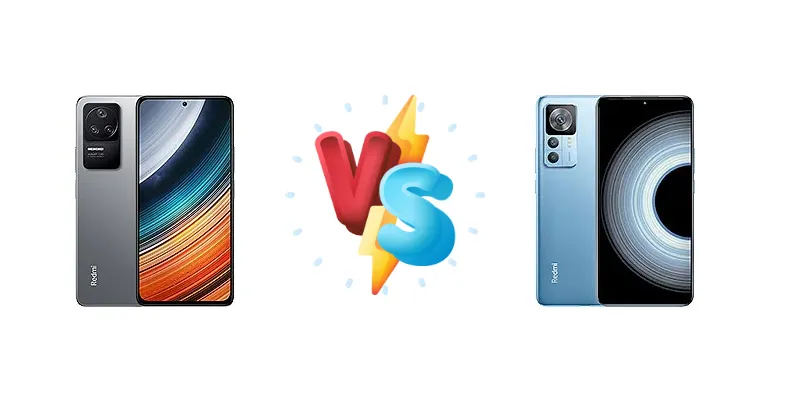
Xiaomi Redmi K40S vs Redmi K50 Ultra: The Ultimate Showdown
| Phones Images | |||||
|---|---|---|---|---|---|
|
🏆 Quick Verdict
The Redmi K50 Ultra is the clear winner, boasting a significantly faster Snapdragon 8+ Gen 1 chipset, a superior 120W charging speed, and generally improved specs. However, the K40S remains a compelling option for budget-conscious buyers seeking excellent performance.
| PHONES | ||
|---|---|---|
| Phone Names | Xiaomi Redmi K40S | Xiaomi Redmi K50 Ultra |
| Network | ||
|---|---|---|
| 2G bands | GSM 850 / 900 / 1800 / 1900 | GSM 850 / 900 / 1800 / 1900 |
| 3G bands | HSDPA 850 / 900 / 1700(AWS) / 1900 / 2100 | HSDPA 850 / 900 / 1700(AWS) / 1900 / 2100 |
| 4G bands | 1, 2, 3, 4, 5, 8, 18, 19, 26, 34, 38, 39, 40, 41, 42 | 1, 3, 4, 5, 8, 18, 19, 26, 34, 38, 39, 40, 41, 42 |
| 5G bands | 1, 3, 5, 8, 28, 38, 40, 41, 77, 78 SA/NSA | 1, 3, 5, 8, 28, 38, 40, 41, 77, 78 SA/NSA |
| Speed | HSPA, LTE, 5G | HSPA, LTE, 5G |
| Technology | GSM / CDMA / HSPA / CDMA2000 / LTE / 5G | GSM / CDMA / HSPA / CDMA2000 / LTE / 5G |
| CDMA2000 1x | CDMA2000 1x | |
| Launch | ||
|---|---|---|
| Announced | 2022, March 17 | 2022, August 11 |
| Status | Available. Released 2022, March 17 | Available. Released 2022, August 25 |
| Body | ||
|---|---|---|
| Build | Glass front (Gorilla Glass 5), plastic back | - |
| Dimensions | 163.2 x 76 x 7.7 mm (6.43 x 2.99 x 0.30 in) | 163.1 x 75.9 x 8.6 mm (6.42 x 2.99 x 0.34 in) |
| SIM | Nano-SIM + Nano-SIM | Nano-SIM + Nano-SIM |
| Weight | 195 g (6.88 oz) | 202 g (7.13 oz) |
| Splash resistant | - | |
| Display | ||
|---|---|---|
| Protection | Corning Gorilla Glass 5 | - |
| Resolution | 1080 x 2400 pixels, 20:9 ratio (~395 ppi density) | 1220 x 2712 pixels, 20:9 ratio (~446 ppi density) |
| Size | 6.67 inches, 107.4 cm2 (~86.6% screen-to-body ratio) | 6.67 inches, 107.4 cm2 (~86.7% screen-to-body ratio) |
| Type | AMOLED, 120Hz, HDR10+, 1300 nits (peak) | OLED, 68B colors, 144Hz, HDR10+, Dolby Vision |
| Platform | ||
|---|---|---|
| CPU | Octa-core (1x3.2 GHz Kryo 585 & 3x2.42 GHz Kryo 585 & 4x1.80 GHz Kryo 585) | Octa-core (1x3.19 GHz Cortex-X2 & 3x2.75 GHz Cortex-A710 & 4x1.80 GHz Cortex-A510) |
| Chipset | Qualcomm SM8250-AC Snapdragon 870 5G (7 nm) | Qualcomm SM8475 Snapdragon 8+ Gen 1 (4 nm) |
| GPU | Adreno 650 | Adreno 730 |
| OS | Android 12, MIUI 13 | Android 12, MIUI 13 |
| Memory | ||
|---|---|---|
| Card slot | No | No |
| Internal | 128GB 6GB RAM, 128GB 8GB RAM, 256GB 8GB RAM, 256GB 12GB RAM | 128GB 8GB RAM, 256GB 8GB RAM, 256GB 12GB RAM, 512GB 12GB RAM |
| UFS 3.1 | UFS 3.1 | |
| Main Camera | ||
|---|---|---|
| Features | Color spectrum sensor, Dual-LED dual-tone flash, HDR, panorama | Color spectrum sensor, LED flash, HDR, panorama |
| Single | 20 MP, (wide) | - |
| Triple | 48 MP, f/1.8, (wide), 1/2.0", 0.8µm, PDAF, OIS 8 MP, 119˚ (ultrawide) 2 MP (macro) | 108 MP, f/1.6, (wide), 1/1.67", PDAF, OIS 8 MP, f/2.2, 120˚, (ultrawide) 2 MP (macro) |
| Video | 4K@30fps, 1080p@30/60/120fps, 720p@960fps; gyro-EIS | 4K@30/60fps, 1080p@30/60/120/240/960fps |
| Selfie camera | ||
|---|---|---|
| Features | - | HDR |
| Single | 20 MP, (wide) | 20 MP, (wide) |
| Video | 1080p@30/120fps | 1080p@30/60fps, 720p@120fps |
| Sound | ||
|---|---|---|
| 3.5mm jack | No | No |
| 35mm jack | No | No |
| Loudspeaker | Yes, with stereo speakers | Yes, with stereo speakers |
| 24-bit/192kHz audio | 24-bit/192kHz audio | |
| Comms | ||
|---|---|---|
| Bluetooth | 5.2, A2DP, LE | 5.2, A2DP, LE, aptX HD, aptX Adaptive |
| Infrared port | - | Yes |
| NFC | Yes | Yes |
| Positioning | GPS (L1+L5), GLONASS (L1), BDS (B1I+B1c+B2a), GALILEO (E1+E5a), QZSS (L1+L5), NavIC (L5) | GPS (L1+L5), GLONASS (L1), BDS (B1I+B1c+B2a), GALILEO (E1+E5a), QZSS (L1+L5), NavIC (L5) |
| Radio | No | No |
| USB | USB Type-C 2.0, OTG | USB Type-C 2.0, OTG |
| WLAN | Wi-Fi 802.11 a/b/g/n/ac/6, dual-band, Wi-Fi Direct | Wi-Fi 802.11 a/b/g/n/ac/6e, dual-band, Wi-Fi Direct |
| Features | ||
|---|---|---|
| Sensors | Fingerprint (side-mounted), accelerometer, gyro, proximity, compass | Fingerprint (under display, optical), accelerometer, gyro, proximity, compass |
| Battery | ||
|---|---|---|
| Charging | 67W wired, PD3.0, QC3, 100% in 38 min | 120W wired, PD3.0, 100% in 19 min |
| Type | Li-Po 4500 mAh | Li-Po 5000 mAh |
| Misc | ||
|---|---|---|
| Colors | Black, Gray, Blue, Green | Black, Gray, Blue, Mercedes AMG |
| Models | - | 22081212C |
| Price | About 260 EUR | About 430 EUR |
Xiaomi Redmi K40S
- Excellent performance for the price
- Smooth 120Hz AMOLED display
- Fast 67W charging
- Good camera system
- Older chipset compared to K50 Ultra
- Slower charging speed
- Design may feel dated
Xiaomi Redmi K50 Ultra
- Flagship Snapdragon 8+ Gen 1 chipset
- Blazing-fast 120W charging
- Improved camera system
- Modern design
- Higher price
- May be overkill for casual users
Display Comparison
Both phones feature AMOLED displays with a 120Hz refresh rate, offering smooth visuals. The K50 Ultra likely has slightly better brightness and color accuracy due to its newer panel, but the difference is subtle. The K50 Ultra may also have a slightly larger screen size (around 6.67 inches vs 6.64 inches for the K40S).
Camera Comparison
The K50 Ultra generally has a more versatile camera system. While the K40S has a capable 48MP main sensor, the K50 Ultra often features a higher resolution main sensor (typically 108MP or 200MP), improved ultrawide and telephoto lenses, and enhanced image processing. Expect better low-light performance and more detail in photos from the K50 Ultra.
Performance
The Snapdragon 8+ Gen 1 in the K50 Ultra is a substantial upgrade over the Snapdragon 870 in the K40S. Expect noticeably faster app loading, smoother multitasking, and better performance in demanding games. The K50 Ultra's chip is more efficient, potentially leading to better sustained performance.
Battery Life
The K50 Ultra's 120W charging is a game-changer, allowing for incredibly fast charging times (around 19 minutes for a full charge). The K40S's 67W charging is still fast, but significantly slower (around 38 minutes). Both phones likely have similar battery capacities (around 5000mAh), but the K50 Ultra's efficiency and faster charging give it an edge.
Buying Guide
The Xiaomi Redmi K40S is ideal for users seeking a high-performance phone without breaking the bank. It's great for gaming and everyday tasks. The Xiaomi Redmi K50 Ultra is for those who demand the absolute best performance, fastest charging, and are willing to pay a premium.