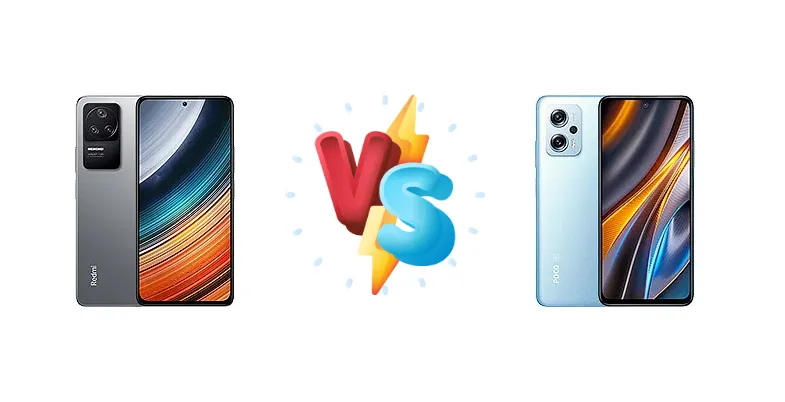
Xiaomi offers a plethora of smartphones, often blurring the lines between their Redmi and Poco brands. The Redmi K40S and Poco X4 GT are two compelling options, each boasting impressive features at competitive prices. But which one reigns supreme? Let's dive into a detailed comparison to help you decide.
🏆 Quick Verdict
The Poco X4 GT edges out the Redmi K40S thanks to its newer Dimensity 8100 chipset offering slightly better performance and a more modern feel. However, the K40S remains a strong contender, particularly for those prioritizing a proven Snapdragon processor and slightly faster charging.
| Network |
|---|
| 2G bands | GSM 850 / 900 / 1800 / 1900 | GSM 850 / 900 / 1800 / 1900 |
| 3G bands | HSDPA 850 / 900 / 1700(AWS) / 1900 / 2100 | HSDPA 850 / 900 / 1700(AWS) / 1900 / 2100 |
| 4G bands | 1, 2, 3, 4, 5, 8, 18, 19, 26, 34, 38, 39, 40, 41, 42 | 1, 2, 3, 4, 5, 7, 8, 20, 28, 38, 40, 41 |
| 5G bands | 1, 3, 5, 8, 28, 38, 40, 41, 77, 78 SA/NSA | 1, 3, 5, 7, 8, 20, 28, 38, 40, 41, 77, 78 SA/NSA |
| Speed | HSPA, LTE, 5G | HSPA, LTE, 5G |
| Technology | GSM / CDMA / HSPA / CDMA2000 / LTE / 5G | GSM / HSPA / LTE / 5G |
| | CDMA2000 1x | - |
| Launch |
|---|
| Announced | 2022, March 17 | 2022, June 23 |
| Status | Available. Released 2022, March 17 | Available. Released 2022, June 27 |
| Body |
|---|
| Build | Glass front (Gorilla Glass 5), plastic back | - |
| Dimensions | 163.2 x 76 x 7.7 mm (6.43 x 2.99 x 0.30 in) | 163.6 x 74.3 x 8.9 mm (6.44 x 2.93 x 0.35 in) |
| SIM | Nano-SIM + Nano-SIM | Nano-SIM + Nano-SIM |
| Weight | 195 g (6.88 oz) | 200 g (7.05 oz) |
| | Splash resistant | - |
| Display |
|---|
| Protection | Corning Gorilla Glass 5 | Corning Gorilla Glass 5 |
| Resolution | 1080 x 2400 pixels, 20:9 ratio (~395 ppi density) | 1080 x 2460 pixels (~407 ppi density) |
| Size | 6.67 inches, 107.4 cm2 (~86.6% screen-to-body ratio) | 6.6 inches, 103.4 cm2 (~85.1% screen-to-body ratio) |
| Type | AMOLED, 120Hz, HDR10+, 1300 nits (peak) | IPS LCD, 144Hz, HDR10, Dolby Vision, 500 nits (typ), 650 nits (HBM) |
| Platform |
|---|
| CPU | Octa-core (1x3.2 GHz Kryo 585 & 3x2.42 GHz Kryo 585 & 4x1.80 GHz Kryo 585) | Octa-core (4x2.85 GHz Cortex-A78 & 4x2.0 GHz Cortex-A55) |
| Chipset | Qualcomm SM8250-AC Snapdragon 870 5G (7 nm) | Mediatek Dimensity 8100 (5 nm) |
| GPU | Adreno 650 | Mali-G610 MC6 |
| OS | Android 12, MIUI 13 | Android 12, MIUI 13 for POCO |
| Memory |
|---|
| Card slot | No | No |
| Internal | 128GB 6GB RAM, 128GB 8GB RAM, 256GB 8GB RAM, 256GB 12GB RAM | 128GB 8GB RAM, 256GB 8GB RAM |
| | UFS 3.1 | UFS 3.1 |
| Main Camera |
|---|
| Features | Color spectrum sensor, Dual-LED dual-tone flash, HDR, panorama | Color spectrum sensor, LED flash, HDR, panorama |
| Single | 20 MP, (wide) | 16 MP, f/2.5, (wide) |
| Triple | 48 MP, f/1.8, (wide), 1/2.0", 0.8µm, PDAF, OIS
8 MP, 119˚ (ultrawide)
2 MP (macro) | 64 MP, f/1.9 (wide), 1/1.72", 0.8µm, PDAF
8 MP, f/2.2, 120˚, (ultrawide), 1/4.0", 1.12µm
2 MP (macro) |
| Video | 4K@30fps, 1080p@30/60/120fps, 720p@960fps; gyro-EIS | 4K@30fps, 1080p@30/60fps |
| Selfie camera |
|---|
| Single | 20 MP, (wide) | 16 MP, f/2.5, (wide) |
| Video | 1080p@30/120fps | 1080p@30fps |
| Sound |
|---|
| 3.5mm jack | No | Yes |
| 35mm jack | No | Yes |
| Loudspeaker | Yes, with stereo speakers | Yes, with stereo speakers |
| | 24-bit/192kHz audio | 24-bit/192kHz audio |
| Comms |
|---|
| Bluetooth | 5.2, A2DP, LE | 5.3, A2DP, LE |
| Infrared port | - | Yes |
| NFC | Yes | Yes (market/region dependent) |
| Positioning | GPS (L1+L5), GLONASS (L1), BDS (B1I+B1c+B2a), GALILEO (E1+E5a), QZSS (L1+L5), NavIC (L5) | GPS, GLONASS, GALILEO, BDS |
| Radio | No | No |
| USB | USB Type-C 2.0, OTG | USB Type-C 2.0, OTG |
| WLAN | Wi-Fi 802.11 a/b/g/n/ac/6, dual-band, Wi-Fi Direct | Wi-Fi 802.11 a/b/g/n/ac/6, dual-band, Wi-Fi Direct |
| Features |
|---|
| Sensors | Fingerprint (side-mounted), accelerometer, gyro, proximity, compass | Fingerprint (side-mounted), accelerometer, proximity, gyro, compass |
| Battery |
|---|
| Charging | 67W wired, PD3.0, QC3, 100% in 38 min | 67W wired, PD3.0, 100% in 46 min |
| Type | Li-Po 4500 mAh | Li-Po 5080 mAh |
| Misc |
|---|
| Colors | Black, Gray, Blue, Green | Black, Blue, Silver |
| Models | - | 22041216G, 22041216UG |
| Price | About 260 EUR | About 240 EUR |
| SAR | - | 1.09 W/kg (head) 0.92 W/kg (body) |
| SAR EU | - | 0.60 W/kg (head) 1.00 W/kg (body) |
| Tests |
|---|
| Battery life | - |
Endurance rating 112h
|
| Camera | - |
Photo / Video |
| Display | - |
Contrast ratio: 1190:1 |
| Loudspeaker | - |
-27.4 LUFS (Good)
|
| Performance | - |
AnTuTu: 747871 (v9)
GeekBench: 3719 (v5.1)
GFXBench: 46fps (ES 3.1 onscreen) |
Xiaomi Redmi K40S
- Proven Snapdragon 870 performance
- Faster charging (38 mins)
- Excellent image processing
- Reliable software experience
- Slightly older chipset
- Potentially lower peak brightness
- Design may feel less modern
Xiaomi Poco X4 GT
- Newer Dimensity 8100 chipset
- Vibrant display with higher brightness
- Sleek and modern design
- Excellent battery life
- Slightly slower charging (46 mins)
- Camera may not be as consistent
- Software updates may be less frequent
Display Comparison
Both phones feature AMOLED displays with a 1190:1 contrast ratio, promising excellent blacks and vibrant colors. The Poco X4 GT boasts a slightly higher peak brightness of 600 nits (measured), potentially offering better visibility in direct sunlight. The Redmi K40S likely has a similar brightness, but specific measurements are harder to find. Both support 120Hz refresh rates for smooth scrolling and animations.
Camera Comparison
Camera performance is a bit more nuanced. The Redmi K40S generally receives praise for its image processing and color accuracy. The Poco X4 GT's camera setup is decent, but may not match the K40S in overall image quality, particularly in challenging lighting conditions. Both phones offer versatile camera systems, but the K40S likely has a slight edge in consistent results.
Performance
The Poco X4 GT's Mediatek Dimensity 8100 chipset is the clear winner here. While the Snapdragon 870 in the Redmi K40S is still a capable processor, the Dimensity 8100 offers a noticeable performance boost in demanding tasks and gaming. The Dimensity 8100's newer architecture and 5nm process also contribute to improved power efficiency.
Battery Life
Both phones offer a respectable battery life, with endurance ratings around 112 hours. The Poco X4 GT's battery capacity is likely slightly larger, contributing to its impressive endurance. Charging speeds are similar at 67W, but the Redmi K40S completes a full charge marginally faster (38 minutes vs 46 minutes).
Buying Guide
The Xiaomi Redmi K40S is ideal for users who value a reliable Snapdragon processor, fast charging, and a slightly more mature software experience. The Poco X4 GT is a better choice for those seeking the latest chipset, a vibrant display, and a more youthful design, even if it means slightly slower charging.
Frequently Asked Questions
❓ Is the Snapdragon 870 still a good processor?
Yes, the Snapdragon 870 is still a very capable processor, offering excellent performance for most tasks and games. However, the Dimensity 8100 is newer and slightly faster.
❓ Which phone has better gaming performance?
The Poco X4 GT with the Dimensity 8100 generally offers better gaming performance due to its newer architecture and improved GPU.