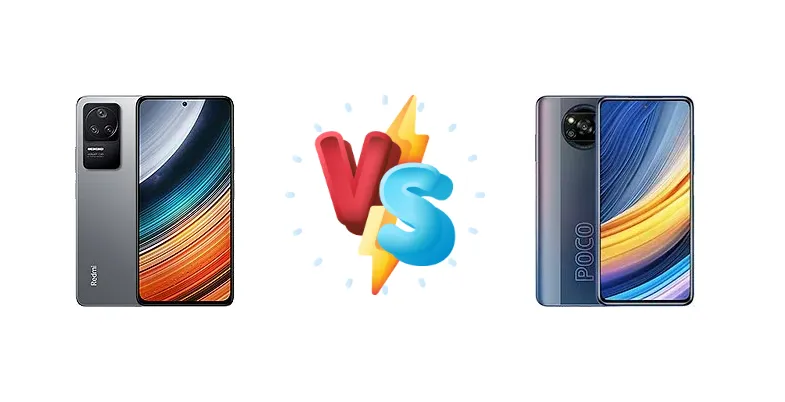
Xiaomi offers a plethora of smartphones catering to different budgets and needs. Two popular contenders are the Redmi K40S and the Poco X3 Pro. Both pack impressive features, but cater to slightly different users. This comprehensive comparison will break down their strengths and weaknesses to help you make the right choice.
🏆 Quick Verdict
The Redmi K40S takes the crown thanks to its superior Snapdragon 870 chipset, faster charging, and generally more refined experience. While the Poco X3 Pro boasts incredible battery life and a competitive price, the K40S offers a noticeable performance boost that justifies the slightly higher cost.
| Network |
|---|
| 2G bands | GSM 850 / 900 / 1800 / 1900 | GSM 850 / 900 / 1800 / 1900 |
| 3G bands | HSDPA 850 / 900 / 1700(AWS) / 1900 / 2100 | HSDPA 850 / 900 / 1700(AWS) / 1900 / 2100 |
| 4G bands | 1, 2, 3, 4, 5, 8, 18, 19, 26, 34, 38, 39, 40, 41, 42 | 1, 2, 3, 4, 5, 7, 8, 20, 28, 38, 40, 41 - International |
| 5G bands | 1, 3, 5, 8, 28, 38, 40, 41, 77, 78 SA/NSA | - |
| Speed | HSPA, LTE, 5G | HSPA, LTE |
| Technology | GSM / CDMA / HSPA / CDMA2000 / LTE / 5G | GSM / HSPA / LTE |
| | CDMA2000 1x | 1, 2, 3, 5, 8, 38, 40, 41 - India |
| Launch |
|---|
| Announced | 2022, March 17 | 2021, March 22 |
| Status | Available. Released 2022, March 17 | Available. Released 2021, March 24 |
| Body |
|---|
| Build | Glass front (Gorilla Glass 5), plastic back | Glass front (Gorilla Glass 6), plastic back |
| Dimensions | 163.2 x 76 x 7.7 mm (6.43 x 2.99 x 0.30 in) | 165.3 x 76.8 x 9.4 mm (6.51 x 3.02 x 0.37 in) |
| SIM | Nano-SIM + Nano-SIM | Nano-SIM + Nano-SIM |
| Weight | 195 g (6.88 oz) | 215 g (7.58 oz) |
| | Splash resistant | IP53, dust and splash resistant |
| Display |
|---|
| Protection | Corning Gorilla Glass 5 | Corning Gorilla Glass 6 |
| Resolution | 1080 x 2400 pixels, 20:9 ratio (~395 ppi density) | 1080 x 2400 pixels, 20:9 ratio (~395 ppi density) |
| Size | 6.67 inches, 107.4 cm2 (~86.6% screen-to-body ratio) | 6.67 inches, 107.4 cm2 (~84.6% screen-to-body ratio) |
| Type | AMOLED, 120Hz, HDR10+, 1300 nits (peak) | IPS LCD, 120Hz, 2404Hz PWM, HDR10, 450 nits (typ) |
| Platform |
|---|
| CPU | Octa-core (1x3.2 GHz Kryo 585 & 3x2.42 GHz Kryo 585 & 4x1.80 GHz Kryo 585) | Octa-core (1x2.96 GHz Kryo 485 Gold & 3x2.42 GHz Kryo 485 Gold & 4x1.78 GHz Kryo 485 Silver) |
| Chipset | Qualcomm SM8250-AC Snapdragon 870 5G (7 nm) | Qualcomm Snapdragon 860 (7 nm) |
| GPU | Adreno 650 | Adreno 640 |
| OS | Android 12, MIUI 13 | Android 11, upgradable to Android 12, MIUI 13 for POCO |
| Memory |
|---|
| Card slot | No | microSDXC (uses shared SIM slot) |
| Internal | 128GB 6GB RAM, 128GB 8GB RAM, 256GB 8GB RAM, 256GB 12GB RAM | 128GB 6GB RAM, 128GB 8GB RAM, 256GB 6GB RAM, 256GB 8GB RAM |
| | UFS 3.1 | UFS 3.1 |
| Main Camera |
|---|
| Features | Color spectrum sensor, Dual-LED dual-tone flash, HDR, panorama | Dual-LED flash, HDR, panorama |
| Quad | - | 48 MP, f/1.8, (wide), 1/2.0", 0.8µm, PDAF
8 MP, f/2.2, 119˚ (ultrawide), 1.0µm
2 MP (macro)
Auxiliary lens |
| Single | 20 MP, (wide) | 20 MP, f/2.2, (wide), 1/3.4", 0.8µm |
| Triple | 48 MP, f/1.8, (wide), 1/2.0", 0.8µm, PDAF, OIS
8 MP, 119˚ (ultrawide)
2 MP (macro) | - |
| Video | 4K@30fps, 1080p@30/60/120fps, 720p@960fps; gyro-EIS | 4K@30fps, 1080p@30/60/120/240fps, 1080p@960fps, gyro-EIS |
| Selfie camera |
|---|
| Features | - | HDR, panorama |
| Single | 20 MP, (wide) | 20 MP, f/2.2, (wide), 1/3.4", 0.8µm |
| Video | 1080p@30/120fps | 1080p@30fps |
| Sound |
|---|
| 3.5mm jack | No | Yes |
| 35mm jack | No | Yes |
| Loudspeaker | Yes, with stereo speakers | Yes, with stereo speakers |
| | 24-bit/192kHz audio | 24-bit/192kHz audio |
| Comms |
|---|
| Bluetooth | 5.2, A2DP, LE | 5.0, A2DP, LE |
| Infrared port | - | Yes |
| NFC | Yes | Yes (market/region dependent) |
| Positioning | GPS (L1+L5), GLONASS (L1), BDS (B1I+B1c+B2a), GALILEO (E1+E5a), QZSS (L1+L5), NavIC (L5) | GPS, GLONASS, GALILEO, BDS |
| Radio | No | FM radio, recording |
| USB | USB Type-C 2.0, OTG | USB Type-C 2.0, OTG |
| WLAN | Wi-Fi 802.11 a/b/g/n/ac/6, dual-band, Wi-Fi Direct | Wi-Fi 802.11 a/b/g/n/ac, dual-band, Wi-Fi Direct |
| Features |
|---|
| Sensors | Fingerprint (side-mounted), accelerometer, gyro, proximity, compass | Fingerprint (side-mounted), accelerometer, gyro, proximity, compass |
| Battery |
|---|
| Charging | 67W wired, PD3.0, QC3, 100% in 38 min | 33W wired, 59% in 30 min, 100% in 59 min |
| Type | Li-Po 4500 mAh | Li-Po 5160 mAh |
| Misc |
|---|
| Colors | Black, Gray, Blue, Green | Phantom Black, Frost Blue, Metal Bronze |
| Models | - | M2102J20SG, M2102J20SI |
| Price | About 260 EUR | $ 128.04 / £ 249.99 |
| SAR | - | 0.99 W/kg (head) 0.67 W/kg (body) |
| SAR EU | - | 0.57 W/kg (head) 0.90 W/kg (body) |
| Tests |
|---|
| Battery life | - |
Endurance rating 112h
|
| Camera | - |
Photo / Video |
| Display | - |
Contrast ratio: 1401:1 (nominal) |
| Loudspeaker | - |
-26.1 LUFS (Good)
|
| Performance | - |
AnTuTu: 453223 (v8)
GeekBench: 2574 (v5.1)
GFXBench: 38fps (ES 3.1 onscreen) |
Xiaomi Redmi K40S
- Superior Performance (Snapdragon 870)
- Faster Charging (67W)
- Better Camera Quality
- More Refined Software Experience
- Slightly Better Display
- Slightly Higher Price
- Battery Life Not as Exceptional as Poco X3 Pro
Xiaomi Poco X3 Pro
- Exceptional Battery Life
- Competitive Price
- Large Display
- Good Performance for the Price
- Slower Performance Compared to K40S
- Slower Charging
- Camera Not as Good as K40S
Display Comparison
Both phones feature a 6.67-inch AMOLED display with a 120Hz refresh rate and a 1401:1 contrast ratio. While the specs are similar, the K40S often exhibits slightly better color accuracy and brightness. The Poco X3 Pro's display is excellent for the price, but the K40S edges it out in overall visual quality.
Camera Comparison
The Redmi K40S generally offers better image quality, particularly in low-light conditions. It typically features a 48MP main sensor, an 8MP ultrawide, and a 5MP macro lens. The Poco X3 Pro has a 48MP main sensor, an 8MP ultrawide, and a 2MP depth sensor. While both are capable, the K40S's image processing tends to be more refined.
Performance
This is where the K40S truly shines. The Snapdragon 870 is significantly more powerful than the Poco X3 Pro's Snapdragon 860. Expect smoother multitasking, faster app loading times, and a better gaming experience on the K40S. The Poco X3 Pro is still capable, but it will struggle with more demanding games at higher settings.
Battery Life
The Poco X3 Pro's biggest strength is its exceptional battery life. Its large battery and efficient processor allow it to easily last a full day, even with heavy usage. The Redmi K40S, while still offering good battery life, doesn't quite match the Poco X3 Pro's endurance.
Buying Guide
The Xiaomi Redmi K40S is ideal for users who prioritize performance, smooth gaming, and fast charging. It's a great choice for those who want a flagship-like experience without breaking the bank. The Poco X3 Pro is perfect for budget-conscious buyers who value exceptional battery life and a large display for media consumption. It's a solid option for casual users and those who don't demand the absolute fastest performance.
Frequently Asked Questions
❓ Is the Redmi K40S worth the extra money?
If performance and camera quality are your priorities, then yes. The Snapdragon 870 offers a significant upgrade over the 860, and the K40S's camera is generally better.
❓ Which phone has the better battery life?
The Poco X3 Pro wins hands down in the battery department. It's designed for all-day (and often multi-day) usage.