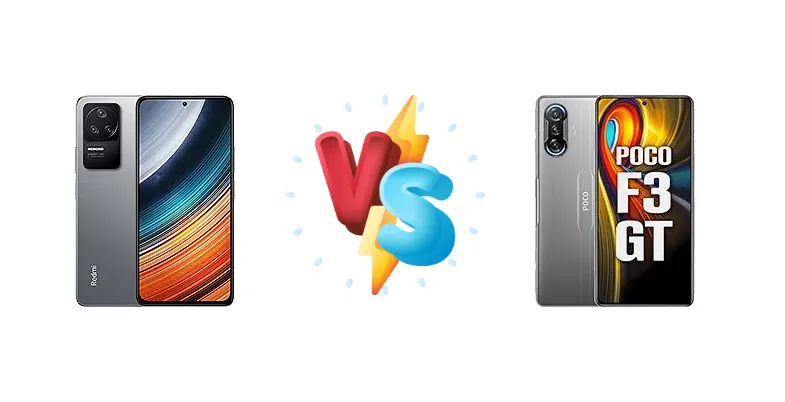
Xiaomi consistently delivers impressive smartphones at competitive prices. The Redmi K40S and Poco F3 GT are two such contenders, offering flagship-level features without breaking the bank. But which one reigns supreme? Let's dive into a comprehensive comparison to help you decide.
🏆 Quick Verdict
The Redmi K40S edges out the Poco F3 GT thanks to its superior Snapdragon 870 chipset, offering noticeably better performance in demanding tasks. While both offer excellent value, the K40S's processing power makes it the slightly better overall choice for most users.
| Network |
|---|
| 2G bands | GSM 850 / 900 / 1800 / 1900 | GSM 850 / 900 / 1800 / 1900 |
| 3G bands | HSDPA 850 / 900 / 1700(AWS) / 1900 / 2100 | HSDPA 850 / 900 / 1900 / 2100 |
| 4G bands | 1, 2, 3, 4, 5, 8, 18, 19, 26, 34, 38, 39, 40, 41, 42 | 1, 3, 5, 8, 40, 41 |
| 5G bands | 1, 3, 5, 8, 28, 38, 40, 41, 77, 78 SA/NSA | 77, 78 SA/NSA |
| Speed | HSPA, LTE, 5G | HSPA, LTE, 5G |
| Technology | GSM / CDMA / HSPA / CDMA2000 / LTE / 5G | GSM / HSPA / LTE / 5G |
| | CDMA2000 1x | - |
| Launch |
|---|
| Announced | 2022, March 17 | 2021, July 23 |
| Status | Available. Released 2022, March 17 | Available. Released 2021, July 26 |
| Body |
|---|
| Build | Glass front (Gorilla Glass 5), plastic back | Glass front (Gorilla Glass 5), glass back (Gorilla Glass 5) |
| Dimensions | 163.2 x 76 x 7.7 mm (6.43 x 2.99 x 0.30 in) | 161.9 x 76.9 x 8.3 mm (6.37 x 3.03 x 0.33 in) |
| SIM | Nano-SIM + Nano-SIM | Nano-SIM + Nano-SIM |
| Weight | 195 g (6.88 oz) | 205 g (7.23 oz) |
| | Splash resistant | Physical pop-up gaming triggers
IP53, dust and splash resistant |
| Display |
|---|
| Protection | Corning Gorilla Glass 5 | Corning Gorilla Glass 5 |
| Resolution | 1080 x 2400 pixels, 20:9 ratio (~395 ppi density) | 1080 x 2400 pixels, 20:9 ratio (~395 ppi density) |
| Size | 6.67 inches, 107.4 cm2 (~86.6% screen-to-body ratio) | 6.67 inches, 107.4 cm2 (~86.3% screen-to-body ratio) |
| Type | AMOLED, 120Hz, HDR10+, 1300 nits (peak) | AMOLED, 1B colors, 120Hz, HDR10+, 500 nits (typ) |
| Platform |
|---|
| CPU | Octa-core (1x3.2 GHz Kryo 585 & 3x2.42 GHz Kryo 585 & 4x1.80 GHz Kryo 585) | Octa-core (1x3.0 GHz Cortex-A78 & 3x2.6 GHz Cortex-A78 & 4x2.0 GHz Cortex-A55) |
| Chipset | Qualcomm SM8250-AC Snapdragon 870 5G (7 nm) | Mediatek Dimensity 1200 (6 nm) |
| GPU | Adreno 650 | Mali-G77 MC9 |
| OS | Android 12, MIUI 13 | Android 11, upgradable to Android 12, MIUI 13 for POCO |
| Memory |
|---|
| Card slot | No | No |
| Internal | 128GB 6GB RAM, 128GB 8GB RAM, 256GB 8GB RAM, 256GB 12GB RAM | 128GB 6GB RAM, 128GB 8GB RAM, 256GB 8GB RAM |
| | UFS 3.1 | UFS 3.1 |
| Main Camera |
|---|
| Features | Color spectrum sensor, Dual-LED dual-tone flash, HDR, panorama | Dual-LED flash, HDR, panorama |
| Single | 20 MP, (wide) | 16 MP, f/2.5, (wide), 1/3.06" 1.0µm |
| Triple | 48 MP, f/1.8, (wide), 1/2.0", 0.8µm, PDAF, OIS
8 MP, 119˚ (ultrawide)
2 MP (macro) | 64 MP, f/1.7, 26mm (wide), 1/2.0", 0.7µm, PDAF
8 MP, f/2.2, 120˚ (ultrawide)
2 MP (macro) |
| Video | 4K@30fps, 1080p@30/60/120fps, 720p@960fps; gyro-EIS | 4K@30fps, 1080p@30/60/120fps, 720p@960fps, HDR |
| Selfie camera |
|---|
| Features | - | HDR, panorama |
| Single | 20 MP, (wide) | 16 MP, f/2.5, (wide), 1/3.06" 1.0µm |
| Video | 1080p@30/120fps | 1080p@30fps, HDR |
| Sound |
|---|
| 3.5mm jack | No | No |
| 35mm jack | No | No |
| Loudspeaker | Yes, with stereo speakers | Yes, with stereo speakers |
| | 24-bit/192kHz audio | 24-bit/192kHz audio
Tuned by JBL |
| Comms |
|---|
| Bluetooth | 5.2, A2DP, LE | 5.1, A2DP, LE |
| Infrared port | - | Yes |
| NFC | Yes | Yes (market/region dependent) |
| Positioning | GPS (L1+L5), GLONASS (L1), BDS (B1I+B1c+B2a), GALILEO (E1+E5a), QZSS (L1+L5), NavIC (L5) | GPS, GLONASS, GALILEO, BDS |
| Radio | No | No |
| USB | USB Type-C 2.0, OTG | USB Type-C 2.0, OTG |
| WLAN | Wi-Fi 802.11 a/b/g/n/ac/6, dual-band, Wi-Fi Direct | Wi-Fi 802.11 a/b/g/n/ac/6, dual-band, Wi-Fi Direct |
| Features |
|---|
| Sensors | Fingerprint (side-mounted), accelerometer, gyro, proximity, compass | Fingerprint (side-mounted), accelerometer, gyro, proximity, compass |
| Battery |
|---|
| Charging | 67W wired, PD3.0, QC3, 100% in 38 min | 67W wired, PD3.0, QC3, 100% in 42 min |
| Type | Li-Po 4500 mAh | Li-Po 5065 mAh |
| Misc |
|---|
| Colors | Black, Gray, Blue, Green | Predator Black, Gunmetal Silver |
| Models | - | MZB09C6IN, M2104K10I |
| Price | About 260 EUR | About 300 EUR |
| SAR | - | 0.81 W/kg (head) 0.48 W/kg (body) |
Xiaomi Redmi K40S
- Superior Snapdragon 870 performance
- Slightly faster charging
- Potentially better image processing
- Design might be less distinctive
- Macro camera is often underwhelming
Xiaomi Poco F3 GT
- Shoulder triggers for enhanced gaming
- Slightly more affordable
- Higher resolution main camera (on paper)
- Dimensity 1200 performance slightly behind Snapdragon 870
- Slightly slower charging
- Image processing not as refined
Display Comparison
Both phones feature a vibrant 6.67-inch AMOLED display with a 120Hz refresh rate, offering a smooth and immersive viewing experience. The K40S might have slightly better color accuracy, but the difference is minimal. Resolution is FHD+ on both.
Camera Comparison
The Redmi K40S typically features a 48MP main camera, 8MP ultrawide, and 5MP macro lens. The Poco F3 GT has a 64MP main camera, 8MP ultrawide, and 2MP macro. While the F3 GT has higher megapixel count, the K40S often delivers slightly better image processing and dynamic range. Both offer decent low-light performance.
Performance
The Redmi K40S boasts the Snapdragon 870, a consistently strong performer. The Poco F3 GT's Dimensity 1200 is also capable, but the Snapdragon generally handles demanding games and applications with greater ease and efficiency. Expect smoother frame rates and less thermal throttling on the K40S.
Battery Life
Both phones pack a 4500mAh battery and support 67W fast charging. The K40S charges slightly faster (38 minutes vs 42 minutes for the F3 GT), providing a small advantage in convenience.
Buying Guide
The Xiaomi Redmi K40S is ideal for gamers and power users who prioritize raw performance and smooth multitasking. The Poco F3 GT is a great option for those seeking a balance of performance, gaming features (like shoulder triggers), and a slightly more affordable price point.
Frequently Asked Questions
❓ Which phone is better for gaming?
The Redmi K40S is generally better for gaming due to its Snapdragon 870 chipset, which offers more consistent performance and better thermal management.
❓ Do both phones have 5G?
Yes, both the Redmi K40S and the Poco F3 GT support 5G connectivity.
❓ What is the difference between the shoulder triggers on the Poco F3 GT?
The Poco F3 GT features built-in shoulder triggers that can be mapped to on-screen buttons, providing a more immersive gaming experience similar to a console controller.