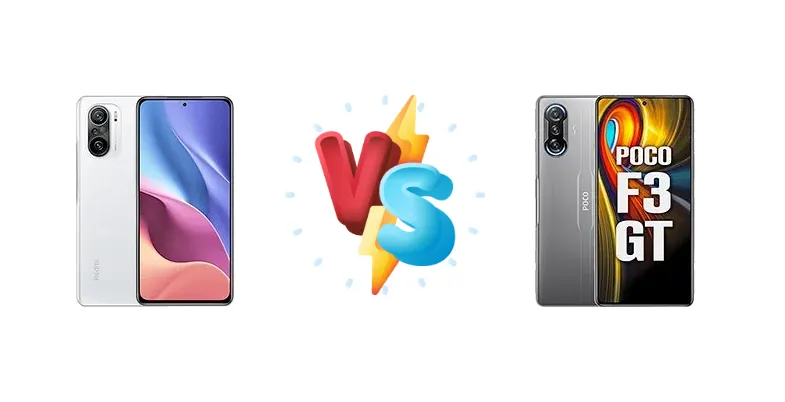
The Xiaomi Redmi K40 and Poco F3 GT represent compelling options in the mid-to-high range smartphone market. While both aim for a premium experience without the flagship price tag, they diverge in their core approaches. The K40 prioritizes a balanced experience with the Snapdragon 870, while the F3 GT aggressively targets gamers with the Dimensity 1200 and faster charging. This comparison dissects these differences to help you choose the right device.
🏆 Quick Verdict
For the average user prioritizing all-around performance and efficiency, the Xiaomi Redmi K40 emerges as the better choice. Its Snapdragon 870 offers a smooth experience, and its 33W charging is adequate. However, gamers and those demanding the fastest possible charging will find the Poco F3 GT’s Dimensity 1200 and 67W charging more appealing.
| Network |
|---|
| 2G bands | GSM 850 / 900 / 1800 / 1900 | GSM 850 / 900 / 1800 / 1900 |
| 3G bands | HSDPA 850 / 900 / 1700(AWS) / 1900 / 2100 | HSDPA 850 / 900 / 1900 / 2100 |
| 4G bands | 1, 2, 3, 4, 5, 7, 8, 18, 19, 26, 28, 34, 38, 39, 40, 41, 42 | 1, 3, 5, 8, 40, 41 |
| 5G bands | 1, 3, 28, 41, 77, 78 SA/NSA/Sub6 | 77, 78 SA/NSA |
| Speed | HSPA, LTE, 5G | HSPA, LTE, 5G |
| Technology | GSM / CDMA / HSPA / CDMA2000 / LTE / 5G | GSM / HSPA / LTE / 5G |
| | CDMA2000 1x | - |
| Launch |
|---|
| Announced | 2021, February 25 | 2021, July 23 |
| Status | Available. Released 2021, March 04 | Available. Released 2021, July 26 |
| Body |
|---|
| Build | - | Glass front (Gorilla Glass 5), glass back (Gorilla Glass 5) |
| Dimensions | 163.7 x 76.4 x 7.8 mm (6.44 x 3.01 x 0.31 in) | 161.9 x 76.9 x 8.3 mm (6.37 x 3.03 x 0.33 in) |
| SIM | Nano-SIM + Nano-SIM | Nano-SIM + Nano-SIM |
| Weight | 196 g (6.91 oz) | 205 g (7.23 oz) |
| | - | Physical pop-up gaming triggers
IP53, dust and splash resistant |
| Display |
|---|
| Protection | Corning Gorilla Glass 5 | Corning Gorilla Glass 5 |
| Resolution | 1080 x 2400 pixels, 20:9 ratio (~395 ppi density) | 1080 x 2400 pixels, 20:9 ratio (~395 ppi density) |
| Size | 6.67 inches, 107.4 cm2 (~85.9% screen-to-body ratio) | 6.67 inches, 107.4 cm2 (~86.3% screen-to-body ratio) |
| Type | Super AMOLED, 120Hz, HDR10+, 1300 nits (peak) | AMOLED, 1B colors, 120Hz, HDR10+, 500 nits (typ) |
| Platform |
|---|
| CPU | Octa-core (1x3.2 GHz Kryo 585 & 3x2.42 GHz Kryo 585 & 4x1.80 GHz Kryo 585) | Octa-core (1x3.0 GHz Cortex-A78 & 3x2.6 GHz Cortex-A78 & 4x2.0 GHz Cortex-A55) |
| Chipset | Qualcomm SM8250-AC Snapdragon 870 5G (7 nm) | Mediatek Dimensity 1200 (6 nm) |
| GPU | Adreno 650 | Mali-G77 MC9 |
| OS | Android 11, MIUI 12 | Android 11, upgradable to Android 12, MIUI 13 for POCO |
| Memory |
|---|
| Card slot | No | No |
| Internal | 128GB 6GB RAM, 128GB 8GB RAM, 256GB 8GB RAM, 256GB 12GB RAM | 128GB 6GB RAM, 128GB 8GB RAM, 256GB 8GB RAM |
| | UFS 3.1 | UFS 3.1 |
| Main Camera |
|---|
| Features | Color spectrum sensor, LED flash, HDR, panorama | Dual-LED flash, HDR, panorama |
| Single | 20 MP, f/2.5, (wide), 1/3.4", 0.8µm | 16 MP, f/2.5, (wide), 1/3.06" 1.0µm |
| Triple | 48 MP, f/1.8, 26mm (wide), 1/2.0", 0.8µm, PDAF
8 MP, f/2.2, 119˚ (ultrawide)
5 MP, f/2.4, 50mm (macro) | 64 MP, f/1.7, 26mm (wide), 1/2.0", 0.7µm, PDAF
8 MP, f/2.2, 120˚ (ultrawide)
2 MP (macro) |
| Video | 4K@30fps, 1080p@30/60/120/240/960fps, gyro-EIS | 4K@30fps, 1080p@30/60/120fps, 720p@960fps, HDR |
| Selfie camera |
|---|
| Features | HDR | HDR, panorama |
| Single | 20 MP, f/2.5, (wide), 1/3.4", 0.8µm | 16 MP, f/2.5, (wide), 1/3.06" 1.0µm |
| Video | 1080p@30fps, 720p@120fps | 1080p@30fps, HDR |
| Sound |
|---|
| 3.5mm jack | No | No |
| 35mm jack | No | No |
| Loudspeaker | Yes, with stereo speakers | Yes, with stereo speakers |
| | 24-bit/192kHz audio | 24-bit/192kHz audio
Tuned by JBL |
| Comms |
|---|
| Bluetooth | 5.1, A2DP, LE | 5.1, A2DP, LE |
| Infrared port | Yes | Yes |
| NFC | Yes | Yes (market/region dependent) |
| Positioning | GPS (L1+L5), GLONASS (G1), BDS (B1I+B2a), GALILEO (E1+E5a), QZSS (L1+L5), NavIC | GPS, GLONASS, GALILEO, BDS |
| Radio | No | No |
| USB | USB Type-C 2.0, OTG | USB Type-C 2.0, OTG |
| WLAN | Wi-Fi 802.11 a/b/g/n/ac/6, dual-band, Wi-Fi Direct | Wi-Fi 802.11 a/b/g/n/ac/6, dual-band, Wi-Fi Direct |
| Features |
|---|
| Sensors | Fingerprint (side-mounted), accelerometer, gyro, proximity, compass | Fingerprint (side-mounted), accelerometer, gyro, proximity, compass |
| Battery |
|---|
| Charging | 33W wired, PD3.0, QC3, 100% in 52 min | 67W wired, PD3.0, QC3, 100% in 42 min |
| Type | Li-Po 4520 mAh | Li-Po 5065 mAh |
| Misc |
|---|
| Colors | Black, White, Aurora | Predator Black, Gunmetal Silver |
| Models | M2012K11AC | MZB09C6IN, M2104K10I |
| Price | About 280 EUR | About 300 EUR |
| SAR | - | 0.81 W/kg (head) 0.48 W/kg (body) |
Xiaomi Redmi K40
- More efficient Snapdragon 870 chipset
- Balanced performance for everyday tasks
- Potentially better thermal management
- Slower 33W charging
- Less focused on gaming features
Xiaomi Poco F3 GT
- Faster 67W charging for quick top-ups
- Powerful Dimensity 1200 for demanding games
- Likely includes gaming-specific features (triggers)
- Dimensity 1200 may run hotter under sustained load
- Potentially lower battery life due to higher power draw
Display Comparison
While display specs aren't provided, both phones likely feature AMOLED panels, common for this price bracket. The key difference lies in the underlying processing power needed to drive them. The Snapdragon 870's ISP is optimized for efficient display output, potentially leading to slightly better battery life during video playback. The Poco F3 GT, geared towards gaming, may prioritize higher refresh rates (likely 120Hz on both) at the expense of some efficiency. Bezels are expected to be minimal on both, reflecting current design trends.
Camera Comparison
Without detailed camera specs, it's difficult to make a definitive judgment. Both phones likely feature multi-camera setups, but the quality hinges on sensor size and image processing. The Snapdragon 870’s ISP is known for its excellent image processing capabilities, potentially delivering more consistent results in various lighting conditions. The Dimensity 1200 also has a capable ISP, but its focus is more on speed and efficiency. We can assume both will have a primary wide-angle lens, an ultrawide, and potentially a macro lens (though the usefulness of a 2MP macro is questionable).
Performance
The core battleground is the chipset. The Poco F3 GT’s Mediatek Dimensity 1200, built on a 6nm process, theoretically offers higher peak performance than the Redmi K40’s Snapdragon 870 (7nm). The Dimensity 1200’s Cortex-A78 cores, clocked at 3.0 GHz, are designed for sustained performance, while the Snapdragon 870’s Kryo 585 cores prioritize efficiency. However, the 7nm process of the Snapdragon 870 often translates to better thermal management, reducing the likelihood of throttling during extended gaming sessions. The F3 GT's focus on gaming suggests aggressive cooling solutions, but the Dimensity 1200's power draw is still a factor. Both likely utilize LPDDR5 RAM, but the speed (e.g., LPDDR5x) isn't specified.
Battery Life
The Redmi K40’s 33W charging, while supporting PD3.0 and QC3, is significantly slower than the Poco F3 GT’s 67W charging. The F3 GT can reach 100% in 42 minutes, while the K40 takes 52 minutes. This difference is substantial for users who prioritize quick top-ups. Battery capacity isn't specified, but the more power-hungry Dimensity 1200 in the F3 GT likely necessitates a larger battery to maintain comparable battery life to the K40. The Snapdragon 870’s efficiency gives the K40 an advantage in longevity under moderate use.
Buying Guide
Buy the Xiaomi Redmi K40 if you need a well-rounded smartphone with excellent performance for everyday tasks, media consumption, and light gaming, coupled with a more efficient chipset. Buy the Xiaomi Poco F3 GT if you prioritize gaming performance, demand the fastest possible charging speeds, and are willing to trade some efficiency for raw power and features like dedicated gaming triggers (not mentioned in specs, but a key F3 GT feature).
Frequently Asked Questions
❓ Will the Poco F3 GT's Dimensity 1200 overheat during prolonged gaming sessions?
The Dimensity 1200 is a powerful chip, and generates more heat than the Snapdragon 870. While the Poco F3 GT likely incorporates cooling solutions, sustained gaming at maximum settings could lead to thermal throttling, reducing performance over time. Monitoring temperatures during gameplay is recommended.
❓ Is the 33W charging on the Redmi K40 slow compared to other phones in this price range?
33W charging is slower than the 67W on the Poco F3 GT, and some competitors offer even faster charging. However, it's still a respectable charging speed and will fully charge the phone in around 52 minutes. It's a trade-off for the Snapdragon 870's efficiency.
❓ Does the Snapdragon 870 in the Redmi K40 handle demanding games like Genshin Impact and PUBG Mobile?
Yes, the Snapdragon 870 is more than capable of running demanding games like Genshin Impact and PUBG Mobile at high settings. While it may not achieve the absolute highest frame rates compared to the Dimensity 1200, it provides a smooth and consistent gaming experience with better thermal management.