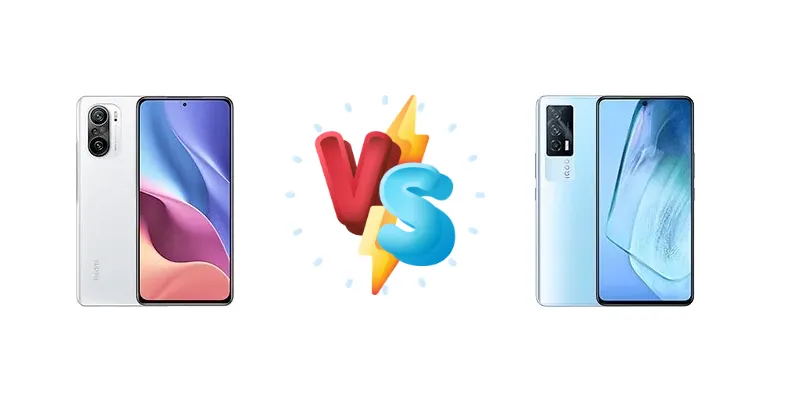
The Xiaomi Redmi K40 and the vivo iQOO 7 (India) represent a fascinating intersection in the mid-range smartphone market. Both devices leverage the proven Qualcomm Snapdragon 870 5G chipset, offering flagship-level performance at a more accessible price point. However, their approaches to battery technology and overall user experience diverge significantly, making a direct comparison crucial for discerning buyers.
🏆 Quick Verdict
For the average user prioritizing convenience and minimal downtime, the vivo iQOO 7 (India) is the clear winner. Its 66W fast charging dramatically reduces charging times, offsetting the Redmi K40’s potentially slightly longer battery life. While performance is nearly identical, the iQOO 7’s charging speed is a game-changer.
| Network |
|---|
| 2G bands | GSM 850 / 900 / 1800 / 1900 | GSM 850 / 900 / 1800 / 1900 |
| 3G bands | HSDPA 850 / 900 / 1700(AWS) / 1900 / 2100 | HSDPA 850 / 900 / 2100 |
| 4G bands | 1, 2, 3, 4, 5, 7, 8, 18, 19, 26, 28, 34, 38, 39, 40, 41, 42 | 1, 3, 5, 8, 38, 40, 41 |
| 5G bands | 1, 3, 28, 41, 77, 78 SA/NSA/Sub6 | SA/NSA |
| Speed | HSPA, LTE, 5G | HSPA, LTE, 5G |
| Technology | GSM / CDMA / HSPA / CDMA2000 / LTE / 5G | GSM / HSPA / LTE / 5G |
| | CDMA2000 1x | - |
| Launch |
|---|
| Announced | 2021, February 25 | 2021, April 26 |
| Status | Available. Released 2021, March 04 | Available. Released 2021, May 01 |
| Body |
|---|
| Dimensions | 163.7 x 76.4 x 7.8 mm (6.44 x 3.01 x 0.31 in) | 163.3 x 76.4 x 8.4 mm (6.43 x 3.01 x 0.33 in) |
| SIM | Nano-SIM + Nano-SIM | Nano-SIM + Nano-SIM |
| Weight | 196 g (6.91 oz) | 196 g (6.91 oz) |
| Display |
|---|
| Protection | Corning Gorilla Glass 5 | - |
| Resolution | 1080 x 2400 pixels, 20:9 ratio (~395 ppi density) | 1080 x 2400 pixels, 20:9 ratio (~398 ppi density) |
| Size | 6.67 inches, 107.4 cm2 (~85.9% screen-to-body ratio) | 6.62 inches, 105.8 cm2 (~84.8% screen-to-body ratio) |
| Type | Super AMOLED, 120Hz, HDR10+, 1300 nits (peak) | AMOLED, 120Hz, HDR10+, 1300 nits (peak) |
| Platform |
|---|
| CPU | Octa-core (1x3.2 GHz Kryo 585 & 3x2.42 GHz Kryo 585 & 4x1.80 GHz Kryo 585) | Octa-core (1x3.2 GHz Kryo 585 & 3x2.42 GHz Kryo 585 & 4x1.80 GHz Kryo 585) |
| Chipset | Qualcomm SM8250-AC Snapdragon 870 5G (7 nm) | Qualcomm SM8250-AC Snapdragon 870 5G (7 nm) |
| GPU | Adreno 650 | Adreno 650 |
| OS | Android 11, MIUI 12 | Android 11, Funtouch 11.1 |
| Memory |
|---|
| Card slot | No | No |
| Internal | 128GB 6GB RAM, 128GB 8GB RAM, 256GB 8GB RAM, 256GB 12GB RAM | 128GB 8GB RAM, 256GB 8GB RAM, 256GB 12GB RAM |
| | UFS 3.1 | - |
| Main Camera |
|---|
| Dual | - | 48 MP, f/1.8, 25mm (wide), 1/2.0", 0.8µm, PDAF, OIS
13 MP, f/2.2, 16mm, 120˚ (ultrawide)
Auxiliary lens |
| Features | Color spectrum sensor, LED flash, HDR, panorama | Dual-LED dual-tone flash, HDR, panorama |
| Single | 20 MP, f/2.5, (wide), 1/3.4", 0.8µm | 16 MP, f/2.0, (wide) |
| Triple | 48 MP, f/1.8, 26mm (wide), 1/2.0", 0.8µm, PDAF
8 MP, f/2.2, 119˚ (ultrawide)
5 MP, f/2.4, 50mm (macro) | - |
| Video | 4K@30fps, 1080p@30/60/120/240/960fps, gyro-EIS | 4K@30fps, 1080p@30fps |
| Selfie camera |
|---|
| Features | HDR | HDR |
| Single | 20 MP, f/2.5, (wide), 1/3.4", 0.8µm | 16 MP, f/2.0, (wide) |
| Video | 1080p@30fps, 720p@120fps | 1080p@30fps |
| Sound |
|---|
| 3.5mm jack | No | No |
| 35mm jack | No | No |
| Loudspeaker | Yes, with stereo speakers | Yes, with dual speakers |
| | 24-bit/192kHz audio | 24-bit/192kHz audio |
| Comms |
|---|
| Bluetooth | 5.1, A2DP, LE | 5.1, A2DP, LE, aptX HD, aptX Adaptive |
| Infrared port | Yes | - |
| NFC | Yes | Yes |
| Positioning | GPS (L1+L5), GLONASS (G1), BDS (B1I+B2a), GALILEO (E1+E5a), QZSS (L1+L5), NavIC | GPS |
| Radio | No | No |
| USB | USB Type-C 2.0, OTG | USB Type-C 2.0, OTG |
| WLAN | Wi-Fi 802.11 a/b/g/n/ac/6, dual-band, Wi-Fi Direct | Wi-Fi 802.11 a/b/g/n/ac, dual-band, Wi-Fi Direct |
| Features |
|---|
| Sensors | Fingerprint (side-mounted), accelerometer, gyro, proximity, compass | Fingerprint (under display, optical), accelerometer, gyro, proximity, compass |
| Battery |
|---|
| Charging | 33W wired, PD3.0, QC3, 100% in 52 min | 66W wired, 100% in 22 min |
| Type | Li-Po 4520 mAh | 4400 mAh |
| Misc |
|---|
| Colors | Black, White, Aurora | Solid Ice, Storm Black, Monster Orange |
| Models | M2012K11AC | - |
| Price | About 280 EUR | About 350 EUR |
Xiaomi Redmi K40
- Potentially better value for money (depending on pricing)
- Balanced overall package
- Xiaomi’s MIUI offers extensive customization options
- Significantly slower charging speed (33W)
- Potential for more throttling under sustained load (depending on cooling)
- MIUI can be resource-intensive
vivo iQOO 7 (India)
- Ultra-fast 66W charging
- Likely superior thermal management for gaming
- iQOO’s Funtouch OS is optimized for performance
- May be slightly more expensive than the Redmi K40
- Funtouch OS can be less customizable than MIUI
- Camera performance is unknown without further specs
Display Comparison
Both devices share a similar display profile, likely utilizing AMOLED panels given the market segment. However, specific details like peak brightness, color accuracy (DCI-P3 coverage), and refresh rate are not provided. The Redmi K40’s display is likely tuned for color vibrancy, typical of Xiaomi’s approach, while iQOO often prioritizes color accuracy for gaming. Without further data, it’s difficult to definitively declare a winner, but the absence of LTPO technology on either suggests a standard refresh rate implementation.
Camera Comparison
Camera specifications are absent, making a detailed comparison impossible. However, given iQOO’s branding, it’s reasonable to expect a focus on computational photography and gaming-oriented camera features. Xiaomi typically offers versatile camera systems with a strong emphasis on image processing. Without sensor size, aperture, or OIS details, it’s impossible to assess image quality or low-light performance. The presence of a 2MP macro lens on either device would be largely inconsequential, offering minimal practical benefit.
Performance
The core of both phones is the Qualcomm SM8250-AC Snapdragon 870 5G (7 nm) chipset, featuring an identical CPU configuration: 1x3.2 GHz Kryo 585, 3x2.42 GHz Kryo 585, and 4x1.80 GHz Kryo 585. This means CPU performance will be virtually indistinguishable between the two. The GPU performance will also be nearly identical. The key differentiator will be thermal management. iQOO, with its gaming focus, likely employs a more aggressive cooling solution, potentially allowing for sustained peak performance for longer durations, mitigating potential throttling under heavy load. RAM type and speed (LPDDR4X vs LPDDR5) are unspecified, but faster RAM would benefit multitasking and gaming.
Battery Life
This is where the iQOO 7 (India) truly shines. While battery capacity is not specified, the 66W wired charging capability is a significant advantage. The iQOO 7 can achieve a 100% charge in just 22 minutes, a substantial improvement over the Redmi K40’s 33W charging, which takes 52 minutes. This difference in charging speed translates to significantly less downtime and greater convenience for users. Even if the Redmi K40 has a slightly larger battery capacity, the iQOO 7’s faster charging effectively mitigates any potential battery life disparity.
Buying Guide
Buy the Xiaomi Redmi K40 if you prioritize a balanced package with a focus on value and don't mind a longer charging time. It's ideal for users who charge their phones overnight or aren't heavily reliant on quick top-ups. Buy the vivo iQOO 7 (India) if you value speed and convenience above all else. Its 66W charging is perfect for gamers, power users, and anyone who frequently finds themselves needing a rapid battery boost.
Frequently Asked Questions
❓ Will the Snapdragon 870 in the iQOO 7 overheat during prolonged gaming sessions like PUBG or Genshin Impact?
The Snapdragon 870 is a well-regarded chipset known for its efficiency. However, sustained gaming can generate heat. iQOO typically prioritizes thermal management in its devices, likely incorporating a more robust cooling system than the Redmi K40. This suggests the iQOO 7 will likely exhibit less throttling and maintain higher frame rates for longer periods during demanding games.
❓ Does the Redmi K40 support fast charging protocols beyond 33W, like Power Delivery (PD)?
The provided specifications indicate the Redmi K40 supports PD3.0 and QC3. While it doesn't support higher wattage PD standards, these protocols ensure compatibility with a wide range of chargers. However, to achieve the full 33W charging speed, a compatible charger is required.
❓ Is the difference in charging speed between 33W and 66W truly noticeable in everyday use?
Absolutely. The 66W charging on the iQOO 7 translates to a significantly faster top-up. A quick 15-minute charge can provide a substantial amount of battery life, making it ideal for users who need a rapid boost before heading out. The Redmi K40’s 33W charging, while adequate, requires considerably more time to achieve a similar level of charge.