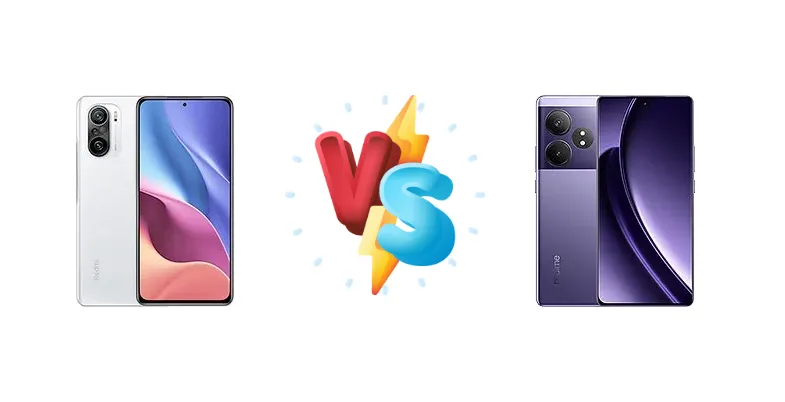
The Xiaomi Redmi K40, released in early 2021, established itself as a performance-to-price champion. Now, the Realme GT Neo6 enters the arena with a newer Snapdragon 8s Gen 3 chipset and significantly faster charging. This comparison dissects the key differences to determine which phone delivers the best experience in today's market.
🏆 Quick Verdict
For most users, the Realme GT Neo6 is the superior choice. Its Snapdragon 8s Gen 3 offers a noticeable performance uplift and improved efficiency over the Redmi K40’s Snapdragon 870, coupled with the game-changing 120W charging. While the K40 remains a capable device, the Neo6’s advancements justify the price difference.
| Network |
|---|
| 2G bands | GSM 850 / 900 / 1800 / 1900 | GSM 850 / 900 / 1800 / 1900 |
| 3G bands | HSDPA 850 / 900 / 1700(AWS) / 1900 / 2100 | HSDPA 850 / 900 / 2100 |
| 4G bands | 1, 2, 3, 4, 5, 7, 8, 18, 19, 26, 28, 34, 38, 39, 40, 41, 42 | 1, 3, 5, 7, 8, 28, 34, 38, 39, 40, 41 |
| 5G bands | 1, 3, 28, 41, 77, 78 SA/NSA/Sub6 | 1, 3, 5, 8, 28, 41, 77, 78 SA/NSA |
| Speed | HSPA, LTE, 5G | HSPA, LTE, 5G |
| Technology | GSM / CDMA / HSPA / CDMA2000 / LTE / 5G | GSM / CDMA / HSPA / CDMA2000 / LTE / 5G |
| | CDMA2000 1x | - |
| Launch |
|---|
| Announced | 2021, February 25 | 2024, May 09 |
| Status | Available. Released 2021, March 04 | Available. Released 2024, May 09 |
| Body |
|---|
| Dimensions | 163.7 x 76.4 x 7.8 mm (6.44 x 3.01 x 0.31 in) | 162 x 75.1 x 8.7 mm (6.38 x 2.96 x 0.34 in) |
| SIM | Nano-SIM + Nano-SIM | Nano-SIM + Nano-SIM |
| Weight | 196 g (6.91 oz) | 191 g (6.74 oz) |
| Display |
|---|
| Protection | Corning Gorilla Glass 5 | - |
| Resolution | 1080 x 2400 pixels, 20:9 ratio (~395 ppi density) | 1264 x 2780 pixels (~450 ppi density) |
| Size | 6.67 inches, 107.4 cm2 (~85.9% screen-to-body ratio) | 6.78 inches, 111.7 cm2 (~91.8% screen-to-body ratio) |
| Type | Super AMOLED, 120Hz, HDR10+, 1300 nits (peak) | LTPO AMOLED, 1B colors, 120Hz, HDR, 1600 nits (HBM), 6000 nits (peak) |
| Platform |
|---|
| CPU | Octa-core (1x3.2 GHz Kryo 585 & 3x2.42 GHz Kryo 585 & 4x1.80 GHz Kryo 585) | Octa-core (1x3.0 GHz Cortex-X4 & 4x2.8 GHz Cortex-A720 & 3x2.0 GHz Cortex-A520) |
| Chipset | Qualcomm SM8250-AC Snapdragon 870 5G (7 nm) | Qualcomm SM8635 Snapdragon 8s Gen 3 (4 nm) |
| GPU | Adreno 650 | Adreno 735 |
| OS | Android 11, MIUI 12 | Android 14, Realme UI 5.0 |
| Memory |
|---|
| Card slot | No | No |
| Internal | 128GB 6GB RAM, 128GB 8GB RAM, 256GB 8GB RAM, 256GB 12GB RAM | 256GB 12GB RAM, 256GB 16GB RAM, 512GB 16GB RAM, 1TB 16GB RAM |
| | UFS 3.1 | - |
| Main Camera |
|---|
| Dual | - | 50 MP, f/1.9, 26mm (wide), 1/1.95", PDAF, OIS
8 MP, f/2.2, 16mm, 112˚ (ultrawide), 1/4.0", 1.12µm |
| Features | Color spectrum sensor, LED flash, HDR, panorama | Color spectrum sensor, Dual-LED flash, HDR, panorama |
| Single | 20 MP, f/2.5, (wide), 1/3.4", 0.8µm | - |
| Triple | 48 MP, f/1.8, 26mm (wide), 1/2.0", 0.8µm, PDAF
8 MP, f/2.2, 119˚ (ultrawide)
5 MP, f/2.4, 50mm (macro) | - |
| Video | 4K@30fps, 1080p@30/60/120/240/960fps, gyro-EIS | 4K@30/60fps, 1080p@30/60/120fps |
| Selfie camera |
|---|
| Features | HDR | Panorama |
| Single | 20 MP, f/2.5, (wide), 1/3.4", 0.8µm | 32 MP, f/2.5, 22mm (wide), 1/2.74" |
| Video | 1080p@30fps, 720p@120fps | 4K@30fps, 1080p@30fps |
| Sound |
|---|
| 3.5mm jack | No | - |
| 35mm jack | No | No |
| Loudspeaker | Yes, with stereo speakers | Yes, with stereo speakers |
| | 24-bit/192kHz audio | - |
| Comms |
|---|
| Bluetooth | 5.1, A2DP, LE | 5.4, A2DP, LE, aptX HD, LHDC |
| Infrared port | Yes | Yes |
| NFC | Yes | Yes |
| Positioning | GPS (L1+L5), GLONASS (G1), BDS (B1I+B2a), GALILEO (E1+E5a), QZSS (L1+L5), NavIC | GPS (L1+L5), BDS (B1I+B1c+B2a), GALILEO (E1+E5a), QZSS (L1+L5), NavIC, GLONASS |
| Radio | No | No |
| USB | USB Type-C 2.0, OTG | USB Type-C 2.0 |
| WLAN | Wi-Fi 802.11 a/b/g/n/ac/6, dual-band, Wi-Fi Direct | Wi-Fi 802.11 a/b/g/n/ac/6, dual-band |
| Features |
|---|
| Sensors | Fingerprint (side-mounted), accelerometer, gyro, proximity, compass | Fingerprint (under display, optical), accelerometer, gyro, proximity, compass |
| Battery |
|---|
| Charging | 33W wired, PD3.0, QC3, 100% in 52 min | 120W wired, 50% in 10 min |
| Type | Li-Po 4520 mAh | 5500 mAh |
| Misc |
|---|
| Colors | Black, White, Aurora | Silver, Green, Purple |
| Models | M2012K11AC | RMX3852 |
| Price | About 280 EUR | About 270 EUR |
Xiaomi Redmi K40
- Excellent value for money
- Proven Snapdragon 870 performance
- Reliable and stable software experience
- Slow charging speed (33W)
- Older chipset architecture
- Potentially shorter software support lifespan
Realme GT Neo6
- Blazing-fast 120W charging
- More powerful Snapdragon 8s Gen 3 chipset
- Improved thermal efficiency
- Likely better camera performance
- Higher price point
- Potential for software bugs (common with newer devices)
Display Comparison
While both phones likely feature AMOLED panels (based on market segment), the context data doesn't specify display characteristics. However, the Realme GT Neo6, being a newer device, likely benefits from a higher peak brightness and potentially a more efficient panel. The Redmi K40’s display, while good for its time, may exhibit lower peak brightness and potentially wider bezels compared to the more refined design of the Neo6. Color accuracy is likely comparable, but the Neo6 may offer more advanced color calibration options.
Camera Comparison
Without specific camera specs, a direct comparison is limited. However, the Realme GT Neo6, as a newer model, likely incorporates a more advanced camera system with a larger main sensor and improved image processing algorithms. The Redmi K40’s camera, while capable, may struggle in low-light conditions compared to the Neo6. The Neo6 likely benefits from features like improved dynamic range and more sophisticated night mode capabilities. The absence of details on OIS for either device makes it difficult to assess stabilization performance.
Performance
The core difference lies in the chipsets. The Realme GT Neo6’s Snapdragon 8s Gen 3 (4nm) represents a significant architectural leap over the Redmi K40’s Snapdragon 870 (7nm). The 8s Gen 3 features the newer Cortex-X4 prime core clocked at 3.0 GHz, offering improved single-core performance. Its Adreno 735 GPU also surpasses the 870’s Adreno 660. The 4nm process node of the 8s Gen 3 translates to better thermal efficiency, meaning the Neo6 is less prone to throttling during sustained workloads. The Redmi K40’s Snapdragon 870 remains a strong performer, but the Neo6 provides a clear advantage in demanding tasks like gaming and video editing.
Battery Life
The Realme GT Neo6’s 120W charging is a game-changer, capable of charging from 0 to 50% in just 10 minutes. The Redmi K40’s 33W charging, while supporting PD3.0 and QC3, takes significantly longer – approximately 52 minutes for a full charge. While battery capacity isn’t specified, the faster charging of the Neo6 mitigates any potential disadvantage from a slightly smaller battery. The 4nm process of the Snapdragon 8s Gen 3 also contributes to better power efficiency, potentially extending battery life on the Neo6.
Buying Guide
Buy the Xiaomi Redmi K40 if you prioritize a proven, reliable chipset at the lowest possible price and aren't concerned with the latest charging technology. It's ideal for users who primarily browse, use social media, and engage in light gaming. Buy the Realme GT Neo6 if you demand faster performance for demanding apps and games, value incredibly rapid charging, and appreciate a more modern chipset with potential for longer software support.
Frequently Asked Questions
❓ Will the Snapdragon 8s Gen 3 in the Realme GT Neo6 handle demanding games like Genshin Impact at max settings?
Yes, the Snapdragon 8s Gen 3 is more than capable of running Genshin Impact at maximum settings with consistently high frame rates. Its improved GPU and thermal efficiency minimize throttling, providing a smoother gaming experience compared to the Redmi K40’s Snapdragon 870.
❓ How much faster is the 120W charging on the Realme GT Neo6 compared to the 33W charging on the Redmi K40 in real-world use?
The difference is substantial. The Realme GT Neo6 can charge from 0% to 50% in approximately 10 minutes, while the Redmi K40 takes over 30 minutes to reach the same level. A full charge on the Neo6 will take around 30-40 minutes, whereas the K40 requires over an hour.
❓ Does the Realme GT Neo6 experience overheating during prolonged gaming sessions?
The Snapdragon 8s Gen 3’s 4nm process and improved thermal design in the Realme GT Neo6 help mitigate overheating. While some warmth is expected during intense gaming, it’s less likely to experience significant throttling compared to the Redmi K40, which can get noticeably warmer under sustained load.