
Xiaomi Redmi K40 vs OnePlus 9RT 5G: Which Snapdragon Phone Reigns Supreme?
| Phones Images | |||||
|---|---|---|---|---|---|
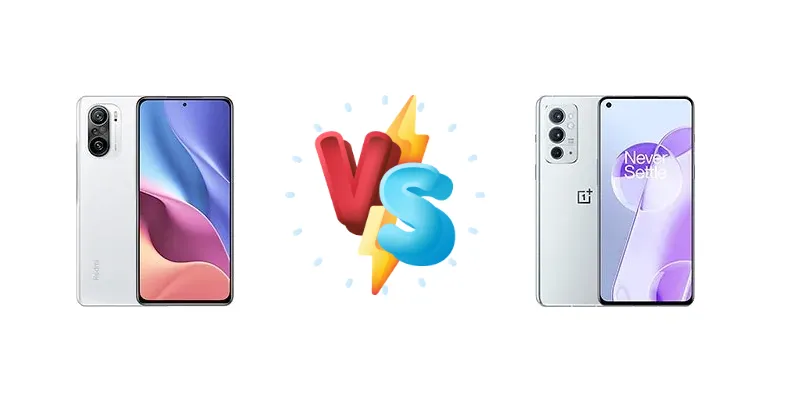
|
🏆 Quick Verdict
For the average user prioritizing sustained performance and faster charging, the OnePlus 9RT 5G is the better choice. Its Snapdragon 888, despite potential thermal throttling, offers a performance edge, and the 65W charging significantly reduces downtime. However, the Redmi K40 remains a strong contender for budget-conscious users valuing efficiency.
| PHONES | ||
|---|---|---|
| Phone Names | Xiaomi Redmi K40 | OnePlus 9RT 5G |
| Network | ||
|---|---|---|
| 2G bands | GSM 850 / 900 / 1800 / 1900 | GSM 850 / 900 / 1800 / 1900 |
| 3G bands | HSDPA 850 / 900 / 1700(AWS) / 1900 / 2100 | HSDPA 800 / 850 / 900 / 1700(AWS) / 1800 / 1900 / 2100 |
| 4G bands | 1, 2, 3, 4, 5, 7, 8, 18, 19, 26, 28, 34, 38, 39, 40, 41, 42 | 1, 2, 3, 4, 5, 7, 8, 12, 17, 18, 19, 20, 26, 28, 34, 38, 39, 40, 41 - Global |
| 5G bands | 1, 3, 28, 41, 77, 78 SA/NSA/Sub6 | 1, 3, 5, 8, 28, 40, 41, 78 SA/NSA - Global |
| Speed | HSPA, LTE, 5G | HSPA 42.2/5.76 Mbps, LTE Cat18 1200/200 Mbps, 5G |
| Technology | GSM / CDMA / HSPA / CDMA2000 / LTE / 5G | GSM / CDMA / HSPA / EVDO / LTE / 5G |
| CDMA2000 1x | CDMA2000 1xEV-DO | |
| Launch | ||
|---|---|---|
| Announced | 2021, February 25 | 2021, October 13 |
| Status | Available. Released 2021, March 04 | Available. Released 2021, October 19 |
| Body | ||
|---|---|---|
| Build | - | Glass front (Gorilla Glass 5), glass back (Gorilla Glass 5), aluminum frame |
| Dimensions | 163.7 x 76.4 x 7.8 mm (6.44 x 3.01 x 0.31 in) | 162.2 x 74.6 x 8.3 mm (6.39 x 2.94 x 0.33 in) |
| SIM | Nano-SIM + Nano-SIM | Nano-SIM + Nano-SIM |
| Weight | 196 g (6.91 oz) | 198.5 g (7.02 oz) |
| Display | ||
|---|---|---|
| Protection | Corning Gorilla Glass 5 | Corning Gorilla Glass 5 |
| Resolution | 1080 x 2400 pixels, 20:9 ratio (~395 ppi density) | 1080 x 2400 pixels, 20:9 ratio (~397 ppi density) |
| Size | 6.67 inches, 107.4 cm2 (~85.9% screen-to-body ratio) | 6.62 inches, 106.3 cm2 (~87.9% screen-to-body ratio) |
| Type | Super AMOLED, 120Hz, HDR10+, 1300 nits (peak) | AMOLED, 120Hz, HDR10+ |
| - | Always-on display | |
| Platform | ||
|---|---|---|
| CPU | Octa-core (1x3.2 GHz Kryo 585 & 3x2.42 GHz Kryo 585 & 4x1.80 GHz Kryo 585) | Octa-core (1x2.84 GHz Cortex-X1 & 3x2.42 GHz Cortex-A78 & 4x1.80 GHz Cortex-A55) |
| Chipset | Qualcomm SM8250-AC Snapdragon 870 5G (7 nm) | Qualcomm SM8350 Snapdragon 888 5G (5 nm) |
| GPU | Adreno 650 | Adreno 660 |
| OS | Android 11, MIUI 12 | Android 11, upgradable to Android 13, OxygenOS 13 |
| Memory | ||
|---|---|---|
| Card slot | No | No |
| Internal | 128GB 6GB RAM, 128GB 8GB RAM, 256GB 8GB RAM, 256GB 12GB RAM | 128GB 8GB RAM, 256GB 8GB RAM, 256GB 12GB RAM |
| UFS 3.1 | UFS 3.1 | |
| Main Camera | ||
|---|---|---|
| Features | Color spectrum sensor, LED flash, HDR, panorama | Dual-LED flash, HDR, panorama |
| Quad | - | 50 MP, f/1.8, 24mm (wide), 1/1.56”, 1.0µm, PDAF, OIS 16 MP, f/2.2, 14mm, 123˚ (ultrawide), 1/3.6", 1.0µm 2 MP (macro) |
| Single | 20 MP, f/2.5, (wide), 1/3.4", 0.8µm | 16 MP, f/2.4, (wide), 1/3.06", 1.0µm |
| Triple | 48 MP, f/1.8, 26mm (wide), 1/2.0", 0.8µm, PDAF 8 MP, f/2.2, 119˚ (ultrawide) 5 MP, f/2.4, 50mm (macro) | - |
| Video | 4K@30fps, 1080p@30/60/120/240/960fps, gyro-EIS | 4K@30/60fps, 1080p@30/60/240fps, Auto HDR, gyro-EIS |
| Selfie camera | ||
|---|---|---|
| Features | HDR | HDR |
| Single | 20 MP, f/2.5, (wide), 1/3.4", 0.8µm | 16 MP, f/2.4, (wide), 1/3.06", 1.0µm |
| Video | 1080p@30fps, 720p@120fps | 1080p@30fps, gyro-EIS |
| Sound | ||
|---|---|---|
| 3.5mm jack | No | No |
| 35mm jack | No | No |
| Loudspeaker | Yes, with stereo speakers | Yes, with stereo speakers |
| 24-bit/192kHz audio | - | |
| Comms | ||
|---|---|---|
| Bluetooth | 5.1, A2DP, LE | 5.2, A2DP, LE |
| Infrared port | Yes | - |
| NFC | Yes | Yes |
| Positioning | GPS (L1+L5), GLONASS (G1), BDS (B1I+B2a), GALILEO (E1+E5a), QZSS (L1+L5), NavIC | GPS (L1+L5), GLONASS (G1), BDS (B1), GALILEO (E1+E5a) |
| Radio | No | No |
| USB | USB Type-C 2.0, OTG | USB Type-C 2.0, OTG |
| WLAN | Wi-Fi 802.11 a/b/g/n/ac/6, dual-band, Wi-Fi Direct | Wi-Fi 802.11 a/b/g/n/ac/6, dual-band, Wi-Fi Direct |
| Features | ||
|---|---|---|
| Sensors | Fingerprint (side-mounted), accelerometer, gyro, proximity, compass | Fingerprint (under display, optical), accelerometer, gyro, proximity, compass |
| Battery | ||
|---|---|---|
| Charging | 33W wired, PD3.0, QC3, 100% in 52 min | 65W wired, 100% in 29 min |
| Type | Li-Po 4520 mAh | Li-Po 4500 mAh |
| Misc | ||
|---|---|---|
| Colors | Black, White, Aurora | Hacker Black, Nano Silver, Blue |
| Models | M2012K11AC | MT2110, MT2111 |
| Price | About 280 EUR | About 590 EUR |
Xiaomi Redmi K40
- More efficient Snapdragon 870 chipset
- Potentially better sustained performance due to thermal efficiency
- More affordable price point (likely)
- Slower 33W charging
- Less powerful chipset compared to the Snapdragon 888
OnePlus 9RT 5G
- Faster 65W charging for quick top-ups
- More powerful Snapdragon 888 chipset
- Potentially better gaming performance
- Snapdragon 888 prone to thermal throttling
- Higher power consumption
Display Comparison
While both phones likely feature AMOLED panels (based on brand history), the provided data doesn't specify display characteristics. However, the choice of chipsets suggests differing priorities. The Snapdragon 888 in the 9RT demands a more robust display pipeline, potentially indicating a higher refresh rate or resolution. The K40’s 870 is more than capable, but the 9RT’s chipset suggests a more visually demanding experience is supported. Bezels and color accuracy are unknown, but OnePlus historically focuses on color calibration.
Camera Comparison
The provided data lacks camera specifications. Given the market positioning, we can infer that both phones likely feature multi-camera setups. However, without sensor size, aperture, or OIS details, a direct comparison is impossible. OnePlus typically emphasizes image processing and color science, while Xiaomi often focuses on high-resolution sensors. The absence of information prevents assessing low-light performance or video capabilities. We can assume both will offer acceptable image quality, but the 9RT’s more powerful ISP (Image Signal Processor) within the Snapdragon 888 may provide an edge in computational photography.
Performance
The core difference lies in the chipsets. The OnePlus 9RT 5G’s Snapdragon 888 (5nm) boasts a Cortex-X1 prime core clocked at 2.84 GHz, offering a theoretical performance advantage over the Redmi K40’s Snapdragon 870 (7nm) with its Kryo 585 prime core at 3.2 GHz. However, the 5nm process of the 888 provides better power efficiency. The 888 is known to generate more heat under sustained load, potentially leading to throttling, while the 870 maintains more consistent performance. The 9RT benefits from the newer architecture, but the K40’s efficiency is a significant advantage for prolonged gaming sessions. Both utilize octa-core configurations, but the architectural differences in the Cortex-X1 vs Kryo 585 cores are crucial.
Battery Life
The Redmi K40’s 33W charging is significantly slower than the OnePlus 9RT 5G’s 65W charging. The 9RT can reach 100% in just 29 minutes, while the K40 takes 52 minutes. While battery capacity isn’t specified, the faster charging of the 9RT is a substantial convenience factor. The Snapdragon 888’s higher power consumption may offset some of this advantage, but the 65W charging still provides a quicker top-up. Users prioritizing minimal downtime will strongly favor the 9RT.
Buying Guide
Buy the Xiaomi Redmi K40 if you need a balanced phone with excellent efficiency, a smooth experience for everyday tasks, and a more affordable price point. It’s ideal for users who don’t heavily game or require the absolute fastest processing speeds. Buy the OnePlus 9RT 5G if you prefer a phone capable of handling demanding games and applications, and if minimizing charging time is a priority. It’s geared towards power users and mobile gamers.