
Xiaomi Redmi K40 vs Honor V40 Lite: A Deep Dive into Mid-Range Power and Charging
| Phones Images | |||||
|---|---|---|---|---|---|
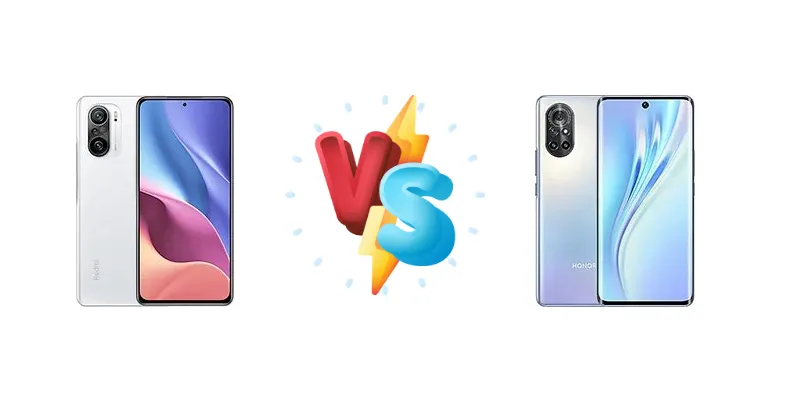
|
🏆 Quick Verdict
For users prioritizing sustained performance and gaming, the Xiaomi Redmi K40 is the clear winner thanks to its Snapdragon 870 chipset. However, the Honor V40 Lite’s significantly faster 66W charging – reaching 60% in just 15 minutes – makes it the superior choice for those who value convenience and minimal downtime.
| PHONES | ||
|---|---|---|
| Phone Names | Xiaomi Redmi K40 | Honor V40 Lite |
| Network | ||
|---|---|---|
| 2G bands | GSM 850 / 900 / 1800 / 1900 | GSM 850 / 900 / 1800 / 1900 |
| 3G bands | HSDPA 850 / 900 / 1700(AWS) / 1900 / 2100 | HSDPA 800 / 850 / 900 / 1700(AWS) / 1900 / 2100 |
| 4G bands | 1, 2, 3, 4, 5, 7, 8, 18, 19, 26, 28, 34, 38, 39, 40, 41, 42 | 1, 2, 3, 4, 5, 8, 18, 19, 26, 34, 38, 39, 40, 41 |
| 5G bands | 1, 3, 28, 41, 77, 78 SA/NSA/Sub6 | 1, 28, 41, 77, 78 SA/NSA |
| Speed | HSPA, LTE, 5G | HSPA, LTE, 5G |
| Technology | GSM / CDMA / HSPA / CDMA2000 / LTE / 5G | GSM / CDMA / HSPA / LTE / 5G |
| CDMA2000 1x | CDMA 800 | |
| Launch | ||
|---|---|---|
| Announced | 2021, February 25 | 2021, March 23 |
| Status | Available. Released 2021, March 04 | Available. Released 2021, March 28 |
| Body | ||
|---|---|---|
| Dimensions | 163.7 x 76.4 x 7.8 mm (6.44 x 3.01 x 0.31 in) | 160.1 x 74.1 x 7.6 mm (6.30 x 2.92 x 0.30 in) |
| SIM | Nano-SIM + Nano-SIM | Nano-SIM + Nano-SIM |
| Weight | 196 g (6.91 oz) | 169 g (5.96 oz) |
| Display | ||
|---|---|---|
| Protection | Corning Gorilla Glass 5 | - |
| Resolution | 1080 x 2400 pixels, 20:9 ratio (~395 ppi density) | 1080 x 2340 pixels, 19.5:9 ratio (~392 ppi density) |
| Size | 6.67 inches, 107.4 cm2 (~85.9% screen-to-body ratio) | 6.57 inches, 106.0 cm2 (~89.3% screen-to-body ratio) |
| Type | Super AMOLED, 120Hz, HDR10+, 1300 nits (peak) | OLED, 1B colors, HDR10, 90Hz |
| Platform | ||
|---|---|---|
| CPU | Octa-core (1x3.2 GHz Kryo 585 & 3x2.42 GHz Kryo 585 & 4x1.80 GHz Kryo 585) | Octa-core (2x2.4 GHz Cortex-A76 & 6x2.0 GHz Cortex-A55) |
| Chipset | Qualcomm SM8250-AC Snapdragon 870 5G (7 nm) | Mediatek Dimensity 800U (7 nm) |
| GPU | Adreno 650 | Mali-G57 MC3 |
| OS | Android 11, MIUI 12 | Android 10, Magic UI 4.0, no Google Play Services |
| Memory | ||
|---|---|---|
| Card slot | No | No |
| Internal | 128GB 6GB RAM, 128GB 8GB RAM, 256GB 8GB RAM, 256GB 12GB RAM | 128GB 8GB RAM, 256GB 8GB RAM |
| UFS 3.1 | UFS | |
| Main Camera | ||
|---|---|---|
| Features | Color spectrum sensor, LED flash, HDR, panorama | LED flash, panorama, HDR |
| Quad | - | 64 MP, f/1.9, 26mm (wide), PDAF 8 MP, f/2.4, 120˚, 17mm (ultrawide) 2 MP (macro) Auxiliary lens |
| Single | 20 MP, f/2.5, (wide), 1/3.4", 0.8µm | 32 MP, f/2.0, 26mm (wide) |
| Triple | 48 MP, f/1.8, 26mm (wide), 1/2.0", 0.8µm, PDAF 8 MP, f/2.2, 119˚ (ultrawide) 5 MP, f/2.4, 50mm (macro) | - |
| Video | 4K@30fps, 1080p@30/60/120/240/960fps, gyro-EIS | 4K, 1080p, 720p@960fps, gyro-EIS |
| Selfie camera | ||
|---|---|---|
| Features | HDR | HDR |
| Single | 20 MP, f/2.5, (wide), 1/3.4", 0.8µm | 32 MP, f/2.0, 26mm (wide) |
| Video | 1080p@30fps, 720p@120fps | 4K |
| Sound | ||
|---|---|---|
| 3.5mm jack | No | No |
| 35mm jack | No | No |
| Loudspeaker | Yes, with stereo speakers | Yes |
| 24-bit/192kHz audio | - | |
| Comms | ||
|---|---|---|
| Bluetooth | 5.1, A2DP, LE | 5.1, A2DP, LE |
| Infrared port | Yes | - |
| NFC | Yes | Yes |
| Positioning | GPS (L1+L5), GLONASS (G1), BDS (B1I+B2a), GALILEO (E1+E5a), QZSS (L1+L5), NavIC | GPS, GLONASS, BDS, GALILEO |
| Radio | No | No |
| USB | USB Type-C 2.0, OTG | USB Type-C 2.0, OTG |
| WLAN | Wi-Fi 802.11 a/b/g/n/ac/6, dual-band, Wi-Fi Direct | Wi-Fi 802.11 a/b/g/n/ac, dual-band, Wi-Fi Direct |
| Features | ||
|---|---|---|
| Sensors | Fingerprint (side-mounted), accelerometer, gyro, proximity, compass | Fingerprint (under display, optical), accelerometer, gyro, proximity, compass |
| Battery | ||
|---|---|---|
| Charging | 33W wired, PD3.0, QC3, 100% in 52 min | 66W wired, 60% in 15 min, 100% in 35 min 5W reverse wired |
| Type | Li-Po 4520 mAh | Li-Po 3800 mAh |
| Misc | ||
|---|---|---|
| Colors | Black, White, Aurora | Black, Blue, Green |
| Models | M2012K11AC | ALA-AN70 |
| Price | About 280 EUR | About 390 EUR |
Xiaomi Redmi K40
- Superior processing power with Snapdragon 870
- Likely better gaming performance
- Potentially more advanced camera system
- Slower charging speed (33W)
- No reverse wireless charging
Honor V40 Lite
- Incredibly fast 66W charging
- 5W reverse wired charging
- More convenient for quick top-ups
- Less powerful Dimensity 800U chipset
- Potentially lower gaming performance
Display Comparison
Neither device's display specifications are provided, so a direct comparison is limited. However, given the K40's positioning, it likely features a higher refresh rate panel (120Hz is common) for smoother scrolling and gaming. The V40 Lite, being a more budget-focused device, may opt for a standard 60Hz panel. Color accuracy and peak brightness will likely be superior on the K40, reflecting its higher tier.
Camera Comparison
Without specific camera sensor details, a definitive comparison is difficult. However, given the K40’s positioning, it likely features a more sophisticated camera system with a larger main sensor and potentially optical image stabilization (OIS). The V40 Lite likely relies on software processing to compensate for a potentially smaller sensor. Image processing styles will also differ; Xiaomi typically leans towards vibrant, saturated colors, while Honor often aims for a more natural look. The absence of details necessitates caution, but the K40 is expected to deliver superior image quality, particularly in low-light conditions.
Performance
The core difference lies in the chipsets. The Xiaomi Redmi K40’s Qualcomm Snapdragon 870 5G (7nm) boasts a more powerful CPU configuration – an octa-core setup with a prime core clocked at 3.2 GHz – compared to the Honor V40 Lite’s MediaTek Dimensity 800U (7nm). The Snapdragon 870’s Kryo 585 cores offer a significant performance advantage in both single-core and multi-core tasks. While the Dimensity 800U is capable, its Cortex-A76 cores, peaking at 2.4 GHz, are less efficient and powerful. This translates to smoother multitasking, faster app loading times, and better sustained performance during gaming on the K40. The K40 also benefits from Qualcomm's superior GPU, offering a more robust gaming experience.
Battery Life
The Honor V40 Lite’s 66W wired charging is its standout feature, capable of reaching 60% charge in just 15 minutes and 100% in 35 minutes. This is significantly faster than the Redmi K40’s 33W charging, which takes 52 minutes for a full charge. While battery capacity isn’t specified for either device, the faster charging of the V40 Lite effectively mitigates any potential capacity disadvantage. The V40 Lite also includes 5W reverse wired charging, a feature absent on the K40, allowing it to charge other devices.
Buying Guide
Buy the Xiaomi Redmi K40 if you need a phone capable of handling demanding games and applications with consistent performance, and if you don't mind slightly slower charging speeds. Buy the Honor V40 Lite if you prioritize incredibly fast charging, frequently find yourself needing to top up quickly, and primarily use your phone for everyday tasks and moderate gaming.