
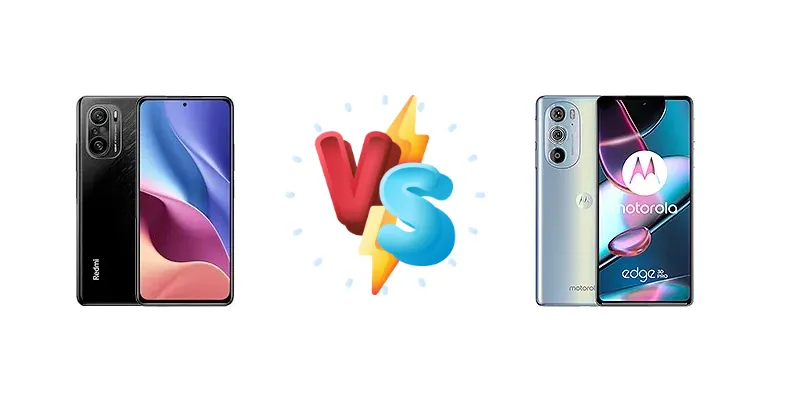
Xiaomi Redmi K40 Pro+ vs Motorola Edge 30 Pro: A Detailed Comparison
| Phones Images | |||||
|---|---|---|---|---|---|
|
🏆 Quick Verdict
For the average user prioritizing fast charging and a slightly more modern chipset, the Motorola Edge 30 Pro is the better choice. However, the Redmi K40 Pro+ remains a strong contender, especially for those seeking excellent performance at a potentially lower price point, and who aren't as reliant on the absolute fastest charging speeds.
| PHONES | ||
|---|---|---|
| Phone Names | Xiaomi Redmi K40 Pro+ | Motorola Edge 30 Pro |
| Network | ||
|---|---|---|
| 2G bands | GSM 850 / 900 / 1800 / 1900 | GSM 850 / 900 / 1800 / 1900 |
| 3G bands | HSDPA 850 / 900 / 1700(AWS) / 1900 / 2100 | HSDPA 850 / 900 / 1700(AWS) / 1900 / 2100 |
| 4G bands | 1, 2, 3, 4, 5, 7, 8, 12, 17, 18, 19, 20, 26, 28, 34, 38, 39, 40, 41, 42 | 1, 2, 3, 4, 5, 7, 8, 12, 13, 17, 18, 19, 20, 25, 26, 28, 32, 38, 39, 40, 41, 42, 43, 48, 66 - International |
| 5G bands | 1, 3, 28, 41, 77, 78 SA/NSA/Sub6 | 1, 3, 5, 7, 8, 20, 28, 38, 40, 41, 66, 77, 78 SA/NSA/Sub6 - International |
| Speed | HSPA, LTE, 5G | HSPA 42.2/5.76 Mbps, LTE Cat20 2000/150 Mbps, 5G |
| Technology | GSM / CDMA / HSPA / CDMA2000 / LTE / 5G | GSM / HSPA / LTE / 5G |
| - | 2, 5, 7, 12, 25, 26, 29, 30, 41, 48, 66, 71, 77, 78, 260, 261 SA/NSA/Sub6/mmWave - USA | |
| Launch | ||
|---|---|---|
| Announced | 2021, February 25 | 2022, January 24 |
| Status | Available. Released 2021, March 04 | Available. Released 2022, March 04 |
| Body | ||
|---|---|---|
| Build | - | Glass front (Gorilla Glass 3), glass back (Gorilla Glass 5), plastic frame |
| Dimensions | 163.7 x 76.4 x 7.8 mm (6.44 x 3.01 x 0.31 in) | 163.1 x 76 x 8.8 mm (6.42 x 2.99 x 0.35 in) |
| SIM | Nano-SIM + Nano-SIM | · Nano-SIM· Nano-SIM + Nano-SIM |
| Weight | 196 g (6.91 oz) | 196 g (6.91 oz) |
| - | Water-repellent design | |
| Display | ||
|---|---|---|
| Protection | Corning Gorilla Glass 5 | Corning Gorilla Glass 3 |
| Resolution | 1080 x 2400 pixels, 20:9 ratio (~395 ppi density) | 1080 x 2400 pixels, 20:9 ratio (~393 ppi density) |
| Size | 6.67 inches, 107.4 cm2 (~85.9% screen-to-body ratio) | 6.7 inches, 108.4 cm2 (~87.4% screen-to-body ratio) |
| Type | Super AMOLED, 120Hz, HDR10+, 1300 nits (peak) | OLED, 1B colors, 144Hz, HDR10+ |
| - | Always-on display | |
| Platform | ||
|---|---|---|
| CPU | Octa-core (1x2.84 GHz Cortex-X1 & 3x2.42 GHz Cortex-A78 & 4x1.80 GHz Cortex-A55) | Octa-core (1x3.00 GHz Cortex-X2 & 3x2.50 GHz Cortex-A710 & 4x1.80 GHz Cortex-A510) |
| Chipset | Qualcomm SM8350 Snapdragon 888 5G (5 nm) | Qualcomm SM8450 Snapdragon 8 Gen 1 (4 nm) |
| GPU | Adreno 660 | Adreno 730 |
| OS | Android 11, MIUI 12 | Android 12, upgradable to Android 14 |
| Memory | ||
|---|---|---|
| Card slot | No | No |
| Internal | 256GB 12GB RAM | 128GB 8GB RAM, 256GB 8GB RAM, 256GB 12GB RAM, 512GB 8GB RAM, 512GB 12GB RAM |
| - | UFS 3.1 | |
| Main Camera | ||
|---|---|---|
| Features | Color spectrum sensor, LED flash, HDR, panorama | Dual-LED dual-tone flash, HDR, panorama |
| Triple | 108 MP, f/1.8, 26mm (wide), 1/1.52", 0.7µm, PDAF 8 MP, f/2.2, 119˚ (ultrawide) 5 MP, f/2.4, 50mm (macro) | 50 MP, f/1.8, (wide), 1/1.55", 1.0µm, multi-directional PDAF, OIS 50 MP, f/2.2, 114˚ (ultrawide), 1/2.76", 0.64µm, AF Auxiliary lens |
| Video | 8K@30fps, 4K@30/60fps, 1080p@30/60/120/240/960fps, gyro-EIS, HDR10+ | 8K@24/30fps, 4K@30/60fps, 1080p@30/60/120/240/960fps, 10-bit HDR10+, gyro-EIS |
| Selfie camera | ||
|---|---|---|
| Features | HDR | HDR |
| Single | 20 MP, f/2.5, (wide), 1/3.4", 0.8µm | 60 MP, f/2.2, (wide), 1/2.8", 0.61µm |
| Video | 1080p@30fps, 720p@120fps | 4K@30fps, 1080p@30/120fps |
| Sound | ||
|---|---|---|
| 3.5mm jack | - | No |
| 35mm jack | No | No |
| Loudspeaker | Yes, with stereo speakers | Yes, with stereo speakers |
| - | 24-bit/192kHz audio | |
| Comms | ||
|---|---|---|
| Bluetooth | 5.2, A2DP, LE | 5.2, A2DP, LE, aptX HD, aptX Adaptive |
| Infrared port | Yes | - |
| NFC | Yes | Yes |
| Positioning | GPS (L1+L5), GLONASS (G1), BDS (B1I+B1c+B2a), GALILEO (E1+E5a), QZSS (L1+L5), NavIC (L5) | GPS (L1+L5), GLONASS, BDS, GALILEO |
| Radio | No | No |
| USB | USB Type-C 2.0, OTG | USB Type-C 3.1, DisplayPort 1.4 |
| WLAN | Wi-Fi 802.11 a/b/g/n/ac/6e, dual-band, Wi-Fi Direct | Wi-Fi 802.11 a/b/g/n/ac/6e, dual-band, Wi-Fi Direct |
| Features | ||
|---|---|---|
| Sensors | Fingerprint (side-mounted), accelerometer, gyro, proximity, compass, barometer | Fingerprint (side-mounted), accelerometer, gyro, proximity, compass, barometer |
| - | Ready For support | |
| Battery | ||
|---|---|---|
| Charging | 33W wired, PD3.0, QC3, 100% in 52 min | 68W wired, 50% in 15 min, 100% in 35 min 15W wireless 5W reverse wireless |
| Type | Li-Po 4520 mAh | Li-Po 4800 mAh |
| Misc | ||
|---|---|---|
| Colors | Black, White, Aurora | Cosmos Blue, Stardust White |
| Models | - | XT2201-1 |
| Price | About 470 EUR | € 475.45 |
| Tests | ||
|---|---|---|
| Battery life | - | Endurance rating 80h |
| Camera | - | Photo / Video |
| Display | - | Contrast ratio: Infinite (nominal) |
| Loudspeaker | - | -24.2 LUFS (Very good) |
| Performance | - | AnTuTu: 941895 (v9) GeekBench: 3658 (v5.1) GFXBench: 78fps (ES 3.1 onscreen) |
Xiaomi Redmi K40 Pro+
- Potentially lower price point
- Excellent Snapdragon 888 performance
- Solid battery endurance
- Slower 33W charging
- No wireless charging
- Older chipset architecture
Motorola Edge 30 Pro
- Faster 68W wired charging
- 15W wireless and 5W reverse wireless charging
- More powerful Snapdragon 8 Gen 1
- Potentially higher price
- Snapdragon 8 Gen 1 can run hotter under sustained load
- Similar battery endurance to K40 Pro+
Display Comparison
The Motorola Edge 30 Pro boasts a measured peak brightness of 685 nits, suggesting a more visible display in direct sunlight compared to the Redmi K40 Pro+, for which brightness data is unavailable. Both displays feature an 'infinite' contrast ratio, typical of OLED panels. While the K40 Pro+’s display specs are less detailed, it’s likely to offer a comparable viewing experience in most conditions. The absence of LTPO technology in either device suggests neither offers dynamically adaptive refresh rates for optimal power efficiency.
Camera Comparison
Both devices are listed as having 'Photo / Video' capabilities, lacking specific details. However, the camera experience will likely differ significantly based on image processing algorithms and sensor choices. Without sensor size or aperture information, it’s difficult to make a definitive judgment. The Edge 30 Pro’s newer ISP within the Snapdragon 8 Gen 1 could offer improved image processing capabilities, particularly in low-light conditions. The absence of detail regarding OIS on either device suggests stabilization may rely heavily on software solutions.
Performance
The Motorola Edge 30 Pro’s Snapdragon 8 Gen 1 (4nm) represents a significant architectural leap over the Redmi K40 Pro+’s Snapdragon 888 (5nm). The Gen 1 utilizes the newer Cortex-X2 core clocked at 3.00 GHz, alongside Cortex-A710 cores, promising a 15-20% performance uplift in CPU-intensive tasks compared to the K40 Pro+'s Cortex-X1 and A78 configuration. However, the 4nm process of the Gen 1 also contributes to improved thermal efficiency, potentially mitigating throttling during sustained workloads. The K40 Pro+’s Snapdragon 888 remains a very capable chip, but the Edge 30 Pro holds a clear advantage in raw processing power.
Battery Life
Both phones achieve an endurance rating of 80 hours, suggesting similar real-world battery life despite differing charging capabilities. The Motorola Edge 30 Pro’s 68W wired charging is significantly faster than the Redmi K40 Pro+’s 33W, achieving 50% charge in just 15 minutes and 100% in 35 minutes. The Edge 30 Pro also adds 15W wireless charging and 5W reverse wireless charging, features absent on the K40 Pro+. While the K40 Pro+ takes 52 minutes to reach 100%, the Edge 30 Pro’s faster charging is a clear convenience advantage for users who frequently need to top up their battery.
Buying Guide
Buy the Xiaomi Redmi K40 Pro+ if you need a powerful phone for demanding tasks like gaming and video editing, and are comfortable with a slightly slower charging speed. It's ideal for users who prioritize raw performance and value. Buy the Motorola Edge 30 Pro if you prefer a more balanced experience with significantly faster charging, wireless charging capabilities, and the benefits of the newer Snapdragon 8 Gen 1 platform, even if it comes at a premium.