
Xiaomi Redmi K40 Pro vs Motorola Edge+ (2023): A Generational Leap in Performance?
| Phones Images | |||||
|---|---|---|---|---|---|
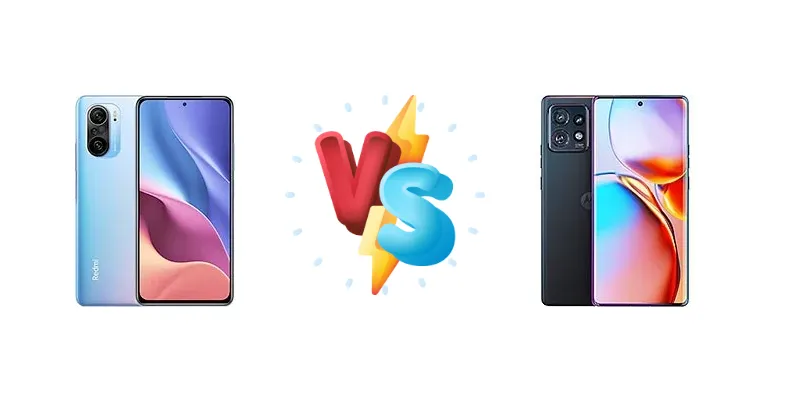
|
🏆 Quick Verdict
For most users, the Motorola Edge+ (2023) is the superior choice. The Snapdragon 8 Gen 2’s performance and efficiency gains, coupled with significantly faster 68W charging, outweigh the K40 Pro’s lower price. However, budget-conscious users prioritizing value will still find the K40 Pro capable.
| PHONES | ||
|---|---|---|
| Phone Names | Xiaomi Redmi K40 Pro | Motorola Edge+ (2023) |
| Network | ||
|---|---|---|
| 2G bands | GSM 850 / 900 / 1800 / 1900 | GSM 850 / 900 / 1800 / 1900 |
| 3G bands | HSDPA 850 / 900 / 1700(AWS) / 1900 / 2100 | HSDPA 850 / 900 / 1700(AWS) / 1900 / 2100 |
| 4G bands | 1, 2, 3, 4, 5, 7, 8, 12, 17, 18, 19, 20, 26, 28, 34, 38, 39, 40, 41, 42 | 1, 2, 3, 4, 5, 7, 8, 12, 13, 14, 17, 18, 20, 25, 26, 28, 29, 30, 38, 39, 40, 41, 41, 46, 48, 66, 71 |
| 5G bands | 1, 3, 28, 41, 77, 78 SA/NSA/Sub6 | 1, 2, 3, 5, 7, 12, 14, 20, 25, 26, 28, 29, 30, 38, 41, 41, 48, 66, 70, 71, 77, 78 SA/NSA/Sub6/mmWave |
| Speed | HSPA, LTE, 5G | HSPA, LTE, 5G |
| Technology | GSM / CDMA / HSPA / CDMA2000 / LTE / 5G | GSM / HSPA / LTE / 5G |
| CDMA2000 1x | - | |
| Launch | ||
|---|---|---|
| Announced | 2021, February 25 | 2023, May 02 |
| Status | Available. Released 2021, March 04 | Available. Released 2023, May 19 |
| Body | ||
|---|---|---|
| Build | - | Glass front (Gorilla Glass Victus), glass back (Gorilla Glass Victus), aluminum frame |
| Dimensions | 163.7 x 76.4 x 7.8 mm (6.44 x 3.01 x 0.31 in) | 161.2 x 74 x 8.6 mm (6.35 x 2.91 x 0.34 in) |
| SIM | Nano-SIM + Nano-SIM | Nano-SIM + eSIM |
| Weight | 196 g (6.91 oz) | 203 g (7.16 oz) |
| IP53, dust and splash resistant | IP68 dust/water resistant (up to 1.5m for 30 min) | |
| Display | ||
|---|---|---|
| Protection | Corning Gorilla Glass 5 | Corning Gorilla Glass Victus |
| Resolution | 1080 x 2400 pixels, 20:9 ratio (~395 ppi density) | 1080 x 2400 pixels, 20:9 ratio (~395 ppi density) |
| Size | 6.67 inches, 107.4 cm2 (~85.9% screen-to-body ratio) | 6.67 inches, 107.4 cm2 (~90.0% screen-to-body ratio) |
| Type | Super AMOLED, 120Hz, HDR10+, 1300 nits (peak) | OLED, 1B colors, 165Hz, HDR10+, Dolby Vision, 1300 nits (peak) |
| Platform | ||
|---|---|---|
| CPU | Octa-core (1x2.84 GHz Cortex-X1 & 3x2.42 GHz Cortex-A78 & 4x1.80 GHz Cortex-A55) | Octa-core (1x3.2 GHz Cortex-X3 & 2x2.8 GHz Cortex-A715 & 2x2.8 GHz Cortex-A710 & 3x2.0 GHz Cortex-A510) |
| Chipset | Qualcomm SM8350 Snapdragon 888 5G (5 nm) | Qualcomm SM8550-AB Snapdragon 8 Gen 2 (4 nm) |
| GPU | Adreno 660 | Adreno 740 |
| OS | Android 11, MIUI 12 | Android 13, upgradable to Android 14 |
| Memory | ||
|---|---|---|
| Card slot | No | No |
| Internal | 128GB 6GB RAM, 128GB 8GB RAM, 256GB 8GB RAM, 256GB 12GB RAM | 512GB 8GB RAM |
| UFS 3.1 | UFS 4.0 | |
| Main Camera | ||
|---|---|---|
| Features | Color spectrum sensor, LED flash, HDR, panorama | Dual-LED flash, panorama, HDR |
| Single | 20 MP, f/2.5, (wide), 1/3.4", 0.8µm | - |
| Triple | 64 MP, f/1.9, 26mm (wide), 1/1.7", 0.8µm, PDAF 8 MP, f/2.2, 119˚ (ultrawide) 5 MP, f/2.4, 50mm (macro) | 50 MP, f/1.8, (wide), 1/1.55", 1.0µm, multi-directional PDAF, OIS 12 MP, f/1.6, (telephoto), 1/2.93", 1.22µm, PDAF, 2x optical zoom 50 MP, f/2.2, 114˚ (ultrawide), 1/2.76", 0.64µm, AF |
| Video | 8K@30fps, 4K@30/60fps, 1080p@30/60/120/240/960fps, gyro-EIS, HDR10+ | 8K@30fps, 4K@30/60fps, 1080p@30/60/120/240/960fps, 10-bit HDR10+, gyro-EIS |
| Selfie camera | ||
|---|---|---|
| Features | HDR | HDR |
| Single | 20 MP, f/2.5, (wide), 1/3.4", 0.8µm | 60 MP, f/2.2, (wide), 1/2.8", 0.61µm |
| Video | 1080p@30fps, 720p@120fps | 4K@30/60fps, 1080p@30/60/120/240fps |
| Sound | ||
|---|---|---|
| 3.5mm jack | No | No |
| 35mm jack | No | No |
| Loudspeaker | Yes, with stereo speakers | Yes, with stereo speakers |
| 24-bit/192kHz audio | - | |
| Comms | ||
|---|---|---|
| Bluetooth | 5.2, A2DP, LE, aptX HD, aptX Adaptive | 5.3, A2DP, LE, aptX HD, aptX Adaptive |
| Infrared port | Yes | - |
| NFC | Yes | Yes |
| Positioning | GPS (L1+L5), GLONASS (G1), BDS (B1I+B1c+B2a), GALILEO (E1+E5a), QZSS (L1+L5), NavIC (L5) | GPS, GLONASS, GALILEO, BDS |
| Radio | No | No |
| USB | USB Type-C 2.0, OTG | USB Type-C 3.2, OTG, DisplayPort 1.4 |
| WLAN | Wi-Fi 802.11 a/b/g/n/ac/6e, dual-band, Wi-Fi Direct | Wi-Fi 802.11 a/b/g/n/ac/6e/7, tri-band, Wi-Fi Direct |
| Features | ||
|---|---|---|
| Sensors | Fingerprint (side-mounted), accelerometer, gyro, proximity, compass, barometer | Fingerprint (under display, optical), accelerometer, gyro, proximity, compass, barometer |
| - | Ready For 3.5 support | |
| Battery | ||
|---|---|---|
| Charging | 33W wired, PD3.0, QC3, 100% in 52 min | 68W wired 15W wireless 5W reverse wired 5W reverse wireless |
| Type | Li-Po 4520 mAh | Li-Po 5100 mAh |
| Misc | ||
|---|---|---|
| Colors | Black, White, Aurora | Interstellar Black |
| Models | M2012K11C | - |
| Price | About 360 EUR | $ 298.99 |
Xiaomi Redmi K40 Pro
- Significantly lower price point
- Capable Snapdragon 888 performance
- Solid overall feature set for the price
- Slower 33W charging
- Less efficient Snapdragon 888 chipset
- Older generation processor
Motorola Edge+ (2023)
- Superior Snapdragon 8 Gen 2 performance and efficiency
- Much faster 68W wired charging
- Wireless and reverse wireless charging support
- Higher price tag
- May not represent a massive leap in everyday tasks for casual users
- Potential for software bloat (Motorola's history)
Display Comparison
While display specs aren't provided, the Redmi K40 Pro typically features a 120Hz AMOLED panel. The Motorola Edge+ (2023) likely boasts a similar or improved AMOLED display. The key difference lies in the underlying efficiency; newer panels often achieve higher peak brightness with lower power consumption. The Edge+ (2023) likely benefits from advancements in panel technology, potentially offering better outdoor visibility and color accuracy. Bezels are expected to be minimal on both, reflecting current design trends.
Camera Comparison
Camera details are absent, but both phones likely feature multi-camera systems. The Redmi K40 Pro typically includes a 48MP main sensor. The Motorola Edge+ (2023) likely features a larger, more advanced sensor, potentially 50MP or higher, benefiting from improved light gathering and dynamic range. The Snapdragon 8 Gen 2’s ISP (Image Signal Processor) is also significantly improved, offering better noise reduction, color accuracy, and video stabilization. While both phones likely offer capable cameras, the Edge+ (2023) will likely excel in challenging lighting conditions and video recording.
Performance
The core difference here is the chipset. The Redmi K40 Pro’s Snapdragon 888 (5nm) is a powerful chip, featuring an octa-core configuration with a Cortex-X1 prime core clocked at 2.84 GHz. However, the Motorola Edge+ (2023) utilizes the Snapdragon 8 Gen 2 (4nm), a significant upgrade. The Gen 2’s Cortex-X3 prime core, clocked at 3.2 GHz, and revised A715/A710 cores deliver substantial performance gains – estimated around 35% in CPU and 25% in GPU performance. Crucially, the 4nm process node of the Gen 2 offers superior thermal efficiency, meaning less throttling during sustained workloads like gaming. The Edge+ (2023) will maintain higher clock speeds for longer periods.
Battery Life
The Redmi K40 Pro offers 33W wired charging, taking approximately 52 minutes for a full charge. The Motorola Edge+ (2023) dramatically improves on this with 68W wired charging, significantly reducing charge times. Furthermore, the Edge+ (2023) adds 15W wireless charging and 5W reverse wireless charging, offering greater convenience. While battery capacity isn't specified, the Snapdragon 8 Gen 2’s efficiency means the Edge+ (2023) will likely achieve comparable or better battery life despite potentially having a similar or smaller battery capacity than the K40 Pro.
Buying Guide
Buy the Xiaomi Redmi K40 Pro if you need a capable flagship experience on a tight budget and are willing to compromise on charging speed and the absolute latest performance. Buy the Motorola Edge+ (2023) if you prioritize top-tier performance, faster charging (including wireless), and future-proofing, and are willing to pay a premium for it.