
Xiaomi Redmi K40 Gaming vs OnePlus Nord 2 5G: A Deep Dive into Dimensity 1200 Performance
| Phones Images | |||||
|---|---|---|---|---|---|
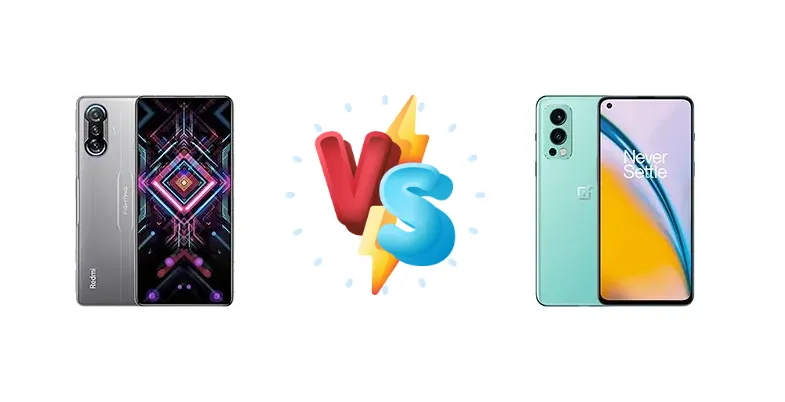
|
🏆 Quick Verdict
For the average user prioritizing rapid charging and a slightly more refined software experience, the OnePlus Nord 2 5G emerges as the winner. Its 65W charging completes a full charge in 30 minutes, a noticeable advantage over the K40 Gaming’s 42-minute timeframe. However, gamers and power users may find the K40 Gaming’s aggressive cooling and potentially lower price more appealing.
| PHONES | ||
|---|---|---|
| Phone Names | Xiaomi Redmi K40 Gaming | OnePlus Nord 2 5G |
| Network | ||
|---|---|---|
| 2G bands | GSM 850 / 900 / 1800 / 1900 | GSM 850 / 900 / 1800 / 1900 |
| 3G bands | HSDPA 850 / 900 / 1700(AWS) / 1900 / 2100 | HSDPA 800 / 850 / 900 / 1700(AWS) / 1800 / 1900 / 2100 |
| 4G bands | 1, 2, 3, 4, 5, 7, 8, 18, 19, 26, 34, 38, 39, 40, 41, 42 | 1, 2, 3, 4, 5, 7, 8, 12, 17, 18, 19, 20, 26, 28, 32, 34, 38, 39, 40, 41, 66 - EU |
| 5G bands | 1, 3, 28, 41, 77, 78 SA/NSA/Sub6 | 1, 3, 7, 8, 20, 28, 38, 41, 66, 78 SA/NSA - EU |
| Speed | HSPA, LTE, 5G | HSPA 42.2/5.76 Mbps, LTE Cat18 1200/150 Mbps, 5G |
| Technology | GSM / CDMA / HSPA / CDMA2000 / LTE / 5G | GSM / HSPA / LTE / 5G |
| CDMA2000 1x | - | |
| Launch | ||
|---|---|---|
| Announced | 2021, April 27 | 2021, July 22 |
| Status | Available. Released 2021, April 30 | Available. Released 2021, July 28 |
| Body | ||
|---|---|---|
| Build | Glass front (Gorilla Glass 5), glass back (Gorilla Glass 5) | Glass front (Gorilla Glass 5), glass back (Gorilla Glass 5), plastic frame |
| Dimensions | 161.9 x 76.9 x 8.3 mm (6.37 x 3.03 x 0.33 in) | 159.1 x 73.3 x 8.3 mm (6.26 x 2.89 x 0.33 in) |
| SIM | Nano-SIM + Nano-SIM | Nano-SIM + Nano-SIM |
| Weight | 205 g (7.23 oz) | 189 g (6.67 oz) |
| Physical pop-up gaming triggers IP53, dust and splash resistant | - | |
| Display | ||
|---|---|---|
| Protection | Corning Gorilla Glass 5 | Corning Gorilla Glass 5 |
| Resolution | 1080 x 2400 pixels, 20:9 ratio (~395 ppi density) | 1080 x 2400 pixels, 20:9 ratio (~409 ppi density) |
| Size | 6.67 inches, 107.4 cm2 (~86.3% screen-to-body ratio) | 6.43 inches, 99.8 cm2 (~85.6% screen-to-body ratio) |
| Type | OLED, 1B colors, 120Hz, HDR10+, 500 nits (typ) | Fluid AMOLED, 90Hz, HDR10+ |
| Platform | ||
|---|---|---|
| CPU | Octa-core (1x3.0 GHz Cortex-A78 & 3x2.6 GHz Cortex-A78 & 4x2.0 GHz Cortex-A55) | Octa-core (1x3.0 GHz Cortex-A78 & 3x2.6 GHz Cortex-A78 & 4x2.0 GHz Cortex-A55) |
| Chipset | Mediatek Dimensity 1200 (6 nm) | Mediatek Dimensity 1200 (6 nm) |
| GPU | Mali-G77 MC9 | Mali-G77 MC9 |
| OS | Android 11, MIUI 12.5 | Android 11, upgradable to Android 13, OxygenOS 13 |
| Memory | ||
|---|---|---|
| Card slot | No | No |
| Internal | 128GB 6GB RAM, 128GB 8GB RAM, 128GB 12GB RAM, 256GB 8GB RAM, 256GB 12GB RAM | 128GB 6GB RAM, 128GB 8GB RAM, 256GB 8GB RAM, 256GB 12GB RAM |
| UFS 3.1 | - | |
| Main Camera | ||
|---|---|---|
| Features | Color spectrum sensor, Dual-LED flash, HDR, panorama | Dual-LED flash, HDR, panorama |
| Single | 16 MP, f/2.5, (wide), 1/3.06" 1.0µm | - |
| Triple | 64 MP, f/1.7, 26mm (wide), 1/2.0", 0.7µm, PDAF 8 MP, f/2.2, 120˚ (ultrawide) 2 MP (macro) | 50 MP, f/1.9, 24mm (wide), 1/1.56", 1.0µm, PDAF, OIS 8 MP, f/2.3, 120˚ (ultrawide) Auxiliary lens |
| Video | 4K@30fps, 1080p@30/60/120fps, 720p@960fps, HDR | 4K@30fps, 1080p@30/60/120fps, gyro-EIS |
| Selfie camera | ||
|---|---|---|
| Features | HDR | Auto HDR |
| Single | 16 MP, f/2.5, (wide), 1/3.06" 1.0µm | 32 MP, f/2.5, (wide), 1/2.8", 0.8µm |
| Video | 1080p@30fps, 720p@120fps, HDR | 1080p@30fps, gyro-EIS |
| Sound | ||
|---|---|---|
| 3.5mm jack | No | No |
| 35mm jack | No | No |
| Loudspeaker | Yes, with stereo speakers | Yes, with stereo speakers |
| 24-bit/192kHz audio Tuned by JBL | - | |
| Comms | ||
|---|---|---|
| Bluetooth | 5.2, A2DP, LE | 5.2, A2DP, LE, aptX HD |
| Infrared port | Yes | - |
| NFC | Yes | Yes |
| Positioning | GPS (L1+L5), GLONASS (G1), BDS (B1I+B2a), GALILEO (E1+E5a), QZSS (L1+L5), NavIC | GPS, GLONASS, GALILEO, BDS, SBAS, NavIC |
| Radio | No | No |
| USB | USB Type-C 2.0, OTG | USB Type-C 2.0, OTG |
| WLAN | Wi-Fi 802.11 a/b/g/n/ac/6, dual-band, Wi-Fi Direct | Wi-Fi 802.11 a/b/g/n/ac/6, dual-band, Wi-Fi Direct |
| Features | ||
|---|---|---|
| Sensors | Fingerprint (side-mounted), accelerometer, gyro, compass, barometer | Fingerprint (under display, optical), accelerometer, gyro, proximity, compass |
| Battery | ||
|---|---|---|
| Charging | 67W wired, PD3.0, QC3, 100% in 42 min | 65W wired, PD, 100% in 30 min |
| Type | Li-Po 5065 mAh | Li-Po 4500 mAh |
| Misc | ||
|---|---|---|
| Colors | Black, Gray, Silver, Bruce Lee Yellow | Gray Sierra, Blue Haze, Green Wood, Pac-Man Edition |
| Models | M2012K10C, M2104K10AC | DN2101, DN2103 |
| Price | About 260 EUR | € 189.00 / $ 219.99 / £ 148.00 |
| Tests | ||
|---|---|---|
| Battery life | - | Endurance rating 102h |
| Camera | - | Photo / Video |
| Display | - | Contrast ratio: Infinite (nominal) |
| Loudspeaker | - | -24.3 LUFS (Very good) |
| Performance | - | AnTuTu: 512164 (v8) | 598022 (v9) GeekBench: 2792 (v5.1) GFXBench: 38fps (ES 3.1 onscreen) |
Xiaomi Redmi K40 Gaming
- Potentially better sustained gaming performance due to enhanced cooling.
- Likely more affordable price point.
- 67W fast charging is still very quick.
- Slower charging time (42 minutes) compared to the Nord 2 5G.
- Less emphasis on camera quality based on market positioning.
- Software experience may be less refined than OnePlus’ OxygenOS.
OnePlus Nord 2 5G
- Faster 65W charging (30 minutes) for increased convenience.
- Clean and optimized OxygenOS software experience.
- Excellent battery endurance (102 hours).
- May throttle more quickly under sustained heavy load due to less aggressive cooling.
- Potentially higher price compared to the Redmi K40 Gaming.
- Camera performance details are unknown.
Display Comparison
Both devices share a similar display profile, though specific details beyond the OnePlus Nord 2 5G’s measured 633 nits peak brightness are limited. The Nord 2 5G’s ‘Infinite’ contrast ratio suggests a typical OLED panel, offering deep blacks. Without knowing the Redmi K40 Gaming’s peak brightness or panel type, it’s difficult to definitively declare a winner. However, the Nord 2 5G’s measured brightness provides a concrete advantage for outdoor visibility.
Camera Comparison
Both devices feature photo and video capabilities, but lack detailed camera specifications in the provided data. Without knowing sensor sizes, aperture values, or image processing algorithms, a direct comparison is impossible. However, the market positioning suggests the Nord 2 5G may prioritize image quality and color accuracy, while the K40 Gaming might lean towards a more vibrant, gaming-focused aesthetic. The absence of information on OIS (Optical Image Stabilization) is a significant omission, impacting low-light performance and video stability.
Performance
The core performance is identical: both phones utilize the Mediatek Dimensity 1200 (6nm) chipset with the same CPU configuration – a 1x3.0 GHz Cortex-A78, 3x2.6 GHz Cortex-A78, and 4x2.0 GHz Cortex-A55 cores. This means comparable CPU performance in everyday tasks and gaming. The key differentiator will likely be thermal management. The Redmi K40 Gaming, marketed as a ‘Gaming’ phone, likely incorporates more aggressive cooling solutions, potentially allowing it to sustain peak performance for longer periods under heavy load. The Nord 2 5G, while capable, doesn’t emphasize gaming-specific cooling.
Battery Life
Both phones boast an impressive endurance rating of 102 hours, indicating similar battery life under typical usage. However, the charging speeds differ significantly. The OnePlus Nord 2 5G’s 65W wired charging, supporting PD, completes a full charge in 30 minutes. The Redmi K40 Gaming’s 67W wired charging, supporting PD3.0 and QC3, takes 42 minutes. This 12-minute difference is substantial, offering a clear convenience advantage to the Nord 2 5G, especially for users who frequently need to top up their battery.
Buying Guide
Buy the Xiaomi Redmi K40 Gaming if you need a phone specifically geared towards extended gaming sessions and appreciate potentially lower pricing. Its focus on performance and cooling makes it ideal for demanding mobile titles. Buy the OnePlus Nord 2 5G if you prefer a balanced experience with a focus on fast charging, a clean software experience, and reliable all-day battery life. It’s the better choice for everyday users who value convenience and efficiency.