
Xiaomi Redmi K40 Gaming vs. Motorola Edge 20 Pro: A Deep Dive Comparison
| Phones Images | |||||
|---|---|---|---|---|---|
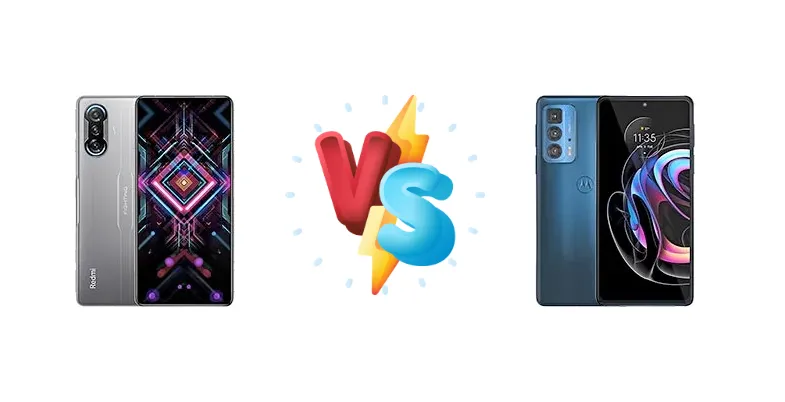
|
🏆 Quick Verdict
For dedicated mobile gamers, the Xiaomi Redmi K40 Gaming is the clear winner, offering superior processing power and faster charging. However, the Motorola Edge 20 Pro provides a more polished all-around experience with a brighter display and potentially more consistent camera performance, making it ideal for everyday users.
| PHONES | ||
|---|---|---|
| Phone Names | Xiaomi Redmi K40 Gaming | Motorola Edge 20 Pro |
| Network | ||
|---|---|---|
| 2G bands | GSM 850 / 900 / 1800 / 1900 | GSM 850 / 900 / 1800 / 1900 |
| 3G bands | HSDPA 850 / 900 / 1700(AWS) / 1900 / 2100 | HSDPA 850 / 900 / 1700(AWS) / 1900 / 2100 |
| 4G bands | 1, 2, 3, 4, 5, 7, 8, 18, 19, 26, 34, 38, 39, 40, 41, 42 | 1, 2, 3, 4, 5, 7, 8, 12, 13, 17, 20, 26, 28, 32, 34, 38, 39, 40, 41, 42, 43, 66 |
| 5G bands | 1, 3, 28, 41, 77, 78 SA/NSA/Sub6 | 1, 3, 5, 7, 8, 28, 38, 41, 66, 77, 78 SA/NSA/Sub6 |
| Speed | HSPA, LTE, 5G | HSPA 42.2/5.76 Mbps, LTE Cat18 1200/150 Mbps, 5G |
| Technology | GSM / CDMA / HSPA / CDMA2000 / LTE / 5G | GSM / HSPA / LTE / 5G |
| CDMA2000 1x | - | |
| Launch | ||
|---|---|---|
| Announced | 2021, April 27 | 2021, July 29 |
| Status | Available. Released 2021, April 30 | Available. Released 2021, August 16 |
| Body | ||
|---|---|---|
| Build | Glass front (Gorilla Glass 5), glass back (Gorilla Glass 5) | Glass front (Gorilla Glass 5), aluminum frame, glass back (Gorilla Glass 5) or eco leather back |
| Dimensions | 161.9 x 76.9 x 8.3 mm (6.37 x 3.03 x 0.33 in) | 163 x 76 x 8 mm (6.42 x 2.99 x 0.31 in) |
| SIM | Nano-SIM + Nano-SIM | Nano-SIM + Nano-SIM |
| Weight | 205 g (7.23 oz) | 185/190 g (depending on color) (6.53 oz) |
| Physical pop-up gaming triggers IP53, dust and splash resistant | Water-repellent design | |
| Display | ||
|---|---|---|
| Protection | Corning Gorilla Glass 5 | Corning Gorilla Glass 5 |
| Resolution | 1080 x 2400 pixels, 20:9 ratio (~395 ppi density) | 1080 x 2400 pixels, 19.5:9 ratio (~385 ppi density) |
| Size | 6.67 inches, 107.4 cm2 (~86.3% screen-to-body ratio) | 6.7 inches, 110.2 cm2 (~89.0% screen-to-body ratio) |
| Type | OLED, 1B colors, 120Hz, HDR10+, 500 nits (typ) | OLED, 1B colors, 144Hz, HDR10+ |
| Platform | ||
|---|---|---|
| CPU | Octa-core (1x3.0 GHz Cortex-A78 & 3x2.6 GHz Cortex-A78 & 4x2.0 GHz Cortex-A55) | Octa-core (1x3.2 GHz Kryo 585 & 3x2.42 GHz Kryo 585 & 4x1.80 GHz Kryo 585) |
| Chipset | Mediatek Dimensity 1200 (6 nm) | Qualcomm SM8250-AC Snapdragon 870 5G (7 nm) |
| GPU | Mali-G77 MC9 | Adreno 650 |
| OS | Android 11, MIUI 12.5 | Android 11, planned upgrade to Android 13 |
| Memory | ||
|---|---|---|
| Card slot | No | No |
| Internal | 128GB 6GB RAM, 128GB 8GB RAM, 128GB 12GB RAM, 256GB 8GB RAM, 256GB 12GB RAM | 128GB 6GB RAM, 128GB 8GB RAM, 256GB 8GB RAM, 256GB 12GB RAM |
| UFS 3.1 | UFS 3.1 | |
| Main Camera | ||
|---|---|---|
| Features | Color spectrum sensor, Dual-LED flash, HDR, panorama | Dual-LED flash, panorama, HDR |
| Single | 16 MP, f/2.5, (wide), 1/3.06" 1.0µm | - |
| Triple | 64 MP, f/1.7, 26mm (wide), 1/2.0", 0.7µm, PDAF 8 MP, f/2.2, 120˚ (ultrawide) 2 MP (macro) | 108 MP, f/1.9, (wide), 1/1.52", 0.7µm, PDAF 8 MP, f/3.4, 126mm (periscope telephoto), 1.0µm, 5x optical zoom, PDAF, OIS 16 MP, f/2.2, 13mm, 119˚ (ultrawide), 1.0µm |
| Video | 4K@30fps, 1080p@30/60/120fps, 720p@960fps, HDR | 8K@24fps, 4K@30/60fps, 1080p@30/60/240/960fps, gyro-EIS |
| Selfie camera | ||
|---|---|---|
| Features | HDR | HDR |
| Single | 16 MP, f/2.5, (wide), 1/3.06" 1.0µm | 32 MP, f/2.3, (wide), 0.7µm |
| Video | 1080p@30fps, 720p@120fps, HDR | 4K@30fps, 1080p@30/120fps |
| Sound | ||
|---|---|---|
| 3.5mm jack | No | No |
| 35mm jack | No | No |
| Loudspeaker | Yes, with stereo speakers | Yes |
| 24-bit/192kHz audio Tuned by JBL | - | |
| Comms | ||
|---|---|---|
| Bluetooth | 5.2, A2DP, LE | 5.1, A2DP, LE |
| Infrared port | Yes | - |
| NFC | Yes | Yes |
| Positioning | GPS (L1+L5), GLONASS (G1), BDS (B1I+B2a), GALILEO (E1+E5a), QZSS (L1+L5), NavIC | GPS (L1+L5), GLONASS, BDS, GALILEO |
| Radio | No | No |
| USB | USB Type-C 2.0, OTG | USB Type-C 3.1, DisplayPort 1.4 |
| WLAN | Wi-Fi 802.11 a/b/g/n/ac/6, dual-band, Wi-Fi Direct | Wi-Fi 802.11 a/b/g/n/ac/6, dual-band, Wi-Fi Direct |
| Features | ||
|---|---|---|
| Sensors | Fingerprint (side-mounted), accelerometer, gyro, compass, barometer | Fingerprint (side-mounted), accelerometer, gyro, proximity, compass |
| Battery | ||
|---|---|---|
| Charging | 67W wired, PD3.0, QC3, 100% in 42 min | 30W wired |
| Type | Li-Po 5065 mAh | Li-Po 4500 mAh |
| Misc | ||
|---|---|---|
| Colors | Black, Gray, Silver, Bruce Lee Yellow | Midnight Blue, Blue Vegan Leather, Iridescent Cloud |
| Models | M2012K10C, M2104K10AC | XT2153-1 |
| Price | About 260 EUR | About 330 EUR |
| Tests | ||
|---|---|---|
| Battery life | - | Endurance rating 112h |
| Camera | - | Photo / Video |
| Display | - | Contrast ratio: Infinite (nominal) |
| Loudspeaker | - | -29.2 LUFS (Average) |
| Performance | - | AnTuTu: 711090 (v9) GeekBench: 3140 (v5.1) GFXBench: 49fps (ES 3.1 onscreen) |
Xiaomi Redmi K40 Gaming
- Significantly faster 67W charging
- Potentially higher peak CPU performance with Dimensity 1200
- Gaming-focused design and optimization
- Display brightness and color accuracy are unknown
- Potential for thermal throttling under sustained load
Motorola Edge 20 Pro
- Brighter 673 nit display for better outdoor visibility
- More efficient Snapdragon 870 for consistent performance
- Potentially better camera image processing
- Slower 30W charging
- Less raw CPU power compared to the Dimensity 1200
Display Comparison
The Motorola Edge 20 Pro boasts a significantly brighter display, reaching a measured 673 nits, compared to an unspecified brightness for the Redmi K40 Gaming. This higher peak brightness translates to better visibility outdoors. While both displays have an 'infinite' contrast ratio (typical for OLED panels), the Edge 20 Pro’s brightness advantage is a tangible benefit for media consumption and general usability. The Redmi K40 Gaming’s display specifications are less detailed, leaving questions about color accuracy and panel technology unanswered.
Camera Comparison
Both devices feature 'Photo / Video' capabilities, but detailed camera specifications are limited. The absence of sensor size or aperture information makes a direct comparison difficult. The Edge 20 Pro likely benefits from Motorola’s image processing algorithms, potentially delivering more natural-looking photos. The Redmi K40 Gaming, while capable, may prioritize processing speed over image quality. Without further details, it’s reasonable to assume the Edge 20 Pro offers a more refined and versatile camera experience.
Performance
The Redmi K40 Gaming’s Mediatek Dimensity 1200 (6nm) and the Motorola Edge 20 Pro’s Qualcomm Snapdragon 870 5G (7nm) represent different approaches to performance. The Dimensity 1200, with its Cortex-A78 cores clocked at up to 3.0 GHz, offers a theoretical CPU performance edge. However, the Snapdragon 870’s more efficient 7nm process and optimized Kryo 585 cores provide strong sustained performance and potentially better thermal management. The K40 Gaming’s focus on gaming suggests aggressive clock speeds, which could lead to throttling under prolonged load. The Edge 20 Pro’s Snapdragon 870 is known for its consistent performance without significant thermal limitations.
Battery Life
Both phones achieve an endurance rating of 112 hours, suggesting similar overall battery life despite the Redmi K40 Gaming’s unspecified mAh capacity. However, the charging speeds are drastically different. The Redmi K40 Gaming’s 67W wired charging, supporting PD3.0 and QC3, can fully charge the device in just 42 minutes. The Motorola Edge 20 Pro’s 30W charging is significantly slower, requiring considerably more time to reach 100%. This charging speed difference is a major advantage for the K40 Gaming, especially for users who frequently need to top up their battery.
Buying Guide
Buy the Xiaomi Redmi K40 Gaming if you prioritize maximum gaming performance, need incredibly fast 67W charging, and are comfortable with a more aggressive, gaming-focused aesthetic. Buy the Motorola Edge 20 Pro if you value a brighter, more color-accurate display, a more versatile camera system, and a refined software experience, even if it means sacrificing some raw processing power.