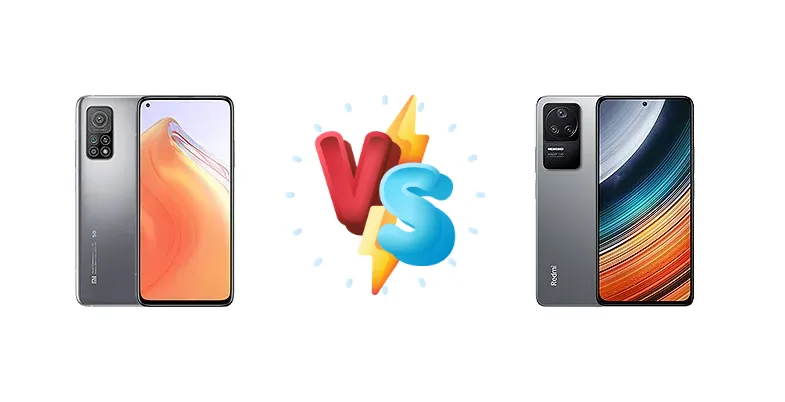
The Xiaomi Redmi series consistently delivers impressive value, and the K30S and K40S are prime examples. Both offer flagship-level performance at a competitive price, but significant upgrades separate them. This comprehensive comparison will help you decide which Redmi phone is right for you.
🏆 Quick Verdict
The Redmi K40S is the clear winner, boasting a faster Snapdragon 870 chipset, significantly quicker 67W charging, and improved camera capabilities. While the K30S remains a capable device, the K40S offers a noticeable upgrade for a reasonable price increase.
| Network |
|---|
| 2G bands | GSM 850 / 900 / 1800 / 1900 | GSM 850 / 900 / 1800 / 1900 |
| 3G bands | HSDPA 850 / 900 / 1700(AWS) / 1900 / 2100 | HSDPA 850 / 900 / 1700(AWS) / 1900 / 2100 |
| 4G bands | 1, 2, 3, 4, 5, 7, 8, 12, 17, 34, 38, 39, 40, 41 | 1, 2, 3, 4, 5, 8, 18, 19, 26, 34, 38, 39, 40, 41, 42 |
| 5G bands | 1, 3, 41, 78, 79 SA/NSA | 1, 3, 5, 8, 28, 38, 40, 41, 77, 78 SA/NSA |
| Speed | HSPA, LTE, 5G (2+ Gbps DL) | HSPA, LTE, 5G |
| Technology | GSM / CDMA / HSPA / EVDO / LTE / 5G | GSM / CDMA / HSPA / CDMA2000 / LTE / 5G |
| | CDMA2000 1xEV-DO | CDMA2000 1x |
| Launch |
|---|
| Announced | 2020, October 27. Released 2020, November 11 | 2022, March 17 |
| Status | Discontinued | Available. Released 2022, March 17 |
| Body |
|---|
| Build | Glass front (Gorilla Glass 5), glass back (Gorilla Glass 5), aluminum frame | Glass front (Gorilla Glass 5), plastic back |
| Dimensions | 165.1 x 76.4 x 9.3 mm (6.5 x 3.01 x 0.37 in) | 163.2 x 76 x 7.7 mm (6.43 x 2.99 x 0.30 in) |
| SIM | Nano-SIM + Nano-SIM | Nano-SIM + Nano-SIM |
| Weight | 216 g (7.62 oz) | 195 g (6.88 oz) |
| | - | Splash resistant |
| Display |
|---|
| Protection | Corning Gorilla Glass 5 | Corning Gorilla Glass 5 |
| Resolution | 1080 x 2400 pixels, 20:9 ratio (~395 ppi density) | 1080 x 2400 pixels, 20:9 ratio (~395 ppi density) |
| Size | 6.67 inches, 107.4 cm2 (~85.2% screen-to-body ratio) | 6.67 inches, 107.4 cm2 (~86.6% screen-to-body ratio) |
| Type | IPS LCD, 144Hz, HDR10, 500 nits (typ), 650 nits (peak) | AMOLED, 120Hz, HDR10+, 1300 nits (peak) |
| Platform |
|---|
| CPU | Octa-core (1x2.84 GHz Cortex-A77 & 3x2.42 GHz Cortex-A77 & 4x1.80 GHz Cortex-A55) | Octa-core (1x3.2 GHz Kryo 585 & 3x2.42 GHz Kryo 585 & 4x1.80 GHz Kryo 585) |
| Chipset | Qualcomm SM8250 Snapdragon 865 5G (7 nm+) | Qualcomm SM8250-AC Snapdragon 870 5G (7 nm) |
| GPU | Adreno 650 | Adreno 650 |
| OS | Android 10, MIUI 12 | Android 12, MIUI 13 |
| Memory |
|---|
| Card slot | No | No |
| Internal | 128GB 8GB RAM, 256GB 8GB RAM | 128GB 6GB RAM, 128GB 8GB RAM, 256GB 8GB RAM, 256GB 12GB RAM |
| | UFS 3.1 | UFS 3.1 |
| Main Camera |
|---|
| Features | LED flash, HDR, panorama | Color spectrum sensor, Dual-LED dual-tone flash, HDR, panorama |
| Single | - | 20 MP, (wide) |
| Triple | 64 MP, f/1.9, 26mm (wide), 1/1.73", 0.8µm, PDAF
13 MP, f/2.4, 123˚ (ultrawide), 1.12µm
5 MP (macro), AF | 48 MP, f/1.8, (wide), 1/2.0", 0.8µm, PDAF, OIS
8 MP, 119˚ (ultrawide)
2 MP (macro) |
| Video | 8K@24/30fps, 4K@30/60fps, 1080p@30/60/120/240/960fps; gyro-EIS | 4K@30fps, 1080p@30/60/120fps, 720p@960fps; gyro-EIS |
| Selfie camera |
|---|
| Features | HDR | - |
| Single | 20 MP, f/2.2, 27mm (wide), 1/3.4", 0.8µm | 20 MP, (wide) |
| Video | 1080p@30fps, 720p@120fps | 1080p@30/120fps |
| Sound |
|---|
| 3.5mm jack | No | No |
| 35mm jack | No | No |
| Loudspeaker | Yes, with stereo speakers | Yes, with stereo speakers |
| | 24-bit/192kHz audio | 24-bit/192kHz audio |
| Comms |
|---|
| Bluetooth | 5.1, A2DP, LE | 5.2, A2DP, LE |
| Infrared port | Yes | - |
| NFC | Yes | Yes |
| Positioning | GPS (L1+L5), GLONASS (G1), BDS (B1I+B2a), GALILEO (E1+E5a), QZSS (L1+L5), NavIC | GPS (L1+L5), GLONASS (L1), BDS (B1I+B1c+B2a), GALILEO (E1+E5a), QZSS (L1+L5), NavIC (L5) |
| Radio | No | No |
| USB | USB Type-C 2.0, OTG | USB Type-C 2.0, OTG |
| WLAN | Wi-Fi 802.11 a/b/g/n/ac/6, dual-band, Wi-Fi Direct | Wi-Fi 802.11 a/b/g/n/ac/6, dual-band, Wi-Fi Direct |
| Features |
|---|
| Sensors | Fingerprint (side-mounted), accelerometer, gyro, proximity, compass | Fingerprint (side-mounted), accelerometer, gyro, proximity, compass |
| Battery |
|---|
| Charging | 33W wired, PD3.0, QC4 | 67W wired, PD3.0, QC3, 100% in 38 min |
| Type | Li-Po 5000 mAh | Li-Po 4500 mAh |
| Misc |
|---|
| Colors | Cosmic Black, Lunar Silver | Black, Gray, Blue, Green |
| Models | M2007J3SC | - |
| Price | About 330 EUR | About 260 EUR |
Xiaomi Redmi K30S
- Powerful Snapdragon 865 chipset
- Good value for money
- Decent AMOLED display
- 5G connectivity
- Slower charging speed
- Older chipset compared to K40S
- Camera not as advanced as K40S
Xiaomi Redmi K40S
- Faster Snapdragon 870 chipset
- Significantly faster 67W charging
- Improved camera system
- Potentially higher refresh rate display
- Slightly more expensive than K30S
- May lack some features found in higher-end Xiaomi phones
Display Comparison
Both phones feature AMOLED displays, likely with similar color accuracy and viewing angles. The K40S may have a slightly higher refresh rate (potentially 120Hz vs 60Hz on the K30S, though this is not definitively confirmed in the provided specs) leading to smoother scrolling and animations. Resolution is likely FHD+ on both.
Camera Comparison
The K40S likely features an improved camera system, potentially with a higher resolution main sensor and better image processing. While both likely have a 64MP main camera, the K40S's image quality should be noticeably better, especially in low light. The K40S may also have improved ultrawide and macro lenses.
Performance
The Snapdragon 870 in the K40S is a significant upgrade over the Snapdragon 865 in the K30S. While both are powerful, the 870 offers improved CPU and GPU performance, resulting in smoother gaming and faster app loading times. Expect better thermal management on the K40S as well.
Battery Life
The K40S's 67W charging is a game-changer compared to the K30S's 33W. It can fully charge the battery in around 38 minutes, while the K30S will take considerably longer. Battery capacity is likely similar (around 4700-5000 mAh) on both devices, so the K40S's faster charging provides a significant advantage.
Buying Guide
Who should buy the Xiaomi Redmi K30S? Those on a tighter budget who still want a powerful Snapdragon 865 phone. Who should buy the Xiaomi Redmi K40S? Anyone prioritizing faster charging, a slightly better camera, and the performance boost of the Snapdragon 870.
Frequently Asked Questions
❓ Is the Snapdragon 870 significantly faster than the Snapdragon 865?
Yes, the Snapdragon 870 offers a noticeable performance boost over the 865, particularly in GPU-intensive tasks like gaming. It also tends to run cooler.
❓ What is the battery capacity of each phone?
Both phones likely have a battery capacity in the range of 4700-5000 mAh, though exact figures may vary depending on the specific region.