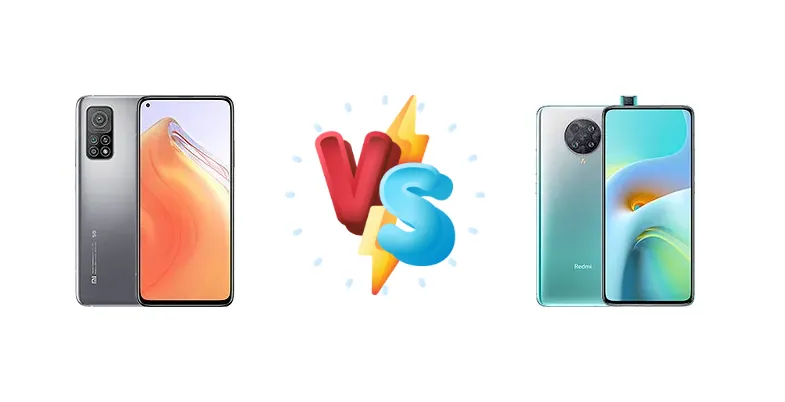
Xiaomi's Redmi series consistently delivers impressive value, and the K30S and K30 Ultra are prime examples. Both offer flagship-level features at competitive prices, but which one reigns supreme? This comprehensive comparison will break down every aspect to help you make the right choice.
🏆 Quick Verdict
The Redmi K30 Ultra edges out the K30S thanks to its faster charging, slightly better camera versatility (especially with the 64MP primary), and the Dimensity 1000+ chipset's strong performance. However, the K30S's Snapdragon 865 remains a powerful contender, particularly for those preferring Qualcomm.
| Network |
|---|
| 2G bands | GSM 850 / 900 / 1800 / 1900 | GSM 850 / 900 / 1800 / 1900 |
| 3G bands | HSDPA 850 / 900 / 1700(AWS) / 1900 / 2100 | HSDPA 850 / 900 / 1900 / 2100 |
| 4G bands | 1, 2, 3, 4, 5, 7, 8, 12, 17, 34, 38, 39, 40, 41 | 1, 3, 5, 7, 8, 34, 38, 39, 40, 41 |
| 5G bands | 1, 3, 41, 78, 79 SA/NSA | 1, 3, 41, 78, 79 SA/NSA |
| EDGE | - | No |
| GPRS | - | No |
| Speed | HSPA, LTE, 5G (2+ Gbps DL) | HSPA, LTE, 5G |
| Technology | GSM / CDMA / HSPA / EVDO / LTE / 5G | GSM / CDMA / HSPA / EVDO / LTE / 5G |
| | CDMA2000 1xEV-DO | CDMA2000 1xEV-DO |
| Launch |
|---|
| Announced | 2020, October 27. Released 2020, November 11 | 2020, August 11. Released 2020, August 14 |
| Status | Discontinued | Discontinued |
| Body |
|---|
| Build | Glass front (Gorilla Glass 5), glass back (Gorilla Glass 5), aluminum frame | Glass front (Gorilla Glass 5), glass back (Gorilla Glass 5), aluminum frame |
| Dimensions | 165.1 x 76.4 x 9.3 mm (6.5 x 3.01 x 0.37 in) | 163.3 x 75.4 x 9.1 mm (6.43 x 2.97 x 0.36 in) |
| SIM | Nano-SIM + Nano-SIM | Nano-SIM + Nano-SIM |
| Weight | 216 g (7.62 oz) | 213 g (7.51 oz) |
| Display |
|---|
| Protection | Corning Gorilla Glass 5 | Corning Gorilla Glass 5 |
| Resolution | 1080 x 2400 pixels, 20:9 ratio (~395 ppi density) | 1080 x 2400 pixels, 20:9 ratio (~395 ppi density) |
| Size | 6.67 inches, 107.4 cm2 (~85.2% screen-to-body ratio) | 6.67 inches, 107.4 cm2 (~87.2% screen-to-body ratio) |
| Type | IPS LCD, 144Hz, HDR10, 500 nits (typ), 650 nits (peak) | AMOLED, 120Hz, HDR10+, 500 nits (typ) |
| Platform |
|---|
| CPU | Octa-core (1x2.84 GHz Cortex-A77 & 3x2.42 GHz Cortex-A77 & 4x1.80 GHz Cortex-A55) | Octa-core (4x2.6 GHz Cortex-A77 & 4x2.0 GHz Cortex-A55) |
| Chipset | Qualcomm SM8250 Snapdragon 865 5G (7 nm+) | Mediatek Dimensity 1000+ (7 nm) |
| GPU | Adreno 650 | Mali-G77 MC9 |
| OS | Android 10, MIUI 12 | Android 10, MIUI 12 |
| Memory |
|---|
| Card slot | No | No |
| Internal | 128GB 8GB RAM, 256GB 8GB RAM | 128GB 6GB RAM, 128GB 8GB RAM, 256GB 8GB RAM, 512GB 8GB RAM |
| | UFS 3.1 | UFS |
| Main Camera |
|---|
| Features | LED flash, HDR, panorama | Dual-LED dual-tone flash, HDR, panorama |
| Quad | - | 64 MP, f/1.9, 26mm (wide), 1/1.73", 0.8µm, PDAF
13 MP, f/2.4, 119˚ (ultrawide), 1.12µm
5 MP, f/2.2, 50mm (telephoto macro), AF
Auxiliary lens |
| Single | - | 8 MP, AF |
| Triple | 64 MP, f/1.9, 26mm (wide), 1/1.73", 0.8µm, PDAF
13 MP, f/2.4, 123˚ (ultrawide), 1.12µm
5 MP (macro), AF | - |
| Video | 8K@24/30fps, 4K@30/60fps, 1080p@30/60/120/240/960fps; gyro-EIS | 4K@30fps, 1080p@30/60/120/240/960fps; gyro-EIS |
| Selfie camera |
|---|
| Features | HDR | HDR |
| Single | 20 MP, f/2.2, 27mm (wide), 1/3.4", 0.8µm | Motorized pop-up 20 MP, (wide) |
| Video | 1080p@30fps, 720p@120fps | 1080p@30fps, 720p@120fps |
| Sound |
|---|
| 3.5mm jack | No | No |
| 35mm jack | No | No |
| Loudspeaker | Yes, with stereo speakers | Yes, with stereo speakers |
| | 24-bit/192kHz audio | 24-bit/192kHz audio
|
| Comms |
|---|
| Bluetooth | 5.1, A2DP, LE | 5.1, A2DP, LE, aptX HD |
| Infrared port | Yes | Yes |
| NFC | Yes | Yes |
| Positioning | GPS (L1+L5), GLONASS (G1), BDS (B1I+B2a), GALILEO (E1+E5a), QZSS (L1+L5), NavIC | GPS (L1+L5), GLONASS (G1), BDS (B1I+B2a), GALILEO (E1+E5a), QZSS (L1+L5) |
| Radio | No | No |
| USB | USB Type-C 2.0, OTG | USB Type-C 2.0, OTG |
| WLAN | Wi-Fi 802.11 a/b/g/n/ac/6, dual-band, Wi-Fi Direct | Wi-Fi 802.11 a/b/g/n/ac/6, dual-band, Wi-Fi Direct |
| Features |
|---|
| Sensors | Fingerprint (side-mounted), accelerometer, gyro, proximity, compass | Fingerprint (under display, optical), accelerometer, gyro, proximity, compass |
| Battery |
|---|
| Charging | 33W wired, PD3.0, QC4 | 33W wired, PD, QC4, 100% in 58 min |
| Talk time | - | Up to 11 h 30 min (multimedia) |
| Type | Li-Po 5000 mAh | Li-Po 4500 mAh |
| Misc |
|---|
| Colors | Cosmic Black, Lunar Silver | Moonlight White, Midnight Black, Mint Green |
| Models | M2007J3SC | M2006J10C |
| Price | About 330 EUR | About 250 EUR |
Xiaomi Redmi K30S
- Proven Snapdragon 865 chipset
- Excellent gaming performance
- Slightly more compact design
- Reliable performance
- Slower charging compared to K30 Ultra
- Less versatile camera system
- 48MP primary sensor
Xiaomi Redmi K30 Ultra
- Faster charging (58 min full charge)
- More versatile camera system with 64MP primary
- Slightly better CPU performance
- Higher resolution display
- Dimensity 1000+ chipset may not be as widely supported
- Slightly larger size
Display Comparison
Both phones feature a 6.67-inch AMOLED display with a 120Hz refresh rate, offering vibrant colors and smooth scrolling. The K30 Ultra has a slightly higher resolution (2400 x 1080 vs 2340 x 1080 on the K30S), resulting in marginally sharper visuals, though the difference is subtle. Both have a punch-hole front camera.
Camera Comparison
The K30 Ultra boasts a more versatile camera system. It features a 64MP primary sensor (vs 48MP on the K30S), an 8MP ultrawide, and a 5MP macro lens. The K30S has a 48MP primary, an 8MP ultrawide, and a 2MP depth sensor. The K30 Ultra generally captures more detailed photos, especially in good lighting. Both offer decent video recording capabilities.
Performance
The K30 Ultra's Dimensity 1000+ generally offers slightly better CPU performance, especially in multi-core tasks. The K30S's Snapdragon 865 is still incredibly capable and excels in GPU performance, making it a strong choice for demanding games. Both handle everyday tasks with ease.
Battery Life
Both phones have a 4700mAh battery. However, the K30 Ultra's 33W charging with PD, QC4 support and a claimed 58-minute full charge gives it a significant advantage over the K30S's 33W charging.
Buying Guide
The Xiaomi Redmi K30S is ideal for users prioritizing a proven Snapdragon chipset, reliable performance for gaming and everyday tasks, and a slightly more compact design. The Xiaomi Redmi K30 Ultra is a better choice for those seeking faster charging, a more versatile camera system with a higher resolution main sensor, and a slightly larger display.
Frequently Asked Questions
❓ Is the Snapdragon 865 still a good chipset in 2024?
Yes, the Snapdragon 865 remains a very capable chipset, offering excellent performance for most users and handling demanding games with ease. While newer chipsets are available, the 865 still provides a premium experience.
❓ Which phone has better battery life?
While both have a 4700mAh battery, the Redmi K30 Ultra's faster charging speeds make it more convenient for topping up the battery quickly. Real-world battery life will be similar between the two.