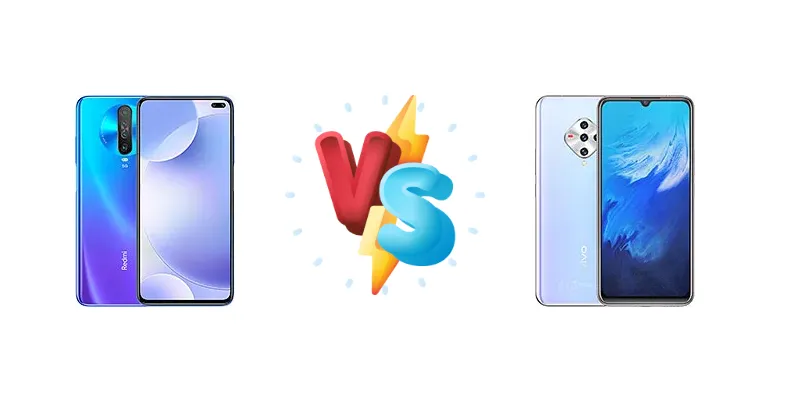
Both the Xiaomi Redmi K30i 5G and the vivo X50e represent compelling options in the mid-range 5G smartphone market. Both devices leverage the Qualcomm Snapdragon 765G chipset, but subtle differences in charging speeds and potential software optimizations create a nuanced comparison for users seeking the best value and experience.
🏆 Quick Verdict
For the average user prioritizing faster charging and potentially more refined software, the vivo X50e edges out the Redmi K30i 5G. However, the K30i 5G remains a strong contender, especially for those seeking maximum value and aren't overly concerned with a slightly slower charging experience.
| Network |
|---|
| 2G bands | GSM 850 / 900 / 1800 / 1900 | GSM 850 / 900 / 1800 / 1900 |
| 3G bands | HSDPA 850 / 900 / 1900 / 2100 | HSDPA 850 / 900 / 1700(AWS) / 1900 / 2100 |
| 4G bands | 1, 3, 5, 7, 8, 34, 38, 39, 40, 41 | 1, 2, 3, 4, 5, 7, 8, 34, 38, 39, 40, 41 |
| 5G bands | 41, 78 Sub6 | 1, 28, 78 SA/NSA |
| Speed | HSPA, LTE, 5G (2+ Gbps DL) | HSPA, LTE (4CA), 5G |
| Technology | GSM / HSPA / LTE / 5G | GSM / HSPA / LTE / 5G |
| Launch |
|---|
| Announced | 2020, May 25. Released 2020, June 07 | 2020, September 30. Released 2020, October 01 |
| Status | Discontinued | Discontinued |
| Body |
|---|
| Build | Glass front (Gorilla Glass 5), glass back (Gorilla Glass 5), aluminum frame | - |
| Dimensions | 165.3 x 76.6 x 8.8 mm (6.51 x 3.02 x 0.35 in) | 162.1 x 75 x 8.9 mm (6.38 x 2.95 x 0.35 in) |
| SIM | Nano-SIM + Nano-SIM | Nano-SIM + Nano-SIM |
| Weight | 208 g (7.34 oz) | 200.4 g (7.05 oz) |
| Display |
|---|
| Protection | Corning Gorilla Glass 5 | - |
| Resolution | 1080 x 2400 pixels, 20:9 ratio (~395 ppi density) | 1080 x 2400 pixels, 20:9 ratio (~409 ppi density) |
| Size | 6.67 inches, 107.4 cm2 (~84.8% screen-to-body ratio) | 6.44 inches, 100.1 cm2 (~82.4% screen-to-body ratio) |
| Type | IPS LCD, 120Hz, HDR10 | AMOLED |
| Platform |
|---|
| CPU | Octa-core (1x2.4 GHz Kryo 475 Prime & 1x2.2 GHz Kryo 475 Gold & 6x1.8 GHz Kryo 475 Silver) | Octa-core (1x2.4 GHz Kryo 475 Prime & 1x2.2 GHz Kryo 475 Gold & 6x1.8 GHz Kryo 475 Silver) |
| Chipset | Qualcomm SM7250 Snapdragon 765G 5G (7 nm) | Qualcomm SM7250 Snapdragon 765G 5G (7 nm) |
| GPU | Adreno 620 | Adreno 620 |
| OS | Android 10, MIUI 11 | Android 10, Funtouch 10 |
| Memory |
|---|
| Card slot | No | microSDXC (uses shared SIM slot) |
| Internal | 128GB 6GB RAM, 128GB 8GB RAM, 256GB 8GB RAM | 128GB 8GB RAM |
| | UFS 2.1 | - |
| Main Camera |
|---|
| Features | Dual-LED flash, HDR, panorama | LED flash, HDR, panorama |
| Quad | 48 MP, f/1.9, (wide), 1/2.0", 0.8µm, PDAF
8 MP, f/2.2, 120˚ (ultrawide), 1/4.0", 1.12µm
2 MP (macro)
Auxiliary lens | 48 MP, f/1.8, (wide), 1/2.0", 0.8µm, PDAF
13 MP, f/2.5, 50mm (telephoto), 1/2.8", 0.8µm, PDAF, 2x optical zoom
8 MP, f/2.2, 120˚, 16mm (ultrawide), 1/4.0", 1.12µm
2 MP (macro) |
| Video | 4K@30fps, 1080p@30fps; gyro-EIS | 4K@30fps, 1080p@30fps, gyro-EIS |
| Selfie camera |
|---|
| Dual | 20 MP, f/2.2, 27mm (wide), 1/3.4", 0.8µm
2 MP, f/2.4, 1/5.0", 1.75µm, depth sensor | - |
| Features | HDR | HDR |
| Single | - | 32 MP, f/2.0, 26mm (wide), 1/2.8", 0.8µm |
| Video | 1080p@30fps | 1080p@30fps |
| Sound |
|---|
| 3.5mm jack | Yes | Yes |
| 35mm jack | Yes | Yes |
| Loudspeaker | Yes | Yes |
| | 24-bit/192kHz audio
| 32-bit/384kHz audio |
| Comms |
|---|
| Bluetooth | 5.1, A2DP, LE, aptX HD | 5.1, A2DP, LE |
| Infrared port | Yes | - |
| NFC | Yes | Yes |
| Positioning | GPS (L1+L5), GLONASS (G1), BDS (B1I+B2a), GALILEO (E1+E5a), QZSS (L1+L5) | GPS, GLONASS, GALILEO, BDS |
| Radio | Unspecified | FM radio |
| USB | USB Type-C 2.0, OTG | USB Type-C 2.0, OTG |
| WLAN | Wi-Fi 802.11 a/b/g/n/ac, dual-band, Wi-Fi Direct | Wi-Fi 802.11 a/b/g/n/ac, dual-band, Wi-Fi Direct |
| Features |
|---|
| Sensors | Fingerprint (side-mounted), accelerometer, gyro, proximity, compass | Fingerprint (under display, optical), accelerometer, gyro, proximity, compass |
| Battery |
|---|
| Charging | 30W wired | 33W wired |
| Type | Li-Po 4500 mAh | 4350 mAh |
| Misc |
|---|
| Colors | Blue, White, Red, Purple | Black, Blue |
| Models | - | V1930 |
| Price | About 250 EUR | About 410 EUR |
Xiaomi Redmi K30i 5G
- Potentially lower price point for maximum value.
- Snapdragon 765G offers strong 5G performance.
- MIUI offers extensive customization options.
- MIUI can be resource-intensive and feature bloatware.
- 30W charging is slower than the vivo X50e.
vivo X50e
- Faster 33W wired charging for quicker top-ups.
- Potentially smoother software experience with Funtouch OS/OriginOS.
- Vivo's reputation for color accuracy in displays.
- May be slightly more expensive than the Redmi K30i 5G.
- Funtouch OS/OriginOS can be polarizing for some users.
Display Comparison
While both phones' display specifications aren't provided, the market positioning suggests both likely utilize IPS LCD panels. The absence of details like refresh rate or resolution means the display experience is likely similar. However, vivo historically focuses on color science, potentially offering a more vibrant and accurate display experience on the X50e. Bezels are likely comparable given the similar price brackets.
Camera Comparison
Without detailed camera specifications, a direct comparison is challenging. However, the market segment suggests both phones will feature multi-camera setups. The image processing style will likely be the key differentiator. Xiaomi’s MIUI tends towards more saturated and contrast-boosted images, while vivo often aims for more natural and balanced colors. The absence of information on sensor sizes makes it difficult to assess low-light performance, but larger sensors generally perform better in challenging lighting conditions. The inclusion of a 2MP macro lens on either device is unlikely to significantly impact image quality.
Performance
Both the Redmi K30i 5G and vivo X50e are powered by the Qualcomm SM7250 Snapdragon 765G (7 nm) chipset, featuring an octa-core CPU configuration (1x2.4 GHz Kryo 475 Prime, 1x2.2 GHz Kryo 475 Gold, and 6x1.8 GHz Kryo 475 Silver). This means raw processing power will be nearly identical. Performance differences will likely stem from RAM management and software optimization. The K30i 5G, running Xiaomi’s MIUI, is known for aggressive background app management, while vivo’s Funtouch OS (or OriginOS) may offer a more balanced approach. Thermal performance should also be similar, given the identical chipset and 7nm fabrication process.
Battery Life
The Redmi K30i 5G supports 30W wired charging, while the vivo X50e boasts 33W wired charging. While the difference of 3W may seem minor, it translates to a potentially faster 0-100% charge time for the X50e. The actual battery capacity of both devices is unknown, but the faster charging speed of the X50e provides a tangible benefit for users who prioritize quick top-ups. The Snapdragon 765G is relatively power-efficient, suggesting both phones should offer all-day battery life with moderate usage.
Buying Guide
Buy the Xiaomi Redmi K30i 5G if you need a highly affordable 5G experience and prioritize maximizing value for your money. It's ideal for users who don't mind a slightly longer charging time. Buy the vivo X50e if you prefer a potentially smoother software experience and value the convenience of faster 33W charging, even if it comes at a slightly higher price point.
Frequently Asked Questions
❓ Will the Snapdragon 765G in either phone struggle with demanding games like PUBG Mobile?
The Snapdragon 765G is capable of running PUBG Mobile at medium to high settings with stable frame rates. However, sustained performance may be limited by thermal throttling. Both phones likely have similar thermal capabilities, so the gaming experience should be comparable.
❓ Does the Redmi K30i 5G's MIUI software receive frequent updates and security patches?
Xiaomi is generally good about providing software updates, but MIUI updates can sometimes be delayed or introduce bugs. Security patches are typically released on a regular basis, but the frequency can vary. Users should check Xiaomi's official website for the latest update information.
❓ Is the 5G connectivity on both phones compatible with all 5G networks?
Both phones support 5G connectivity, but compatibility with specific 5G bands varies by region. It's crucial to check with your mobile carrier to ensure that the phones are compatible with their 5G network before purchasing.