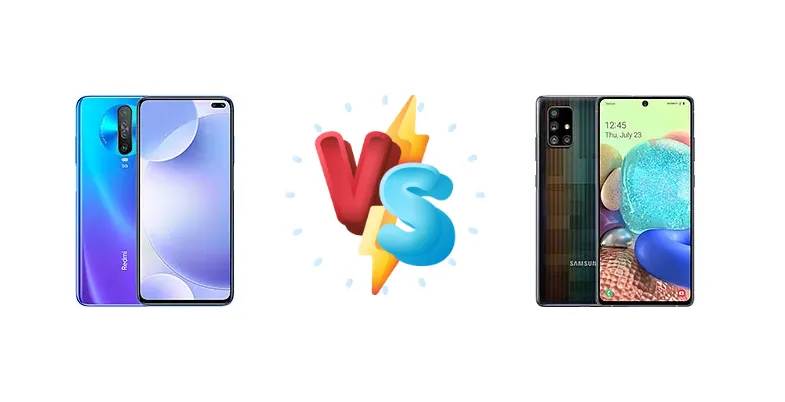
Both the Xiaomi Redmi K30i 5G and the Samsung Galaxy A71 5G UW represent compelling options in the mid-range 5G smartphone market. While both devices share the same Qualcomm Snapdragon 765G chipset, subtle differences in charging speeds and potential software optimizations create distinct user experiences. This comparison dissects these nuances to determine which phone delivers the most value.
🏆 Quick Verdict
For the average user prioritizing faster charging and potentially more aggressive pricing, the Xiaomi Redmi K30i 5G emerges as the winner. While the Samsung Galaxy A71 5G UW benefits from Samsung’s established brand recognition and software ecosystem, the K30i’s 30W charging provides a tangible advantage in daily usability.
| Network |
|---|
| 2G bands | GSM 850 / 900 / 1800 / 1900 | GSM 850 / 900 / 1800 / 1900 |
| 3G bands | HSDPA 850 / 900 / 1900 / 2100 | HSDPA 850 / 900 / 1900 / 2100 |
| 4G bands | 1, 3, 5, 7, 8, 34, 38, 39, 40, 41 | 2, 3, 4, 5, 7, 12, 13, 20, 28, 66 |
| 5G bands | 41, 78 Sub6 | 260, 261 SA/NSA/mmWave |
| Speed | HSPA, LTE, 5G (2+ Gbps DL) | HSPA, LTE, 5G |
| Technology | GSM / HSPA / LTE / 5G | GSM / HSPA / LTE / 5G |
| Launch |
|---|
| Announced | 2020, May 25. Released 2020, June 07 | 2020, July 07 |
| Status | Discontinued | Available. Released 2020, July 16 |
| Body |
|---|
| Build | Glass front (Gorilla Glass 5), glass back (Gorilla Glass 5), aluminum frame | Glass front (Gorilla Glass 3), plastic back, aluminum frame |
| Dimensions | 165.3 x 76.6 x 8.8 mm (6.51 x 3.02 x 0.35 in) | 162.8 x 75.7 x 8.4 mm (6.41 x 2.98 x 0.33 in) |
| SIM | Nano-SIM + Nano-SIM | Nano-SIM (pre-installed) |
| Weight | 208 g (7.34 oz) | 188 g (6.63 oz) |
| Display |
|---|
| Protection | Corning Gorilla Glass 5 | Corning Gorilla Glass 3 |
| Resolution | 1080 x 2400 pixels, 20:9 ratio (~395 ppi density) | 1080 x 2400 pixels, 20:9 ratio (~393 ppi density) |
| Size | 6.67 inches, 107.4 cm2 (~84.8% screen-to-body ratio) | 6.7 inches, 108.4 cm2 (~87.9% screen-to-body ratio) |
| Type | IPS LCD, 120Hz, HDR10 | Super AMOLED Plus |
| Platform |
|---|
| CPU | Octa-core (1x2.4 GHz Kryo 475 Prime & 1x2.2 GHz Kryo 475 Gold & 6x1.8 GHz Kryo 475 Silver) | Octa-core (1x2.4 GHz Kryo 475 Prime & 1x2.2 GHz Kryo 475 Gold & 6x1.8 GHz Kryo 475 Silver) |
| Chipset | Qualcomm SM7250 Snapdragon 765G 5G (7 nm) | Qualcomm SM7250 Snapdragon 765G 5G (7 nm) |
| GPU | Adreno 620 | Adreno 620 |
| OS | Android 10, MIUI 11 | Android 10, One UI 2.1 |
| Memory |
|---|
| Card slot | No | microSDXC (dedicated slot) |
| Internal | 128GB 6GB RAM, 128GB 8GB RAM, 256GB 8GB RAM | 128GB 8GB RAM |
| | UFS 2.1 | UFS 2.1 |
| Main Camera |
|---|
| Features | Dual-LED flash, HDR, panorama | LED flash, panorama, HDR |
| Quad | 48 MP, f/1.9, (wide), 1/2.0", 0.8µm, PDAF
8 MP, f/2.2, 120˚ (ultrawide), 1/4.0", 1.12µm
2 MP (macro)
Auxiliary lens | 64 MP, f/1.8, 26mm (wide), 1/1.72", 0.8µm, PDAF
12 MP, f/2.2, 123˚ (ultrawide)
5 MP (macro)
Auxiliary lens |
| Video | 4K@30fps, 1080p@30fps; gyro-EIS | 4K@30fps, 1080p@30/240fps, 1080p@960fps; gyro-EIS |
| Selfie camera |
|---|
| Dual | 20 MP, f/2.2, 27mm (wide), 1/3.4", 0.8µm
2 MP, f/2.4, 1/5.0", 1.75µm, depth sensor | - |
| Features | HDR | HDR |
| Single | - | 32 MP, f/2.2, 26mm (wide), 1/2.8", 0.8µm |
| Video | 1080p@30fps | 4K@30fps, 1080p@30fps |
| Sound |
|---|
| 3.5mm jack | Yes | Yes |
| 35mm jack | Yes | Yes |
| Loudspeaker | Yes | Yes |
| | 24-bit/192kHz audio
| - |
| Comms |
|---|
| Bluetooth | 5.1, A2DP, LE, aptX HD | 5.0, A2DP, LE |
| Infrared port | Yes | - |
| NFC | Yes | No |
| Positioning | GPS (L1+L5), GLONASS (G1), BDS (B1I+B2a), GALILEO (E1+E5a), QZSS (L1+L5) | GPS, GLONASS, GALILEO, BDS |
| Radio | Unspecified | No |
| USB | USB Type-C 2.0, OTG | USB Type-C 2.0, OTG |
| WLAN | Wi-Fi 802.11 a/b/g/n/ac, dual-band, Wi-Fi Direct | Wi-Fi 802.11 a/b/g/n/ac, dual-band, Wi-Fi Direct |
| Features |
|---|
| Sensors | Fingerprint (side-mounted), accelerometer, gyro, proximity, compass | Fingerprint (under display, optical), accelerometer, gyro, proximity, compass |
| | - | ANT+ |
| Battery |
|---|
| Charging | 30W wired | 25W wired |
| Type | Li-Po 4500 mAh | Li-Po 4500 mAh |
| Misc |
|---|
| Colors | Blue, White, Red, Purple | Prism Bricks Black |
| Models | - | SM-A716V |
| Price | About 250 EUR | - |
| SAR | - | 0.50 W/kg (head) 0.78 W/kg (body) |
Xiaomi Redmi K30i 5G
- Faster 30W charging
- Potentially more aggressive pricing
- MIUI offers extensive customization options
- MIUI can be resource-intensive
- Potential for more bloatware
Samsung Galaxy A71 5G UW
- Samsung’s One UI is generally more polished
- Established brand reputation
- Potentially wider carrier compatibility
- Slower 25W charging
- May be more expensive than the K30i
Display Comparison
Neither device’s display specifications are provided, so we must rely on market positioning. Given the A71 5G UW’s positioning as a slightly more premium device, it likely features a marginally better display in terms of color accuracy and potentially peak brightness. However, both will likely utilize AMOLED panels, common in this price bracket. The absence of high refresh rate technology on either device suggests a focus on battery efficiency rather than visual fluidity.
Camera Comparison
Without detailed camera specifications, a direct comparison is difficult. However, both phones likely feature a multi-camera setup with a primary sensor, ultrawide, and potentially a macro lens. The image processing style will be a key differentiator. Samsung typically favors vibrant, saturated colors, while Xiaomi often aims for a more natural look. The absence of information regarding sensor size and optical image stabilization (OIS) makes it impossible to definitively declare a winner; however, a larger sensor generally translates to better low-light performance.
Performance
Both the Redmi K30i 5G and the Galaxy A71 5G UW are powered by the Qualcomm SM7250 Snapdragon 765G 5G (7 nm) chipset, featuring an octa-core CPU configuration with the same Kryo 475 core arrangement (1x2.4 GHz Prime, 1x2.2 GHz Gold, and 6x1.8 GHz Silver). This means raw processing power will be nearly identical. Performance differences will likely stem from RAM management and software optimization. Xiaomi’s MIUI is known for aggressive background app management, which could impact multitasking, while Samsung’s One UI generally offers a more balanced approach. Thermal throttling, however, should be minimal given the 7nm process node and the chipset’s mid-range power consumption.
Battery Life
The Redmi K30i 5G boasts 30W wired charging, a significant advantage over the Galaxy A71 5G UW’s 25W charging. While battery capacity isn’t specified, the faster charging speed will translate to noticeably quicker top-up times. A full charge on the K30i should take considerably less time than on the A71 5G UW, making it more convenient for users who frequently need to recharge their devices. This difference in charging speed is a key differentiator, especially for users who prioritize convenience.
Buying Guide
Buy the Xiaomi Redmi K30i 5G if you need faster charging speeds and are comfortable with Xiaomi’s MIUI software. It’s ideal for users who frequently top up their phones throughout the day and prioritize value. Buy the Samsung Galaxy A71 5G UW if you prefer Samsung’s One UI, a more established brand reputation, and potentially wider carrier compatibility, even if it means sacrificing some charging speed.
Frequently Asked Questions
❓ Will the Snapdragon 765G in the Redmi K30i 5G handle demanding games like PUBG Mobile smoothly?
Yes, the Snapdragon 765G is capable of running PUBG Mobile at high settings with stable frame rates. However, sustained performance may be limited by thermal throttling, though the 7nm process node should mitigate this to some extent. Expect a playable experience, but not necessarily at the absolute highest settings for extended periods.
❓ Does the Samsung Galaxy A71 5G UW support carrier aggregation for faster 5G speeds?
The 'UW' designation in the Galaxy A71 5G UW typically indicates support for millimeter wave (mmWave) 5G, which requires specific infrastructure and offers significantly faster speeds than sub-6GHz 5G. However, mmWave coverage is limited. The phone also supports sub-6GHz 5G and carrier aggregation, allowing it to utilize multiple 5G bands for improved speeds and reliability where available.
❓ How does Xiaomi's MIUI software compare to Samsung's One UI in terms of updates and security patches?
Samsung generally provides more consistent and timely software updates and security patches compared to Xiaomi. While Xiaomi has improved in recent years, Samsung’s commitment to long-term software support is typically stronger. This is a significant consideration for users who prioritize security and access to the latest features.