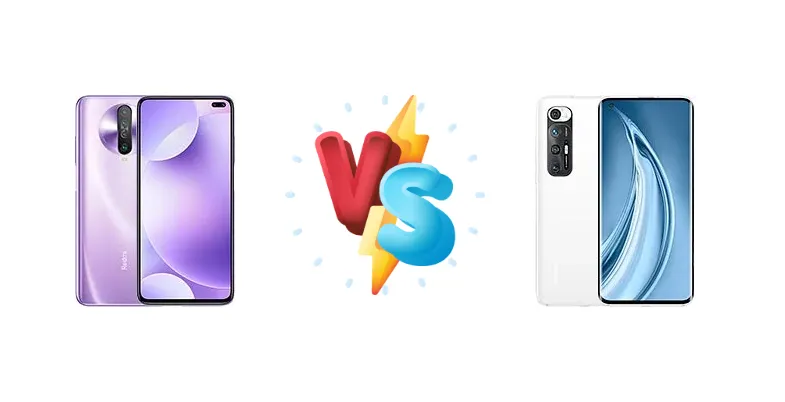
The Xiaomi Redmi K30 and Mi 10S represent distinct points in Xiaomi's product strategy. The K30, released as a value-focused option, aimed to deliver a solid experience at a competitive price. The Mi 10S, positioned higher, brought a more powerful processor and additional features to the table. This comparison dissects the key differences to determine which phone best suits your needs.
🏆 Quick Verdict
For most users, the Xiaomi Mi 10S is the superior choice, justifying its higher price with a significantly faster Snapdragon 870 processor and faster charging. However, the Redmi K30 remains a compelling option for budget-conscious buyers prioritizing long battery life and acceptable performance for everyday tasks.
| Network |
|---|
| 2G bands | GSM 850 / 900 / 1800 / 1900 | GSM 850 / 900 / 1800 / 1900 |
| 3G bands | HSDPA 850 / 900 / 2100 | HSDPA 850 / 900 / 1700(AWS) / 1900 / 2100 |
| 4G bands | 1, 3, 5, 8, 34, 38, 39, 40, 41 | 1, 2, 3, 4, 5, 7, 8, 12, 17, 34, 38, 39, 40, 41 |
| 5G bands | - | 1, 3, 41, 78, 79 SA/NSA |
| Speed | HSPA, LTE | HSPA, LTE, 5G |
| Technology | GSM / CDMA / HSPA / EVDO / LTE | GSM / HSPA / LTE / 5G |
| | CDMA2000 1xEV-DO | - |
| Launch |
|---|
| Announced | 2019, December 10. Released 2019, December 20 | 2021, March 10 |
| Status | Discontinued | Available. Released 2021, March 12 |
| Body |
|---|
| Build | Glass front (Gorilla Glass 5), glass back (Gorilla Glass 5), aluminum frame | - |
| Dimensions | 165.3 x 76.6 x 8.8 mm (6.51 x 3.02 x 0.35 in) | 162.6 x 74.8 x 9 mm (6.40 x 2.94 x 0.35 in) |
| SIM | Nano-SIM + Nano-SIM | Nano-SIM + Nano-SIM |
| Weight | 208 g (7.34 oz) | 208 g (7.34 oz) |
| Display |
|---|
| Protection | Corning Gorilla Glass 5 | Corning Gorilla Glass 5 |
| Resolution | 1080 x 2400 pixels, 20:9 ratio (~395 ppi density) | 1080 x 2340 pixels, 19.5:9 ratio (~386 ppi density) |
| Size | 6.67 inches, 107.4 cm2 (~84.8% screen-to-body ratio) | 6.67 inches, 109.2 cm2 (~89.8% screen-to-body ratio) |
| Type | IPS LCD, 120Hz, HDR10 | AMOLED, 90Hz, HDR10+, 500 nits (typ), 1120 nits (peak) |
| Platform |
|---|
| CPU | Octa-core (2x2.2 GHz Kryo 470 Gold & 6x1.8 GHz Kryo 470 Silver) | Octa-core (1x3.2 GHz Kryo 585 & 3x2.42 GHz Kryo 585 & 4x1.80 GHz Kryo 585) |
| Chipset | Qualcomm SDM730 Snapdragon 730G (8 nm) | Qualcomm SM8250-AC Snapdragon 870 5G (7 nm) |
| GPU | Adreno 618 | Adreno 650 |
| OS | Android 10, MIUI 11 | Android 11, MIUI 12 |
| Memory |
|---|
| Card slot | microSDXC (uses shared SIM slot) | No |
| Internal | 64GB 6GB RAM, 128GB 6GB RAM, 128GB 8GB RAM, 256GB 8GB RAM | 128GB 8GB RAM, 256GB 8GB RAM, 256GB 12GB RAM |
| | UFS 2.1
| UFS 3.0 |
| Main Camera |
|---|
| Features | Dual-LED flash, HDR, panorama | Dual-LED dual-tone flash, HDR, panorama |
| Quad | 64 MP, f/1.9, 26mm (wide), 1/1.72", 0.8µm, PDAF
8 MP, f/2.2, 13mm (ultrawide), 1/4.0", 1.12µm
2 MP (macro)
Auxiliary lens | 108 MP, f/1.7, 26mm (wide), 1/1.33", 0.8µm, PDAF, OIS
13 MP, f/2.4, 123˚ (ultrawide)
2 MP (macro)
Auxiliary lens |
| Single | - | 20 MP, (wide), 1/3.4", 0.8µm |
| Video | 4K@30fps, 1080p@30/120fps, 720p@960fps; gyro-EIS | 8K@30fps, 4K@30/60fps, 1080p@30/60/120fps; gyro-EIS |
| Selfie camera |
|---|
| Dual | 20 MP, f/2.2, 27mm (wide), 1/3.4", 0.8µm
2 MP, f/2.4, 1/5.0", 1.75µm, depth sensor | - |
| Features | HDR | HDR, panorama |
| Single | - | 20 MP, (wide), 1/3.4", 0.8µm |
| Video | 1080p@30fps | 1080p@30fps, 720p@120fps |
| Sound |
|---|
| 3.5mm jack | Yes | No |
| 35mm jack | Yes | No |
| Loudspeaker | Yes | Yes, with stereo speakers |
| | 24-bit/192kHz audio
| 24-bit/192kHz audio
Tuned by Harman Kardon |
| Comms |
|---|
| Bluetooth | 5.0, A2DP, LE, aptX HD | 5.1, A2DP, LE, aptX HD, aptX Adaptive |
| Infrared port | Yes | Yes |
| NFC | Yes | Yes |
| Positioning | GPS, GLONASS, GALILEO, BDS | GPS (L1+L5), GLONASS (G1), BDS (B1I+B2a), GALILEO (E1+E5a), QZSS (L1+L5) |
| Radio | FM radio, recording | No |
| USB | USB Type-C 2.0, OTG | USB Type-C 2.0, OTG |
| WLAN | Wi-Fi 802.11 a/b/g/n/ac, dual-band, Wi-Fi Direct | Wi-Fi 802.11 a/b/g/n/ac/6, dual-band, Wi-Fi Direct |
| Features |
|---|
| Sensors | Fingerprint (side-mounted), accelerometer, gyro, proximity, compass | Fingerprint (under display, optical), accelerometer, gyro, proximity, compass, barometer |
| Battery |
|---|
| Charging | 27W wired, 100% in 68 min | 33W wired, PD3.0, QC4, 100% in 56 min
30W wireless, 100% in 69 min
10W reverse wireless |
| Type | Li-Po 4500 mAh, non-removable | Li-Po 4780 mAh |
| Misc |
|---|
| Colors | Blue, Red, Purple | Titanium Black, Ice Blue, Pearl White |
| Models | M1912G7BE, M1912G7BC | M2102J2SC |
| Price | About 210 EUR | About 430 EUR |
| Tests |
|---|
| Audio quality |
Noise -94.0dB / Crosstalk -93.0dB | - |
| Battery life |
Endurance rating 101h
| - |
| Camera |
Photo / Video | - |
| Display |
Contrast ratio: 1378:1 (nominal) | - |
| Performance |
AnTuTu: 218200 (v7), 272229 (v8)
GeekBench: 7008 (v4.4), 1692 (v5.1)
GFXBench: 15fps (ES 3.1 onscreen) | - |
Xiaomi Redmi K30
- Exceptional battery life (101h endurance)
- More affordable price point
- Decent performance for everyday tasks
- Slower processor compared to the Mi 10S
- Slower charging speed
Xiaomi Mi 10S
- Significantly faster Snapdragon 870 processor
- Faster wired and wireless charging
- More future-proofed for demanding applications
- Higher price tag
- Potentially shorter battery life compared to the K30
Display Comparison
Both phones feature displays suitable for their price points, but the Redmi K30's 1378:1 contrast ratio provides a slightly more visually striking image. While both lack high refresh rates, the K30's measured 714 nits of peak brightness ensures good visibility even outdoors. The Mi 10S's display specifications are not provided, so a direct comparison of panel technology (e.g., AMOLED vs. IPS) is unavailable, but it's reasonable to expect similar or slightly improved brightness given its higher positioning.
Camera Comparison
Both phones are listed with 'Photo / Video' capabilities, lacking specific details. Without sensor size, aperture, or OIS information, a detailed camera comparison is impossible. However, given the Mi 10S's higher price point, it's reasonable to assume a more advanced camera system with potentially larger sensors and improved image processing algorithms. The absence of details suggests neither phone prioritizes camera performance as a key selling point, and users should temper expectations.
Performance
The core difference lies in the chipsets. The Redmi K30's Snapdragon 730G (8nm) is a capable mid-range processor, featuring an octa-core configuration with 2x2.2 GHz Kryo 470 Gold and 6x1.8 GHz Kryo 470 Silver cores. The Mi 10S, however, boasts the Snapdragon 870 5G (7nm). This represents a substantial leap in performance, with a single Kryo 585 core clocked at 3.2 GHz, supported by 3x2.42 GHz and 4x1.80 GHz cores. The 7nm process node of the 870 also contributes to improved thermal efficiency, meaning sustained performance is less likely to be throttled during extended gaming sessions. This difference will be most noticeable in graphically intensive games and demanding applications.
Battery Life
The Redmi K30 excels in battery endurance, achieving a remarkable 101-hour rating. While the Mi 10S doesn't have a published endurance rating, it compensates with significantly faster charging. The K30 supports 27W wired charging, taking 68 minutes to reach 100%. The Mi 10S offers 33W wired charging (with PD3.0 and QC4 support) reducing the charge time to 56 minutes. Furthermore, the Mi 10S adds 30W wireless charging and 10W reverse wireless charging, features absent on the K30. This makes the Mi 10S more convenient for users who frequently top up their battery or need to charge accessories.
Buying Guide
Buy the Xiaomi Redmi K30 if you need exceptional battery endurance (101h rating) and are primarily focused on everyday tasks like browsing, social media, and light gaming. Buy the Xiaomi Mi 10S if you prioritize smooth performance in demanding applications, faster charging speeds, and a more future-proofed chipset for gaming and heavier workloads.
Frequently Asked Questions
❓ Will the Snapdragon 730G in the Redmi K30 struggle with demanding games like Genshin Impact?
The Snapdragon 730G can run Genshin Impact, but you'll likely need to lower the graphics settings to medium or low to achieve a consistently smooth frame rate. The Mi 10S's Snapdragon 870 will provide a much more fluid experience at higher settings.
❓ How much faster is the 33W charging on the Mi 10S compared to the 27W charging on the Redmi K30 in real-world use?
The Mi 10S charges from 0-100% in 56 minutes, while the Redmi K30 takes 68 minutes. This translates to roughly 12 minutes saved per full charge, making the Mi 10S more convenient for quick top-ups.
❓ Does the Mi 10S's wireless charging capability add significant convenience?
Yes, the 30W wireless charging on the Mi 10S is a significant convenience feature, especially for users who prefer not to deal with cables. The 10W reverse wireless charging also allows you to charge smaller accessories like earbuds or smartwatches.