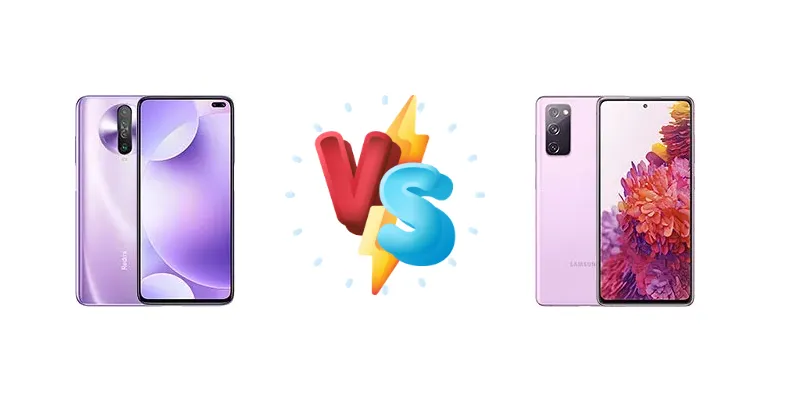
The Xiaomi Redmi K30 and the Samsung Galaxy S20 FE 2022 represent compelling options in the mid-range smartphone space, but cater to different priorities. The K30, now an older model, focuses on maximizing battery life and offering solid performance at a lower price point. The S20 FE 2022, while initially a flagship, has seen price drops, bringing its Snapdragon 865 power within reach of a wider audience. This comparison dissects their strengths and weaknesses to determine which device delivers the best value.
🏆 Quick Verdict
For the average user prioritizing raw performance and future-proofing, the Samsung Galaxy S20 FE 2022 is the clear winner. Its Snapdragon 865 chipset offers a significant leap in processing power over the Redmi K30’s Snapdragon 730G. However, the Redmi K30 remains a strong contender for those prioritizing exceptional battery life and a more budget-friendly price.
| Network |
|---|
| 2G bands | GSM 850 / 900 / 1800 / 1900 | GSM 850 / 900 / 1800 / 1900 |
| 3G bands | HSDPA 850 / 900 / 2100 | HSDPA 850 / 900 / 1700(AWS) / 1900 / 2100 |
| 4G bands | 1, 3, 5, 8, 34, 38, 39, 40, 41 | LTE |
| 5G bands | - | SA/NSA/Sub6 |
| Speed | HSPA, LTE | HSPA 42.2/5.76 Mbps, LTE (5CA) Cat19 1800/200 Mbps, 5G |
| Technology | GSM / CDMA / HSPA / EVDO / LTE | GSM / CDMA / HSPA / EVDO / LTE / 5G |
| | CDMA2000 1xEV-DO | CDMA2000 1xEV-DO |
| Launch |
|---|
| Announced | 2019, December 10. Released 2019, December 20 | 2022, April 01 |
| Status | Discontinued | Available. Released 2022, April 01 |
| Body |
|---|
| Build | Glass front (Gorilla Glass 5), glass back (Gorilla Glass 5), aluminum frame | Glass front (Gorilla Glass 3), plastic back, aluminum frame |
| Dimensions | 165.3 x 76.6 x 8.8 mm (6.51 x 3.02 x 0.35 in) | 159.8 x 74.5 x 8.4 mm (6.29 x 2.93 x 0.33 in) |
| SIM | Nano-SIM + Nano-SIM | Nano-SIM + Nano-SIM |
| Weight | 208 g (7.34 oz) | 190 g (6.70 oz) |
| | - | IP68 dust/water resistant (up to 1.5m for 30 min) |
| Display |
|---|
| Protection | Corning Gorilla Glass 5 | Corning Gorilla Glass 3 |
| Resolution | 1080 x 2400 pixels, 20:9 ratio (~395 ppi density) | 1080 x 2400 pixels, 20:9 ratio (~405 ppi density) |
| Size | 6.67 inches, 107.4 cm2 (~84.8% screen-to-body ratio) | 6.5 inches, 102.0 cm2 (~85.7% screen-to-body ratio) |
| Type | IPS LCD, 120Hz, HDR10 | Super AMOLED, 120Hz, HDR10+ |
| | - | Always-on display |
| Platform |
|---|
| CPU | Octa-core (2x2.2 GHz Kryo 470 Gold & 6x1.8 GHz Kryo 470 Silver) | Octa-core (1x2.84 GHz Cortex-A77 & 3x2.42 GHz Cortex-A77 & 4x1.80 GHz Cortex-A55) |
| Chipset | Qualcomm SDM730 Snapdragon 730G (8 nm) | Qualcomm SM8250 Snapdragon 865 5G (7 nm+) |
| GPU | Adreno 618 | Adreno 650 |
| OS | Android 10, MIUI 11 | Android 12, One UI 4.1 |
| Memory |
|---|
| Card slot | microSDXC (uses shared SIM slot) | microSDXC (uses shared SIM slot) |
| Internal | 64GB 6GB RAM, 128GB 6GB RAM, 128GB 8GB RAM, 256GB 8GB RAM | 128GB 6GB RAM |
| | UFS 2.1
| UFS 3.1 |
| Main Camera |
|---|
| Features | Dual-LED flash, HDR, panorama | LED flash, auto-HDR, panorama |
| Quad | 64 MP, f/1.9, 26mm (wide), 1/1.72", 0.8µm, PDAF
8 MP, f/2.2, 13mm (ultrawide), 1/4.0", 1.12µm
2 MP (macro)
Auxiliary lens | - |
| Triple | - | 12 MP, f/1.8, 26mm (wide), 1/1.76", 1.8µm, dual pixel PDAF, OIS
8 MP, f/2.4, 76mm (telephoto), 1/4.5", 1.0µm, PDAF, OIS, 3x optical zoom
12 MP, f/2.2, 13mm, 123˚ (ultrawide), 1/3.0", 1.12µm |
| Video | 4K@30fps, 1080p@30/120fps, 720p@960fps; gyro-EIS | 4K@30/60fps, 1080p@30/60fps, gyro-EIS |
| Selfie camera |
|---|
| Dual | 20 MP, f/2.2, 27mm (wide), 1/3.4", 0.8µm
2 MP, f/2.4, 1/5.0", 1.75µm, depth sensor | - |
| Features | HDR | HDR |
| Single | - | 32 MP, f/2.2, 26mm (wide), 1/2.74", 0.8µm |
| Video | 1080p@30fps | 4K@30/60fps, 1080p@30/60fps, gyro-EIS |
| Sound |
|---|
| 3.5mm jack | Yes | No |
| 35mm jack | Yes | No |
| Loudspeaker | Yes | Yes, with stereo speakers |
| | 24-bit/192kHz audio
| 32-bit/384kHz audio
Tuned by AKG |
| Comms |
|---|
| Bluetooth | 5.0, A2DP, LE, aptX HD | 5.0, A2DP, LE |
| Infrared port | Yes | - |
| NFC | Yes | Yes |
| Positioning | GPS, GLONASS, GALILEO, BDS | GPS, GLONASS, BDS, GALILEO |
| Radio | FM radio, recording | No |
| USB | USB Type-C 2.0, OTG | USB Type-C 3.2, OTG |
| WLAN | Wi-Fi 802.11 a/b/g/n/ac, dual-band, Wi-Fi Direct | Wi-Fi 802.11 a/b/g/n/ac/6, dual-band, Wi-Fi Direct |
| Features |
|---|
| Sensors | Fingerprint (side-mounted), accelerometer, gyro, proximity, compass | Fingerprint (under display, optical), accelerometer, gyro, compass |
| | - | Virtual proximity sensing
Bixby natural language commands and dictation
Samsung Pay (Visa, MasterCard certified) |
| Battery |
|---|
| Charging | 27W wired, 100% in 68 min | 25W wired, PD3.0
15W wireless (Qi)
4.5W reverse wireless |
| Type | Li-Po 4500 mAh, non-removable | Li-Ion 4500 mAh |
| Misc |
|---|
| Colors | Blue, Red, Purple | Cloud White, Cloud Lavender, Cloud Navy |
| Models | M1912G7BE, M1912G7BC | SM-G781NK, SM-G781NK22 |
| Price | About 210 EUR | About 520 EUR |
| Tests |
|---|
| Audio quality |
Noise -94.0dB / Crosstalk -93.0dB | - |
| Battery life |
Endurance rating 101h
| - |
| Camera |
Photo / Video | - |
| Display |
Contrast ratio: 1378:1 (nominal) | - |
| Performance |
AnTuTu: 218200 (v7), 272229 (v8)
GeekBench: 7008 (v4.4), 1692 (v5.1)
GFXBench: 15fps (ES 3.1 onscreen) | - |
Xiaomi Redmi K30
- Exceptional battery life (101h endurance)
- More affordable price point
- Reliable performance for everyday tasks
- Less powerful processor compared to the S20 FE
- Potentially inferior camera performance
Samsung Galaxy S20 FE 2022
- Significantly faster processor (Snapdragon 865)
- Superior display quality (likely AMOLED)
- Versatile charging options (wired, wireless, reverse wireless)
- Shorter battery life compared to the K30
- Potentially higher price
Display Comparison
The Redmi K30 boasts a contrast ratio of 1378:1 and a measured peak brightness of 714 nits. While respectable, this is likely outmatched by the S20 FE 2022, which, typical of Samsung, likely features a Super AMOLED panel with superior color accuracy and potentially higher peak brightness (though specific data is unavailable). The S20 FE 2022’s display technology will offer deeper blacks and a more vibrant viewing experience. The K30’s contrast ratio is good, but the S20 FE’s AMOLED panel is a significant advantage for media consumption.
Camera Comparison
Both devices are listed as having 'Photo / Video' capabilities, lacking specific details. However, given Samsung’s camera expertise, the S20 FE 2022 likely features a more sophisticated camera system with better image processing. While the K30 may offer acceptable image quality, the S20 FE’s sensor size and image processing algorithms will likely result in superior dynamic range, low-light performance, and overall image clarity. The absence of specific sensor details makes a precise comparison difficult, but Samsung’s track record suggests a clear advantage.
Performance
The core difference lies in the chipsets. The Redmi K30 utilizes the Qualcomm Snapdragon 730G (8nm), featuring an octa-core CPU with a 2x2.2 GHz Kryo 470 Gold and 6x1.8 GHz Kryo 470 Silver configuration. The S20 FE 2022, however, is powered by the Snapdragon 865 5G (7nm+). This represents a substantial upgrade in processing and graphics capabilities. The 865’s Cortex-A77 cores (1x2.84 GHz & 3x2.42 GHz) paired with 4x1.80 GHz Cortex-A55 cores deliver significantly faster performance in CPU-intensive tasks and gaming. The 7nm+ fabrication process also contributes to better thermal efficiency, though the S20 FE’s higher performance will still generate more heat under sustained load.
Battery Life
The Redmi K30 shines in battery endurance, achieving a remarkable 101-hour rating. While the S20 FE 2022’s battery capacity is unknown, its more powerful processor will consume more power. The K30’s 27W wired charging (100% in 68 minutes) is competitive, but the S20 FE 2022 adds the convenience of 25W wired charging with PD3.0, 15W wireless charging (Qi), and even 4.5W reverse wireless charging. The K30’s longer battery life is a significant advantage for users who prioritize minimizing charging frequency, but the S20 FE 2022 offers more versatile charging options.
Buying Guide
Buy the Xiaomi Redmi K30 if you need exceptional battery endurance and a reliable daily driver for basic tasks, prioritizing longevity over cutting-edge performance. Buy the Samsung Galaxy S20 FE 2022 if you prefer a smoother, more responsive experience for demanding applications like gaming and video editing, and value the benefits of a more powerful processor and 5G connectivity.
Frequently Asked Questions
❓ Does the Snapdragon 730G in the Redmi K30 struggle with graphically demanding games like Genshin Impact?
While the Snapdragon 730G is capable, Genshin Impact and similar titles will likely require reduced graphics settings for a smooth experience. The K30 can run these games, but the S20 FE 2022’s Snapdragon 865 provides a much more comfortable and consistent gaming experience at higher settings.
❓ Is the lack of 5G on the Redmi K30 a significant drawback in 2024?
The Redmi K30 does not support 5G. While 5G coverage isn't universal, it's becoming increasingly prevalent. If you live in an area with robust 5G infrastructure and anticipate using it frequently, the S20 FE 2022’s 5G connectivity is a valuable advantage.
❓ How does the charging speed of the Redmi K30 compare to real-world usage?
The Redmi K30’s 27W charging takes 68 minutes for a full charge. This is a respectable charging speed, but it's worth noting that charging speed slows down as the battery fills. Expect approximately 50% charge in around 30 minutes.