
Xiaomi Redmi K30 vs. Google Pixel 5a 5G: A Deep Dive Comparison
| Phones Images | |||||
|---|---|---|---|---|---|
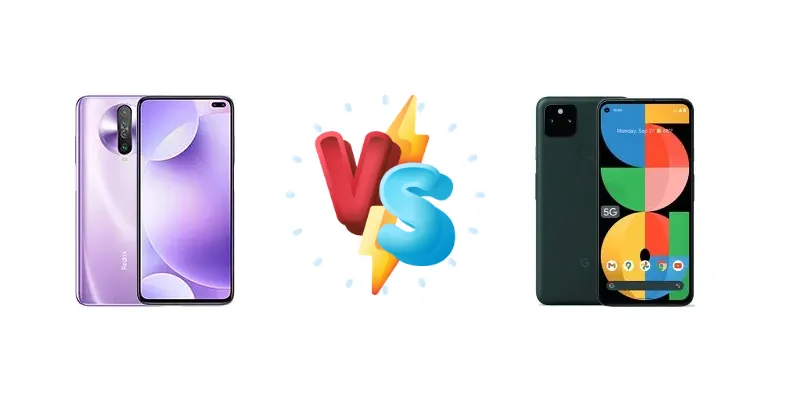
|
🏆 Quick Verdict
For the average user prioritizing long-term software support and camera quality, the Google Pixel 5a 5G is the better choice. However, if maximizing battery life and fast charging are paramount, and you're comfortable with a potentially shorter software support window, the Redmi K30 offers excellent value.
| PHONES | ||
|---|---|---|
| Phone Names | Xiaomi Redmi K30 | Google Pixel 5a 5G |
| Network | ||
|---|---|---|
| 2G bands | GSM 850 / 900 / 1800 / 1900 | GSM 850 / 900 / 1800 / 1900 |
| 3G bands | HSDPA 850 / 900 / 2100 | HSDPA 850 / 900 / 1700(AWS) / 1900 / 2100 |
| 4G bands | 1, 3, 5, 8, 34, 38, 39, 40, 41 | 1, 2, 3, 4, 5, 7, 8, 12, 13, 14, 17, 18, 19, 20, 25, 26, 28, 29, 30, 32, 38, 39, 40, 41, 42, 46, 48, 66, 71 |
| 5G bands | - | 1, 2, 5, 12, 25, 28, 41, 66, 71, 77, 78 SA/NSA/Sub6 |
| Speed | HSPA, LTE | HSPA, LTE, 5G |
| Technology | GSM / CDMA / HSPA / EVDO / LTE | GSM / HSPA / EVDO / LTE / 5G |
| CDMA2000 1xEV-DO | CDMA2000 1xEV-DO | |
| Launch | ||
|---|---|---|
| Announced | 2019, December 10. Released 2019, December 20 | 2021, August 17 |
| Status | Discontinued | Available. Released 2021, August 26 |
| Body | ||
|---|---|---|
| Build | Glass front (Gorilla Glass 5), glass back (Gorilla Glass 5), aluminum frame | Glass front (Gorilla Glass 3), aluminum frame, aluminum back |
| Dimensions | 165.3 x 76.6 x 8.8 mm (6.51 x 3.02 x 0.35 in) | 156.2 x 73.2 x 8.8 mm (6.15 x 2.88 x 0.35 in) |
| SIM | Nano-SIM + Nano-SIM | Nano-SIM + eSIM |
| Weight | 208 g (7.34 oz) | 183 g (6.46 oz) |
| - | IP67 dust/water resistant (up to 1m for 30 min) | |
| Display | ||
|---|---|---|
| Protection | Corning Gorilla Glass 5 | Corning Gorilla Glass 3 |
| Resolution | 1080 x 2400 pixels, 20:9 ratio (~395 ppi density) | 1080 x 2400 pixels, 20:9 ratio (~415 ppi density) |
| Size | 6.67 inches, 107.4 cm2 (~84.8% screen-to-body ratio) | 6.34 inches, 97.0 cm2 (~84.9% screen-to-body ratio) |
| Type | IPS LCD, 120Hz, HDR10 | OLED, HDR |
| - | Always-on display | |
| Platform | ||
|---|---|---|
| CPU | Octa-core (2x2.2 GHz Kryo 470 Gold & 6x1.8 GHz Kryo 470 Silver) | Octa-core (1x2.4 GHz Kryo 475 Prime & 1x2.2 GHz Kryo 475 Gold & 6x1.8 GHz Kryo 475 Silver) |
| Chipset | Qualcomm SDM730 Snapdragon 730G (8 nm) | Qualcomm SM7250 Snapdragon 765G 5G (7 nm) |
| GPU | Adreno 618 | Adreno 620 |
| OS | Android 10, MIUI 11 | Android 11, upgradable to Android 14 |
| Memory | ||
|---|---|---|
| Card slot | microSDXC (uses shared SIM slot) | No |
| Internal | 64GB 6GB RAM, 128GB 6GB RAM, 128GB 8GB RAM, 256GB 8GB RAM | 128GB 6GB RAM |
| UFS 2.1 | - | |
| Main Camera | ||
|---|---|---|
| Dual | - | 12.2 MP, f/1.7, 27mm, (wide), 1/2.55", 1.4µm, dual pixel PDAF, OIS 16 MP, f/2.2, 119˚ (ultrawide), 1.0µm |
| Features | Dual-LED flash, HDR, panorama | LED flash, Pixel Shift, Auto-HDR, panorama |
| Quad | 64 MP, f/1.9, 26mm (wide), 1/1.72", 0.8µm, PDAF 8 MP, f/2.2, 13mm (ultrawide), 1/4.0", 1.12µm 2 MP (macro) Auxiliary lens | - |
| Single | - | 8 MP, f/2.0, 24mm (wide), 1.12µm |
| Video | 4K@30fps, 1080p@30/120fps, 720p@960fps; gyro-EIS | 4K@30/60fps, 1080p@30/60/120/240fps; gyro-EIS |
| Selfie camera | ||
|---|---|---|
| Dual | 20 MP, f/2.2, 27mm (wide), 1/3.4", 0.8µm 2 MP, f/2.4, 1/5.0", 1.75µm, depth sensor | - |
| Features | HDR | HDR |
| Single | - | 8 MP, f/2.0, 24mm (wide), 1.12µm |
| Video | 1080p@30fps | 1080p@30fps |
| Sound | ||
|---|---|---|
| 3.5mm jack | Yes | Yes |
| 35mm jack | Yes | Yes |
| Loudspeaker | Yes | Yes, with stereo speakers |
| 24-bit/192kHz audio | - | |
| Comms | ||
|---|---|---|
| Bluetooth | 5.0, A2DP, LE, aptX HD | 5.0, A2DP, LE, aptX HD |
| Infrared port | Yes | - |
| NFC | Yes | Yes |
| Positioning | GPS, GLONASS, GALILEO, BDS | GPS, GLONASS, GALILEO, QZSS, BDS |
| Radio | FM radio, recording | No |
| USB | USB Type-C 2.0, OTG | USB Type-C 3.1 |
| WLAN | Wi-Fi 802.11 a/b/g/n/ac, dual-band, Wi-Fi Direct | Wi-Fi 802.11 a/b/g/n/ac, dual-band, Wi-Fi Direct |
| Features | ||
|---|---|---|
| Sensors | Fingerprint (side-mounted), accelerometer, gyro, proximity, compass | Fingerprint (rear-mounted), accelerometer, gyro, proximity, compass, barometer |
| Battery | ||
|---|---|---|
| Charging | 27W wired, 100% in 68 min | 18W wired, PD2.0 |
| Type | Li-Po 4500 mAh, non-removable | Li-Po 4680 mAh |
| Misc | ||
|---|---|---|
| Colors | Blue, Red, Purple | Mostly Black |
| Models | M1912G7BE, M1912G7BC | G1F8F, G4S1M |
| Price | About 210 EUR | $ 189.00 / C$ 249.99 |
| Tests | ||
|---|---|---|
| Audio quality | Noise -94.0dB / Crosstalk -93.0dB | - |
| Battery life | Endurance rating 101h | Endurance rating 122h |
| Camera | Photo / Video | - |
| Display | Contrast ratio: 1378:1 (nominal) | Contrast ratio: Infinite (nominal) |
| Performance | AnTuTu: 218200 (v7), 272229 (v8) GeekBench: 7008 (v4.4), 1692 (v5.1) GFXBench: 15fps (ES 3.1 onscreen) | AnTuTu: 291303 (v8) GeekBench: 1337 (v5.1) GFXBench: 19fps (ES 3.1 onscreen) |
Xiaomi Redmi K30
- Faster 27W wired charging
- Brighter display for outdoor use
- Potentially longer software support (Xiaomi's MIUI updates)
- Less efficient Snapdragon 730G chipset
- Shorter battery life compared to Pixel 5a 5G
- Camera performance lags behind Pixel 5a 5G
Google Pixel 5a 5G
- Superior camera quality with Google’s software
- Longer battery life (122h endurance)
- More efficient Snapdragon 765G chipset
- Slower 18W wired charging
- Lower peak display brightness
- Potentially limited software updates compared to newer Pixel models
Display Comparison
The Pixel 5a 5G boasts a peak brightness of 861 nits, exceeding the Redmi K30’s 714 nits, making it more legible under direct sunlight. While the Redmi K30’s display offers a 1378:1 contrast ratio, the Pixel 5a 5G claims an 'Infinite' contrast ratio, likely due to its OLED panel, which inherently provides perfect blacks. This difference translates to richer colors and deeper blacks on the Pixel. Both displays lack high refresh rates, a common omission in this price bracket, but the Pixel’s superior brightness and contrast give it a noticeable edge for multimedia consumption.
Camera Comparison
While both phones offer capable camera systems, the Pixel 5a 5G leverages Google’s renowned computational photography expertise. Although specific sensor details are missing for both, the Pixel’s image processing algorithms consistently deliver superior dynamic range, detail, and low-light performance. The Redmi K30’s camera is adequate for everyday photography, but it lacks the Pixel’s ability to consistently produce stunning images with minimal effort. The Pixel 5a 5G’s software optimizations are a significant differentiator, offering features like Night Sight and Super Res Zoom that elevate its camera performance beyond the hardware specifications.
Performance
Both phones utilize Qualcomm Snapdragon 7-series chipsets, but the Pixel 5a 5G’s Snapdragon 765G (7nm) represents a generational improvement over the Redmi K30’s Snapdragon 730G (8nm). The 765G features a faster Kryo 475 Prime core clocked at 2.4 GHz, compared to the K30’s 2.2 GHz Kryo 470 Gold cores. This translates to snappier application loading and smoother multitasking on the Pixel. While both have 6x 1.8 GHz efficiency cores, the 7nm process node of the 765G contributes to better power efficiency and potentially less thermal throttling during sustained workloads. The Pixel 5a 5G will likely handle graphically intensive games with more consistent frame rates.
Battery Life
The Google Pixel 5a 5G demonstrates a clear advantage in battery endurance, achieving a rating of 122 hours compared to the Redmi K30’s 101 hours. This is despite the Redmi K30 having a larger battery capacity (not specified in the data, but typical for the K30 series). The Snapdragon 765G’s 7nm process and Google’s software optimizations contribute to this improved efficiency. However, the Redmi K30 compensates with significantly faster 27W wired charging, reaching 100% in 68 minutes, while the Pixel 5a 5G’s 18W charging with PD2.0 is considerably slower. This means the K30 can quickly top up its battery, even if it doesn’t last as long on a single charge.
Buying Guide
Buy the Xiaomi Redmi K30 if you need exceptional battery endurance, faster wired charging, and a brighter display for outdoor visibility. It’s ideal for users who heavily consume media and prioritize longevity between charges. Buy the Google Pixel 5a 5G if you prefer a streamlined Android experience with guaranteed updates, a superior camera system with Google’s computational photography, and a more efficient chipset, even if it means slightly slower charging.