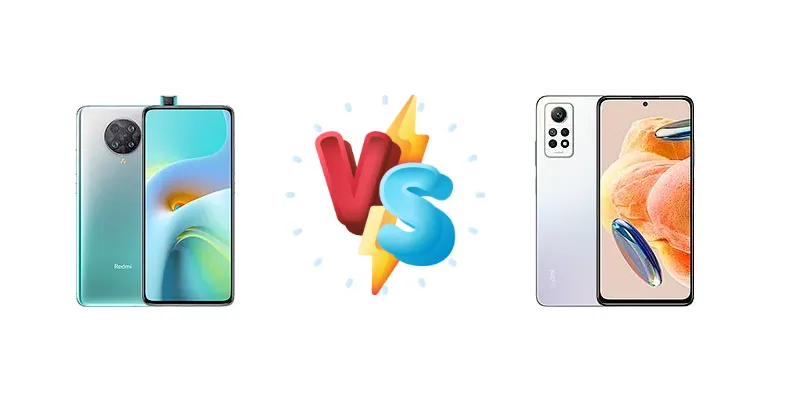
Xiaomi consistently delivers impressive smartphones at competitive prices. Today, we're pitting two popular models against each other: the powerful Redmi K30 Ultra and the feature-rich Redmi Note 12 Pro 4G. Which one offers the best bang for your buck?
🏆 Quick Verdict
The Redmi K30 Ultra boasts significantly superior performance thanks to its Dimensity 1000+ chipset. However, the Note 12 Pro 4G wins on charging speed and potentially offers a more refined overall experience for users prioritizing those features. It depends on your priorities!
| Network |
|---|
| 2G bands | GSM 850 / 900 / 1800 / 1900 | GSM 850 / 900 / 1800 / 1900 |
| 3G bands | HSDPA 850 / 900 / 1900 / 2100 | HSDPA 850 / 900 / 1700(AWS) / 1900 / 2100 |
| 4G bands | 1, 3, 5, 7, 8, 34, 38, 39, 40, 41 | 1, 2, 3, 4, 5, 7, 8, 20, 28, 38, 40, 41, 66 |
| 5G bands | 1, 3, 41, 78, 79 SA/NSA | - |
| EDGE | No | - |
| GPRS | No | - |
| Speed | HSPA, LTE, 5G | HSPA, LTE |
| Technology | GSM / CDMA / HSPA / EVDO / LTE / 5G | GSM / HSPA / LTE |
| | CDMA2000 1xEV-DO | - |
| Launch |
|---|
| Announced | 2020, August 11. Released 2020, August 14 | 2023, March 03 |
| Status | Discontinued | Available. Released 2023, April 11 |
| Body |
|---|
| Build | Glass front (Gorilla Glass 5), glass back (Gorilla Glass 5), aluminum frame | - |
| Dimensions | 163.3 x 75.4 x 9.1 mm (6.43 x 2.97 x 0.36 in) | 164.2 x 76.1 x 8.1 mm (6.46 x 3.00 x 0.32 in) |
| SIM | Nano-SIM + Nano-SIM | Nano-SIM + Nano-SIM |
| Weight | 213 g (7.51 oz) | 201.8 g (7.13 oz) |
| Display |
|---|
| Protection | Corning Gorilla Glass 5 | - |
| Resolution | 1080 x 2400 pixels, 20:9 ratio (~395 ppi density) | 1080 x 2400 pixels, 20:9 ratio (~395 ppi density) |
| Size | 6.67 inches, 107.4 cm2 (~87.2% screen-to-body ratio) | 6.67 inches, 107.4 cm2 (~86.0% screen-to-body ratio) |
| Type | AMOLED, 120Hz, HDR10+, 500 nits (typ) | AMOLED, 120Hz, Dolby Vision, 700 nits (HBM), 1100 nits (peak) |
| Platform |
|---|
| CPU | Octa-core (4x2.6 GHz Cortex-A77 & 4x2.0 GHz Cortex-A55) | Octa-core (2x2.2 GHz Kryo 470 Gold & 6x1.8 GHz Kryo 470 Silver) |
| Chipset | Mediatek Dimensity 1000+ (7 nm) | Qualcomm SM7150 Snapdragon 732G (8 nm) |
| GPU | Mali-G77 MC9 | Adreno 618 |
| OS | Android 10, MIUI 12 | Android 11, MIUI 13 |
| Memory |
|---|
| Card slot | No | microSDXC (uses shared SIM slot) |
| Internal | 128GB 6GB RAM, 128GB 8GB RAM, 256GB 8GB RAM, 512GB 8GB RAM | 128GB 6GB RAM, 128GB 8GB RAM, 256GB 8GB RAM |
| | UFS | UFS 2.2 |
| Main Camera |
|---|
| Features | Dual-LED dual-tone flash, HDR, panorama | LED flash, HDR, panorama |
| Quad | 64 MP, f/1.9, 26mm (wide), 1/1.73", 0.8µm, PDAF
13 MP, f/2.4, 119˚ (ultrawide), 1.12µm
5 MP, f/2.2, 50mm (telephoto macro), AF
Auxiliary lens | 108 MP, f/1.9, (wide), 1/1.52", 0.7µm, PDAF
8 MP, 120˚, (ultrawide)
2 MP (macro)
Auxiliary lens |
| Single | 8 MP, AF | - |
| Video | 4K@30fps, 1080p@30/60/120/240/960fps; gyro-EIS | 4K@30fps, 1080p@30/60fps |
| Selfie camera |
|---|
| Features | HDR | - |
| Single | Motorized pop-up 20 MP, (wide) | 16 MP, f/2.4, (wide) |
| Video | 1080p@30fps, 720p@120fps | 1080p@30fps |
| Sound |
|---|
| 3.5mm jack | No | Yes |
| 35mm jack | No | Yes |
| Loudspeaker | Yes, with stereo speakers | Yes, with stereo speakers |
| | 24-bit/192kHz audio
| - |
| Comms |
|---|
| Bluetooth | 5.1, A2DP, LE, aptX HD | 5.0, A2DP, LE |
| Infrared port | Yes | Yes |
| NFC | Yes | Yes (market/region dependent) |
| Positioning | GPS (L1+L5), GLONASS (G1), BDS (B1I+B2a), GALILEO (E1+E5a), QZSS (L1+L5) | GPS, GLONASS, GALILEO, BDS |
| Radio | No | Unspecified |
| USB | USB Type-C 2.0, OTG | USB Type-C 2.0, OTG |
| WLAN | Wi-Fi 802.11 a/b/g/n/ac/6, dual-band, Wi-Fi Direct | Wi-Fi 802.11 a/b/g/n/ac, dual-band |
| Features |
|---|
| Sensors | Fingerprint (under display, optical), accelerometer, gyro, proximity, compass | Fingerprint (side-mounted), accelerometer, gyro, compass |
| Battery |
|---|
| Charging | 33W wired, PD, QC4, 100% in 58 min | 67W wired |
| Talk time | Up to 11 h 30 min (multimedia) | - |
| Type | Li-Po 4500 mAh | Li-Po 5000 mAh |
| Misc |
|---|
| Colors | Moonlight White, Midnight Black, Mint Green | Star Blue, Graphite Gray, Polar White, Ice blue |
| Models | M2006J10C | 2209116AG, 2209116AG |
| Price | About 250 EUR | About 150 EUR |
Xiaomi Redmi K30 Ultra
- Superior Performance
- 120Hz Display
- Fast Charging (33W)
- Good Value (when available)
- Older Model (Availability)
- Camera may not be as refined as Note 12 Pro
- Slower Charging than Note 12 Pro
Xiaomi Redmi Note 12 Pro 4G
- Fast Charging (67W)
- Potentially Better Camera (Higher Resolution)
- More Modern Design
- Easier to Find
- Lower Performance than K30 Ultra
- 60Hz Display
- Less Powerful Chipset
Display Comparison
The Redmi K30 Ultra typically features a 6.67-inch AMOLED display with a 120Hz refresh rate, offering vibrant colors and smooth scrolling. The Redmi Note 12 Pro 4G usually has a 6.67-inch AMOLED display, but likely with a standard 60Hz refresh rate. The K30 Ultra's higher refresh rate provides a noticeably smoother visual experience, especially for gaming and fast-paced content.
Camera Comparison
The Redmi Note 12 Pro 4G often features a higher resolution main camera (typically 50MP) compared to the K30 Ultra (often 64MP). While megapixels aren't everything, the Note 12 Pro 4G may offer slightly better detail in well-lit conditions. Both phones offer decent camera capabilities, but the Note 12 Pro 4G might have a slight edge in still photography.
Performance
Here's where the K30 Ultra truly shines. The Dimensity 1000+ is a significantly more powerful chipset than the Snapdragon 732G. Expect noticeably faster app loading times, smoother multitasking, and better gaming performance on the K30 Ultra. The Note 12 Pro 4G is still capable for everyday tasks, but it won't handle demanding games as well.
Battery Life
The Redmi Note 12 Pro 4G's 67W wired charging is a major advantage, allowing for incredibly fast charging times. The K30 Ultra's 33W charging is still respectable, but considerably slower. Battery capacity is likely similar between the two, but the Note 12 Pro 4G will recharge much faster.
Buying Guide
The Redmi K30 Ultra is ideal for gamers and power users who demand top-tier performance. The Redmi Note 12 Pro 4G is a great choice for everyday users who value fast charging, a good camera, and a balanced feature set.
Frequently Asked Questions
❓ Is the Redmi K30 Ultra still worth buying?
If you can find one and prioritize performance, yes. However, its age means software updates may be limited.
❓ Which phone has better battery life?
While battery capacity is similar, the Note 12 Pro 4G's faster charging makes it feel like it has better battery life overall.
❓ Can the Redmi Note 12 Pro 4G handle gaming?
It can handle casual games, but demanding titles may experience lag or reduced frame rates.