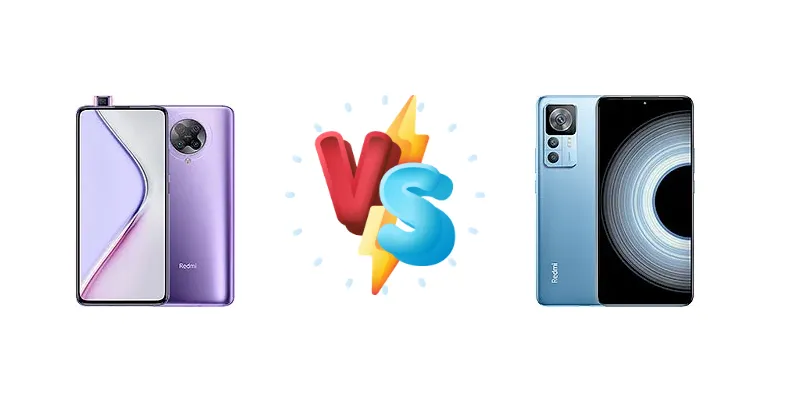
Xiaomi's Redmi series consistently delivers impressive value. But with the K30 Pro Zoom and the newer K50 Ultra, choosing the right phone can be tricky. This comprehensive comparison breaks down the key differences to help you decide which device best suits your needs.
🏆 Quick Verdict
The Redmi K50 Ultra is the clear winner, boasting a significantly faster processor, vastly superior charging speeds, and an improved camera system. While the K30 Pro Zoom remains a capable device, the K50 Ultra's advancements make it the better choice for most users.
| Network |
|---|
| 2G bands | GSM 850 / 900 / 1800 / 1900 | GSM 850 / 900 / 1800 / 1900 |
| 3G bands | HSDPA 850 / 900 / 1900 / 2100 | HSDPA 850 / 900 / 1700(AWS) / 1900 / 2100 |
| 4G bands | 1, 3, 5, 7, 8, 34, 38, 39, 40, 41 | 1, 3, 4, 5, 8, 18, 19, 26, 34, 38, 39, 40, 41, 42 |
| 5G bands | 1, 3, 41, 78, 79 SA/NSA | 1, 3, 5, 8, 28, 38, 40, 41, 77, 78 SA/NSA |
| Speed | HSPA, LTE, 5G | HSPA, LTE, 5G |
| Technology | GSM / CDMA / HSPA / EVDO / LTE / 5G | GSM / CDMA / HSPA / CDMA2000 / LTE / 5G |
| | CDMA2000 1xEV-DO | CDMA2000 1x |
| Launch |
|---|
| Announced | 2020, March 24. Released 2020, April 04 | 2022, August 11 |
| Status | Discontinued | Available. Released 2022, August 25 |
| Body |
|---|
| Build | Glass front (Gorilla Glass 5), glass back (Gorilla Glass 5), aluminum frame | - |
| Dimensions | 163.3 x 75.4 x 8.9 mm (6.43 x 2.97 x 0.35 in) | 163.1 x 75.9 x 8.6 mm (6.42 x 2.99 x 0.34 in) |
| SIM | Nano-SIM + Nano-SIM | Nano-SIM + Nano-SIM |
| Weight | 218 g (7.69 oz) | 202 g (7.13 oz) |
| Display |
|---|
| Protection | Corning Gorilla Glass 5 | - |
| Resolution | 1080 x 2400 pixels, 20:9 ratio (~395 ppi density) | 1220 x 2712 pixels, 20:9 ratio (~446 ppi density) |
| Size | 6.67 inches, 107.4 cm2 (~87.2% screen-to-body ratio) | 6.67 inches, 107.4 cm2 (~86.7% screen-to-body ratio) |
| Type | Super AMOLED, HDR10+, 500 nits (typ) | OLED, 68B colors, 144Hz, HDR10+, Dolby Vision |
| Platform |
|---|
| CPU | Octa-core (1x2.84 GHz Cortex-A77 & 3x2.42 GHz Cortex-A77 & 4x1.80 GHz Cortex-A55) | Octa-core (1x3.19 GHz Cortex-X2 & 3x2.75 GHz Cortex-A710 & 4x1.80 GHz Cortex-A510) |
| Chipset | Qualcomm SM8250 Snapdragon 865 5G (7 nm+) | Qualcomm SM8475 Snapdragon 8+ Gen 1 (4 nm) |
| GPU | Adreno 650 | Adreno 730 |
| OS | Android 10, MIUI 11 | Android 12, MIUI 13 |
| Memory |
|---|
| Card slot | No | No |
| Internal | 128GB 8GB RAM, 256GB 8GB RAM, 512GB 12GB RAM | 128GB 8GB RAM, 256GB 8GB RAM, 256GB 12GB RAM, 512GB 12GB RAM |
| | UFS 3.1 | UFS 3.1 |
| Main Camera |
|---|
| Features | Dual-LED dual-tone flash, HDR, panorama | Color spectrum sensor, LED flash, HDR, panorama |
| Quad | 64 MP, 26mm (wide), 1/1.72", 0.8µm, PDAF, OIS
8 MP, (telephoto), PDAF, OIS, 3x optical zoom
13 MP, 13mm (ultrawide)
Auxiliary lens | - |
| Triple | - | 108 MP, f/1.6, (wide), 1/1.67", PDAF, OIS
8 MP, f/2.2, 120˚, (ultrawide)
2 MP (macro) |
| Video | 8K@24/30fps, 4K@30/60fps, 1080p@30/60/120/240fps, 1080p@960fps; gyro-EIS | 4K@30/60fps, 1080p@30/60/120/240/960fps |
| Selfie camera |
|---|
| Features | HDR | HDR |
| Single | Motorized pop-up 20 MP, (wide), 1/3.4", 0.8µm | 20 MP, (wide) |
| Video | 1080p@30fps | 1080p@30/60fps, 720p@120fps |
| Sound |
|---|
| 3.5mm jack | Yes | No |
| 35mm jack | Yes | No |
| Loudspeaker | Yes | Yes, with stereo speakers |
| | 24-bit/192kHz audio
| 24-bit/192kHz audio |
| Comms |
|---|
| Bluetooth | 5.1, A2DP, LE, aptX HD, aptX Adaptive | 5.2, A2DP, LE, aptX HD, aptX Adaptive |
| Infrared port | Yes | Yes |
| NFC | Yes | Yes |
| Positioning | GPS (L1+L5), GLONASS (G1), BDS (B1I+B2a), GALILEO (E1+E5a), QZSS (L1+L5) | GPS (L1+L5), GLONASS (L1), BDS (B1I+B1c+B2a), GALILEO (E1+E5a), QZSS (L1+L5), NavIC (L5) |
| Radio | No | No |
| USB | USB Type-C 2.0, OTG | USB Type-C 2.0, OTG |
| WLAN | Wi-Fi 802.11 a/b/g/n/ac/6, dual-band, Wi-Fi Direct | Wi-Fi 802.11 a/b/g/n/ac/6e, dual-band, Wi-Fi Direct |
| Features |
|---|
| Sensors | Fingerprint (under display, optical), accelerometer, gyro, proximity, compass, barometer | Fingerprint (under display, optical), accelerometer, gyro, proximity, compass |
| Battery |
|---|
| Charging | 33W wired, PD, QC4, 100% in 63 min | 120W wired, PD3.0, 100% in 19 min |
| Type | Li-Po 4700 mAh | Li-Po 5000 mAh |
| Misc |
|---|
| Colors | Grey, Purple, White, Blue | Black, Gray, Blue, Mercedes AMG |
| Models | - | 22081212C |
| Price | About 500 EUR | About 430 EUR |
Xiaomi Redmi K30 Pro Zoom
- Solid Snapdragon 865 performance
- Good value for money (especially now)
- Decent camera system
- 5G connectivity
- Slower charging speed
- Older chipset compared to competitors
- Camera not as advanced as newer models
- Design may feel dated
Xiaomi Redmi K50 Ultra
- Blazing-fast Snapdragon 8+ Gen 1 performance
- Incredibly fast 120W charging
- Improved camera system
- Brighter and smoother display
- Modern design
- Potentially higher price
- May lack some features found on flagship models
- Software experience can vary
Display Comparison
The Redmi K50 Ultra typically features a brighter AMOLED display with a higher refresh rate (often 120Hz or higher) compared to the K30 Pro Zoom's AMOLED panel. Expect more vibrant colors and smoother scrolling on the K50 Ultra. Resolution is likely similar, around FHD+.
Camera Comparison
The K50 Ultra generally features a more advanced camera system, often including a higher resolution primary sensor and improved image processing capabilities. Expect better low-light performance, more detail, and potentially enhanced video recording features on the K50 Ultra. The K30 Pro Zoom's camera is still capable, but noticeably behind.
Performance
The Snapdragon 8+ Gen 1 in the K50 Ultra offers a substantial performance boost over the Snapdragon 865 in the K30 Pro Zoom. Expect faster app loading, smoother multitasking, and significantly improved gaming performance on the K50 Ultra. The newer CPU architecture also contributes to better power efficiency.
Battery Life
The K50 Ultra's 120W charging is a game-changer, allowing for incredibly fast charging times. The K30 Pro Zoom's 33W charging is adequate but significantly slower. Battery capacity is likely similar between the two devices, but the K50 Ultra's charging speed makes a huge difference in usability.
Buying Guide
The Redmi K30 Pro Zoom is a good option for budget-conscious users who prioritize a solid Snapdragon 865 experience and don't need the absolute latest features. The Redmi K50 Ultra is ideal for power users, gamers, and anyone who values fast charging and a top-tier camera.
Frequently Asked Questions
❓ Is the Redmi K50 Ultra worth the upgrade from the Redmi K30 Pro Zoom?
Yes, the K50 Ultra offers significant improvements in performance, charging speed, and camera quality, making it a worthwhile upgrade for most users.
❓ What is the battery life like on each phone?
Both phones offer decent battery life, but the K50 Ultra's faster charging makes up for any slight differences in battery capacity.
❓ Which phone is better for gaming?
The Redmi K50 Ultra is significantly better for gaming due to its more powerful processor and smoother display.