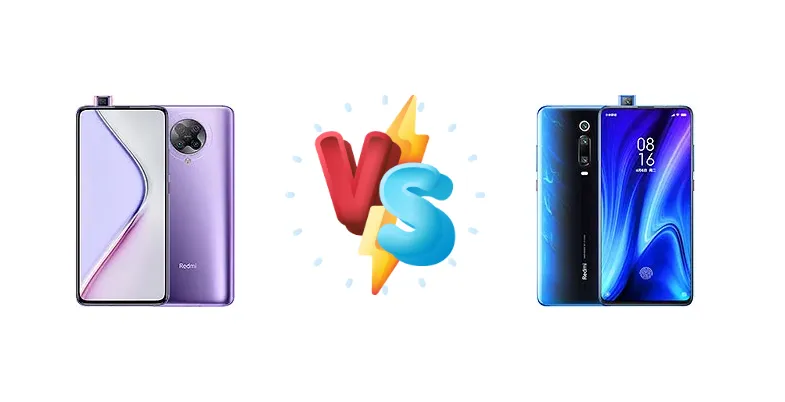
Xiaomi's Redmi series consistently delivers impressive value. The Redmi K30 Pro Zoom and Redmi K20 Pro were both popular choices, but which one holds up better today? This comprehensive comparison dives deep into their features, performance, and overall worth.
🏆 Quick Verdict
The Redmi K30 Pro Zoom edges out the K20 Pro thanks to its Snapdragon 865, faster charging, and improved camera zoom capabilities. However, the K20 Pro remains a compelling option for budget-conscious buyers seeking a still-capable flagship experience.
| Network |
|---|
| 2G bands | GSM 850 / 900 / 1800 / 1900 | GSM 850 / 900 / 1800 / 1900 |
| 3G bands | HSDPA 850 / 900 / 1900 / 2100 | HSDPA 850 / 900 / 1900 / 2100 |
| 4G bands | 1, 3, 5, 7, 8, 34, 38, 39, 40, 41 | 1, 3, 5, 7, 8, 34, 38, 39, 40, 41 |
| 5G bands | 1, 3, 41, 78, 79 SA/NSA | - |
| Speed | HSPA, LTE, 5G | HSPA, LTE |
| Technology | GSM / CDMA / HSPA / EVDO / LTE / 5G | GSM / CDMA / HSPA / LTE |
| | CDMA2000 1xEV-DO | CDMA 800 & TD-SCDMA |
| Launch |
|---|
| Announced | 2020, March 24. Released 2020, April 04 | 2019, September. Released 2019, September |
| Status | Discontinued | Discontinued |
| Body |
|---|
| Build | Glass front (Gorilla Glass 5), glass back (Gorilla Glass 5), aluminum frame | Glass front (Gorilla Glass 5), glass back (Gorilla Glass 5), aluminum frame |
| Dimensions | 163.3 x 75.4 x 8.9 mm (6.43 x 2.97 x 0.35 in) | 156.7 x 74.3 x 8.8 mm (6.17 x 2.93 x 0.35 in) |
| SIM | Nano-SIM + Nano-SIM | Nano-SIM + Nano-SIM |
| Weight | 218 g (7.69 oz) | 191 g (6.74 oz) |
| Display |
|---|
| Protection | Corning Gorilla Glass 5 | Corning Gorilla Glass 5 |
| Resolution | 1080 x 2400 pixels, 20:9 ratio (~395 ppi density) | 1080 x 2340 pixels, 19.5:9 ratio (~403 ppi density) |
| Size | 6.67 inches, 107.4 cm2 (~87.2% screen-to-body ratio) | 6.39 inches, 100.2 cm2 (~86.1% screen-to-body ratio) |
| Type | Super AMOLED, HDR10+, 500 nits (typ) | Super AMOLED, HDR10 |
| Platform |
|---|
| CPU | Octa-core (1x2.84 GHz Cortex-A77 & 3x2.42 GHz Cortex-A77 & 4x1.80 GHz Cortex-A55) | Octa-core (1x2.96 GHz Kryo 485 & 3x2.42 GHz Kryo 485 & 4x1.8 GHz Kryo 485) |
| Chipset | Qualcomm SM8250 Snapdragon 865 5G (7 nm+) | Qualcomm SM8150 Snapdragon 855+ (7 nm) |
| GPU | Adreno 650 | Adreno 640 (700 MHz) |
| OS | Android 10, MIUI 11 | Android 10, MIUI 11 |
| Memory |
|---|
| Card slot | No | No |
| Internal | 128GB 8GB RAM, 256GB 8GB RAM, 512GB 12GB RAM | 128GB 8GB RAM, 512GB 8GB RAM, 512GB 12GB RAM |
| | UFS 3.1 | UFS 2.1 |
| Main Camera |
|---|
| Features | Dual-LED dual-tone flash, HDR, panorama | Laser AF, Dual-LED flash, HDR, panorama |
| Quad | 64 MP, 26mm (wide), 1/1.72", 0.8µm, PDAF, OIS
8 MP, (telephoto), PDAF, OIS, 3x optical zoom
13 MP, 13mm (ultrawide)
Auxiliary lens | - |
| Triple | - | 48 MP, f/1.8, 26mm (wide), 1/2.0", 0.8µm, PDAF
8 MP, f/2.4, 53mm (telephoto), 1/4.0", 1.12µm, PDAF, 2x optical zoom
13 MP, f/2.4, 12mm (ultrawide), 1/3.1", 1.12µm |
| Video | 8K@24/30fps, 4K@30/60fps, 1080p@30/60/120/240fps, 1080p@960fps; gyro-EIS | 4K@30/60fps, 1080p@30/120/240fps, 1080p@960fps |
| Selfie camera |
|---|
| Features | HDR | HDR |
| Single | Motorized pop-up 20 MP, (wide), 1/3.4", 0.8µm | Motorized pop-up 20 MP, f/2.2, (wide), 1/3.4", 0.8µm |
| Video | 1080p@30fps | 1080p@30fps |
| Sound |
|---|
| 3.5mm jack | Yes | Yes |
| 35mm jack | Yes | Yes |
| Loudspeaker | Yes | Yes |
| | 24-bit/192kHz audio
| 24-bit/192kHz audio
|
| Comms |
|---|
| Bluetooth | 5.1, A2DP, LE, aptX HD, aptX Adaptive | 5.0, A2DP, LE, aptX HD |
| Infrared port | Yes | - |
| NFC | Yes | Yes |
| Positioning | GPS (L1+L5), GLONASS (G1), BDS (B1I+B2a), GALILEO (E1+E5a), QZSS (L1+L5) | GPS (L1+L5), GLONASS (G1), BDS (B1), GALILEO (E1+E5a) |
| Radio | No | Yes |
| USB | USB Type-C 2.0, OTG | USB Type-C 2.0, OTG |
| WLAN | Wi-Fi 802.11 a/b/g/n/ac/6, dual-band, Wi-Fi Direct | Wi-Fi 802.11 a/b/g/n/ac, dual-band, Wi-Fi Direct |
| Features |
|---|
| Sensors | Fingerprint (under display, optical), accelerometer, gyro, proximity, compass, barometer | Fingerprint (under display, optical), accelerometer, gyro, proximity, compass |
| Battery |
|---|
| Charging | 33W wired, PD, QC4, 100% in 63 min | 27W wired, QC4 |
| Type | Li-Po 4700 mAh | Li-Po 4000 mAh, non-removable |
| Misc |
|---|
| Colors | Grey, Purple, White, Blue | Carbon black, Flame red, Glacier blue, Summer Honey, Pearl White |
| Price | About 500 EUR | About 450 EUR |
Xiaomi Redmi K30 Pro Zoom
- Snapdragon 865 for better performance
- Faster 33W charging
- Improved camera with periscope zoom
- 5G Connectivity
- Potentially higher price (depending on current market value)
- Design might be less appealing to some
Xiaomi Redmi K20 Pro Premium
- More affordable
- Excellent AMOLED display
- Capable camera system
- Sleek design
- Snapdragon 855+ is slightly older
- Slower 27W charging
- No 5G
Display Comparison
Both phones feature vibrant AMOLED displays with Full HD+ resolution. The K30 Pro Zoom might have slightly better color accuracy and brightness, but the difference is minimal. The K20 Pro's display is still excellent for everyday use and media consumption.
Camera Comparison
The K30 Pro Zoom boasts a superior camera system, particularly its periscope zoom lens, allowing for impressive zoomed-in shots. While the K20 Pro's camera is still capable, the K30 Pro Zoom delivers better image quality, especially in low light and at higher zoom levels. Both have excellent selfie cameras.
Performance
The Snapdragon 865 in the K30 Pro Zoom offers a noticeable performance boost over the K20 Pro's Snapdragon 855+. Expect smoother multitasking, faster app loading times, and better gaming performance on the K30 Pro Zoom. Both phones handle everyday tasks with ease.
Battery Life
The K30 Pro Zoom's 33W fast charging is significantly faster than the K20 Pro's 27W charging. Both phones offer all-day battery life with moderate usage, but the K30 Pro Zoom will recharge much quicker.
Buying Guide
The Redmi K30 Pro Zoom is ideal for users prioritizing performance, faster charging, and enhanced zoom photography. The Redmi K20 Pro is a great choice for those seeking a flagship experience at a more affordable price point, especially if they don't heavily rely on the latest and greatest features.
Frequently Asked Questions
❓ Is the Redmi K30 Pro Zoom worth the extra money?
If you prioritize performance, faster charging, and a better camera, especially zoom capabilities, then yes. Otherwise, the K20 Pro offers excellent value for the price.
❓ Which phone has better software support?
Xiaomi's software support varies. Check current MIUI versions and update policies for both devices as they may differ. Generally, newer devices receive updates for a longer period.