
Xiaomi Redmi K30 5G vs. Google Pixel 4a 5G: A Deep Dive into the 765G Experience
| Phones Images | |||||
|---|---|---|---|---|---|
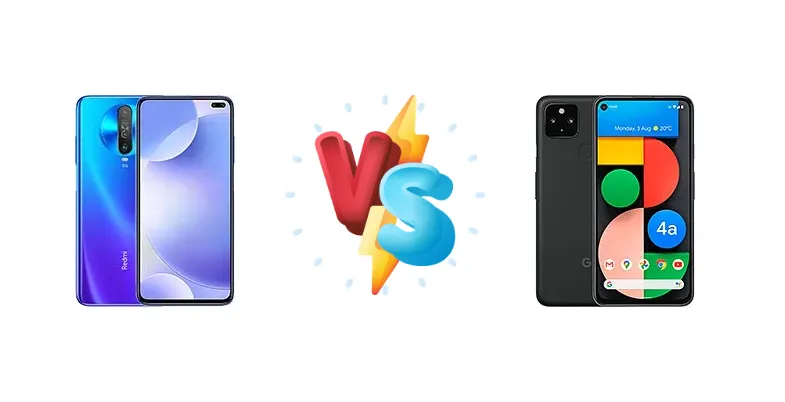
|
🏆 Quick Verdict
For the average user prioritizing fast charging and a potentially longer lifespan due to Xiaomi’s robust build quality, the Redmi K30 5G is the better choice. However, Pixel purists and those heavily invested in the Google ecosystem will find the Pixel 4a 5G’s software experience and camera processing more appealing.
| PHONES | ||
|---|---|---|
| Phone Names | Xiaomi Redmi K30 5G | Google Pixel 4a 5G |
| Network | ||
|---|---|---|
| 2G bands | GSM 850 / 900 / 1800 / 1900 | GSM 850 / 900 / 1800 / 1900 |
| 3G bands | HSDPA 850 / 900 / 1900 / 2100 | HSDPA 850 / 900 / 1700(AWS) / 1900 / 2100 |
| 4G bands | 1, 3, 5, 7, 8, 34, 38, 39, 40, 41 | 1, 2, 3, 4, 5, 7, 8, 12, 13, 14, 17, 18, 19, 20, 25, 26, 28, 29, 30, 32, 38, 39, 40, 41, 42, 46, 48, 66, 71 |
| 5G bands | 41, 78 Sub6 | 1, 2, 3, 5, 7, 8, 12, 28, 41, 66, 71, 77, 78 Sub6, mmWave (market dependant) |
| Speed | HSPA, LTE, 5G (2+ Gbps DL) | HSPA, LTE, 5G |
| Technology | GSM / HSPA / LTE / 5G | GSM / HSPA / LTE / 5G |
| Launch | ||
|---|---|---|
| Announced | 2019, December 10. Released 2020, January 07 | 2020, September 30 |
| Status | Discontinued | Available. Released 2020, November 05 |
| Body | ||
|---|---|---|
| Build | Glass front (Gorilla Glass 5), glass back (Gorilla Glass 5), aluminum frame | Glass front (Gorilla Glass 3), plastic back, plastic frame |
| Dimensions | 165.3 x 76.6 x 8.8 mm (6.51 x 3.02 x 0.35 in) | 153.9 x 74 x 8.2 mm (Sub-6) or 8.5 mm (Sub-6 and mmWave) |
| SIM | Nano-SIM + Nano-SIM | Nano-SIM + eSIM |
| Weight | 208 g (7.34 oz) | 168 g (5G Sub-6); 171 g ( 5G Sub-6 and mmWave) (5.93 oz) |
| Display | ||
|---|---|---|
| Protection | Corning Gorilla Glass 5 | Corning Gorilla Glass 3 |
| Resolution | 1080 x 2400 pixels, 20:9 ratio (~395 ppi density) | 1080 x 2340 pixels, 19.5:9 ratio (~413 ppi density) |
| Size | 6.67 inches, 107.4 cm2 (~84.8% screen-to-body ratio) | 6.2 inches, 95.7 cm2 (~84.1% screen-to-body ratio) |
| Type | IPS LCD, 120Hz, HDR10 | OLED, HDR |
| - | Always-on display | |
| Platform | ||
|---|---|---|
| CPU | Octa-core (1x2.4 GHz Kryo 475 Prime & 1x2.2 GHz Kryo 475 Gold & 6x1.8 GHz Kryo 475 Silver) | Octa-core (1x2.4 GHz Kryo 475 Prime & 1x2.2 GHz Kryo 475 Gold & 6x1.8 GHz Kryo 475 Silver) |
| Chipset | Qualcomm SM7250 Snapdragon 765G 5G (7 nm) | Qualcomm SM7250 Snapdragon 765G 5G (7 nm) |
| GPU | Adreno 620 | Adreno 620 |
| OS | Android 10, upgradable to Android 11, MIUI 12 | Android 11, upgradable to Android 14 |
| Memory | ||
|---|---|---|
| Card slot | No | No |
| Internal | 64GB 6GB RAM, 128GB 6GB RAM, 128GB 8GB RAM, 256GB 8GB RAM | 128GB 6GB RAM |
| UFS 2.1 | UFS 2.1 | |
| Main Camera | ||
|---|---|---|
| Dual | - | 12.2 MP, f/1.7, 27mm (wide), 1/2.55", 1.4µm, dual pixel PDAF, OIS 16 MP, f/2.2, 107˚ (ultrawide), 1.0µm |
| Features | Dual-LED flash, HDR, panorama | LED flash, Pixel Shift, Auto-HDR, panorama |
| Quad | 64 MP, f/1.9, 26mm (wide), 1/1.72", 0.8µm, PDAF 8 MP, f/2.2, 13mm (ultrawide), 1/4.0", 1.12µm 5 MP (macro) Auxiliary lens | - |
| Video | 4K@30fps, 1080p@30/120fps, 720p@960fps; gyro-EIS | 4K@30/60fps, 1080p@30/60/120/240fps; gyro-EIS |
| Selfie camera | ||
|---|---|---|
| Dual | 20 MP, f/2.2, 27mm (wide), 1/3.4", 0.8µm 2 MP, f/2.4, 1/5.0", 1.75µm, depth sensor | - |
| Features | HDR | HDR |
| Single | - | 8 MP, f/2.0, 24mm (wide), 1/4.0", 1.12µm |
| Video | 1080p@30fps | 1080p@30fps |
| Sound | ||
|---|---|---|
| 3.5mm jack | Yes | Yes |
| 35mm jack | Yes | Yes |
| Loudspeaker | Yes | Yes, with stereo speakers |
| 24-bit/192kHz audio | - | |
| Comms | ||
|---|---|---|
| Bluetooth | 5.1, A2DP, LE, aptX HD | 5.0, A2DP, LE, aptX HD |
| Infrared port | Yes | - |
| NFC | Yes | Yes |
| Positioning | GPS (L1+L5), GLONASS (G1), BDS (B1I+B2a), GALILEO (E1+E5a), QZSS (L1+L5) | GPS, GLONASS, GALILEO, QZSS, BDS |
| Radio | FM radio | No |
| USB | USB Type-C 2.0, OTG | USB Type-C 3.1 |
| WLAN | Wi-Fi 802.11 a/b/g/n/ac, dual-band, Wi-Fi Direct | Wi-Fi 802.11 a/b/g/n/ac, dual-band, Wi-Fi Direct |
| Features | ||
|---|---|---|
| Sensors | Fingerprint (side-mounted), accelerometer, gyro, proximity, compass | Fingerprint (rear-mounted), accelerometer, gyro, proximity, compass, barometer |
| Battery | ||
|---|---|---|
| Charging | 30W wired, 100% in 57 min | 18W wired, PD2.0 |
| Type | Li-Po 4500 mAh, non-removable | Li-Po 3885 mAh |
| Misc | ||
|---|---|---|
| Colors | Blue, Red, Purple, White | Just Black, Clearly White |
| Models | M1912G7BE, M1912G7BC | GD1YQ, G025I, G025E, G025H, G6QU3 |
| Price | About 260 EUR | About 140 EUR |
Xiaomi Redmi K30 5G
- Significantly faster 30W charging
- Potentially higher refresh rate display
- Likely more durable build quality
- MIUI software can be bloated
- Less consistent camera processing
Google Pixel 4a 5G
- Clean and streamlined Android experience
- Excellent computational photography
- Guaranteed software updates from Google
- Slower 18W charging
- Potentially less durable build
Display Comparison
While both devices share a similar display size, detailed display specs are missing. However, given the K30 5G’s initial positioning, it likely features a higher refresh rate panel (120Hz is common for this era) compared to the Pixel 4a 5G’s standard 60Hz. This difference would translate to smoother scrolling and animations for the K30 5G, benefiting gamers and frequent social media users. The K30 5G also likely boasts a higher peak brightness, improving outdoor visibility.
Camera Comparison
Detailed camera specs are unavailable, but the Pixel 4a 5G is expected to excel in image processing thanks to Google’s renowned computational photography algorithms. While the K30 5G may have higher megapixel counts, the Pixel’s software is likely to produce more consistently pleasing images, particularly in challenging lighting conditions. The Pixel’s focus on software optimization will likely yield better dynamic range and detail. The K30 5G may offer more versatility with additional lenses, but the Pixel’s single-lens setup is often sufficient.
Performance
Both the Redmi K30 5G and Pixel 4a 5G are powered by the Qualcomm SM7250 Snapdragon 765G 5G (7 nm) chipset, featuring an octa-core CPU configuration (1x2.4 GHz Kryo 475 Prime, 1x2.2 GHz Kryo 475 Gold, and 6x1.8 GHz Kryo 475 Silver). This means raw processing power will be nearly identical. The key differentiator lies in software optimization and thermal management. Google’s software is known for its efficiency, potentially allowing the Pixel 4a 5G to maintain peak performance for longer periods. However, the K30 5G’s larger chassis might offer better passive cooling.
Battery Life
The Redmi K30 5G’s 30W wired charging is a significant advantage over the Pixel 4a 5G’s 18W wired charging with PD2.0. The K30 5G can reach 100% charge in just 57 minutes, while the Pixel 4a 5G will take considerably longer. While battery capacity isn’t specified, the faster charging of the K30 5G mitigates the impact of a potentially smaller battery, allowing for quicker top-ups throughout the day. The Pixel 4a 5G’s slower charging may require overnight charging for consistent use.
Buying Guide
Buy the Xiaomi Redmi K30 5G if you need faster charging speeds, a potentially more durable build, and are comfortable with Xiaomi’s MIUI software. It’s ideal for power users and those who frequently top up their phones throughout the day. Buy the Google Pixel 4a 5G if you prefer a clean Android experience, prioritize Google’s computational photography, and value guaranteed software updates directly from Google. It’s best suited for users who want a hassle-free, streamlined smartphone experience.