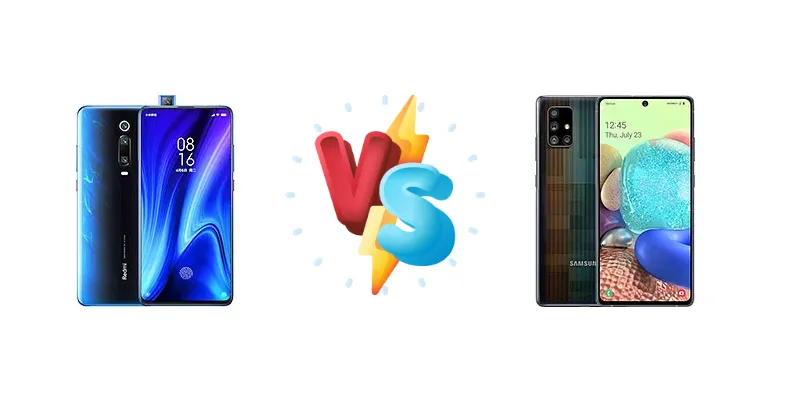
The Xiaomi Redmi K20 and Samsung Galaxy A71 5G UW represent compelling options in the increasingly crowded mid-range 5G smartphone market. While both aim to deliver 5G connectivity without a flagship price tag, they achieve this through different approaches to chipset selection and feature prioritization. This comparison dissects the core differences between the Snapdragon 730-powered K20 and the Snapdragon 765G-equipped A71 5G UW, helping you determine which device best suits your needs.
🏆 Quick Verdict
For the average user prioritizing 5G connectivity and faster charging, the Samsung Galaxy A71 5G UW is the better choice. Its Snapdragon 765G offers a slight performance edge, and the 25W charging significantly reduces downtime. However, the Redmi K20 remains a strong contender for those seeking a more value-focused option.
| Network |
|---|
| 2G bands | GSM 850 / 900 / 1800 / 1900 | GSM 850 / 900 / 1800 / 1900 |
| 3G bands | HSDPA 850 / 900 / 1900 / 2100 | HSDPA 850 / 900 / 1900 / 2100 |
| 4G bands | 1, 3, 5, 7, 8, 34, 38, 39, 40, 41 | 2, 3, 4, 5, 7, 12, 13, 20, 28, 66 |
| 5G bands | - | 260, 261 SA/NSA/mmWave |
| Speed | HSPA, LTE | HSPA, LTE, 5G |
| Technology | GSM / HSPA / LTE | GSM / HSPA / LTE / 5G |
| Launch |
|---|
| Announced | 2019, May. Released 2019, June | 2020, July 07 |
| Status | Discontinued | Available. Released 2020, July 16 |
| Body |
|---|
| Build | Glass front (Gorilla Glass 5), glass back (Gorilla Glass 5), aluminum frame | Glass front (Gorilla Glass 3), plastic back, aluminum frame |
| Dimensions | 156.7 x 74.3 x 8.8 mm (6.17 x 2.93 x 0.35 in) | 162.8 x 75.7 x 8.4 mm (6.41 x 2.98 x 0.33 in) |
| SIM | Nano-SIM + Nano-SIM | Nano-SIM (pre-installed) |
| Weight | 191 g (6.74 oz) | 188 g (6.63 oz) |
| Display |
|---|
| Protection | Corning Gorilla Glass 5 | Corning Gorilla Glass 3 |
| Resolution | 1080 x 2340 pixels, 19.5:9 ratio (~403 ppi density) | 1080 x 2400 pixels, 20:9 ratio (~393 ppi density) |
| Size | 6.39 inches, 100.2 cm2 (~86.1% screen-to-body ratio) | 6.7 inches, 108.4 cm2 (~87.9% screen-to-body ratio) |
| Type | Super AMOLED, HDR | Super AMOLED Plus |
| Platform |
|---|
| CPU | Octa-core (2x2.2 GHz Kryo 470 Gold & 6x1.8 GHz Kryo 470 Silver) | Octa-core (1x2.4 GHz Kryo 475 Prime & 1x2.2 GHz Kryo 475 Gold & 6x1.8 GHz Kryo 475 Silver) |
| Chipset | Qualcomm SDM730 Snapdragon 730 (8 nm) | Qualcomm SM7250 Snapdragon 765G 5G (7 nm) |
| GPU | Adreno 618 | Adreno 620 |
| OS | Android 9.0 (Pie), upgradable to Android 10, MIUI 12 | Android 10, One UI 2.1 |
| Memory |
|---|
| Card slot | No | microSDXC (dedicated slot) |
| Internal | 64GB 6GB RAM, 128GB 6GB RAM, 256GB 8GB RAM | 128GB 8GB RAM |
| | UFS 2.1 | UFS 2.1 |
| Main Camera |
|---|
| Features | Dual-LED flash, HDR, panorama | LED flash, panorama, HDR |
| Quad | - | 64 MP, f/1.8, 26mm (wide), 1/1.72", 0.8µm, PDAF
12 MP, f/2.2, 123˚ (ultrawide)
5 MP (macro)
Auxiliary lens |
| Triple | 48 MP, f/1.8, 26mm (wide), 1/2.0", 0.8µm, PDAF
8 MP, f/2.4, 53mm (telephoto), 1/4.0", 1.12µm, PDAF, 2x optical zoom
13 MP, f/2.4, 12mm (ultrawide), 1/3.1", 1.12µm | - |
| Video | 4K@30fps, 1080p@30/120/240fps, 1080p@960fps | 4K@30fps, 1080p@30/240fps, 1080p@960fps; gyro-EIS |
| Selfie camera |
|---|
| Features | HDR | HDR |
| Single | Motorized pop-up 20 MP, f/2.2, (wide), 1/3.4", 0.8µm | 32 MP, f/2.2, 26mm (wide), 1/2.8", 0.8µm |
| Video | 1080p@30fps | 4K@30fps, 1080p@30fps |
| Sound |
|---|
| 3.5mm jack | Yes | Yes |
| 35mm jack | Yes | Yes |
| Loudspeaker | Yes | Yes |
| | 24-bit/192kHz audio
| - |
| Comms |
|---|
| Bluetooth | 5.0, A2DP, LE, aptX HD | 5.0, A2DP, LE |
| NFC | Yes (China only) | No |
| Positioning | GPS, GLONASS, GALILEO, BDS | GPS, GLONASS, GALILEO, BDS |
| Radio | FM radio | No |
| USB | USB Type-C 2.0, OTG | USB Type-C 2.0, OTG |
| WLAN | Wi-Fi 802.11 a/b/g/n/ac, dual-band, Wi-Fi Direct | Wi-Fi 802.11 a/b/g/n/ac, dual-band, Wi-Fi Direct |
| Features |
|---|
| Sensors | Fingerprint (under display, optical), accelerometer, gyro, proximity, compass | Fingerprint (under display, optical), accelerometer, gyro, proximity, compass |
| | - | ANT+ |
| Battery |
|---|
| Charging | 18W wired | 25W wired |
| Type | Li-Po 4000 mAh, non-removable | Li-Po 4500 mAh |
| Misc |
|---|
| Colors | Carbon black, Red flame, Glacier blue, Pearl White | Prism Bricks Black |
| Models | M1903F10I | SM-A716V |
| Price | About 260 EUR | - |
| SAR | 1.07 W/kg (head) 0.72 W/kg (body) | 0.50 W/kg (head) 0.78 W/kg (body) |
Xiaomi Redmi K20
- Potentially lower price point
- Competent Snapdragon 730 performance for everyday tasks
- Likely AMOLED display for vibrant colors
- Slower 18W charging
- Lacks 5G connectivity
- Older chipset with less efficient power consumption
Samsung Galaxy A71 5G UW
- Faster 25W charging for quicker top-ups
- Integrated 5G modem for future-proof connectivity
- More powerful Snapdragon 765G for smoother performance
- Potentially higher price
- May not offer a significantly superior camera experience
- Performance gains may not be noticeable for basic tasks
Display Comparison
Neither device boasts a cutting-edge display, but differences exist. While specific panel details (like peak brightness in nits) are unavailable, the A71 5G UW benefits from the newer Snapdragon 765G’s improved display engine capabilities. The Redmi K20’s display technology is not specified, but given its market positioning, it likely utilizes an AMOLED panel. Bezels are expected to be comparable on both devices, typical of this price bracket. Color accuracy is likely to be well-tuned on both, given Samsung’s display expertise and Xiaomi’s increasing focus on display quality.
Camera Comparison
Detailed camera specs beyond the chipsets are limited. However, the image signal processor (ISP) within the Snapdragon 765G is more advanced, offering improved image processing capabilities compared to the 730. This likely results in better dynamic range and noise reduction in photos and videos captured on the A71 5G UW. The absence of information regarding sensor sizes makes a direct comparison difficult, but Samsung typically prioritizes camera performance in its A-series devices. The Redmi K20’s camera performance is likely competent, but the A71 5G UW is expected to deliver a more polished and versatile camera experience.
Performance
The core difference lies in the chipsets. The Samsung Galaxy A71 5G UW’s Snapdragon 765G (7nm) represents a generational leap over the Redmi K20’s Snapdragon 730 (8nm). The 765G features a Kryo 475 Prime core clocked at 2.4GHz, offering a performance advantage over the K20’s 2.2GHz Kryo 470 Gold cores. While both utilize a 6x1.8GHz Kryo Silver cluster, the 7nm process node of the 765G contributes to better power efficiency and potentially less thermal throttling under sustained load. This translates to smoother multitasking and a more consistent gaming experience on the A71 5G UW. The A71 5G UW also benefits from integrated 5G modem, while the K20 lacks 5G support.
Battery Life
The Redmi K20 features 18W wired charging, while the Galaxy A71 5G UW steps up to 25W. This difference in charging wattage is significant. While battery capacity isn’t specified, the faster charging on the A71 5G UW translates to considerably quicker top-ups. A full charge on the A71 5G UW is expected to take significantly less time than on the K20. The 7nm process of the 765G also contributes to better power efficiency, potentially offsetting any capacity differences between the two devices.
Buying Guide
Buy the Xiaomi Redmi K20 if you prioritize maximizing value and are comfortable with slightly slower charging speeds. It's ideal for users who primarily browse, consume media, and engage in casual gaming. Buy the Samsung Galaxy A71 5G UW if you need reliable 5G connectivity, faster charging, and a slightly more refined overall experience, even if it comes at a modest price premium. This phone is better suited for users who frequently stream high-bandwidth content or play graphically demanding games.
Frequently Asked Questions
❓ Does the Snapdragon 765G in the Galaxy A71 5G UW overheat during prolonged gaming sessions?
The Snapdragon 765G is generally well-managed in terms of thermals. While some heat generation is inevitable during intensive gaming, the 7nm process node and Samsung’s thermal management solutions should prevent significant throttling. However, sustained gaming at maximum settings may still lead to some performance reduction over extended periods.
❓ Is the lack of 5G on the Redmi K20 a significant drawback in 2024?
The significance of lacking 5G depends on your location and carrier coverage. If 5G is widely available in your area and you anticipate utilizing it frequently, the Redmi K20’s absence of 5G support is a considerable limitation. However, if 5G coverage is limited or you primarily use Wi-Fi, it may not be a major concern.
❓ How much faster is the 25W charging on the A71 5G UW compared to the K20's 18W?
The difference is substantial. While exact times depend on battery capacity, the A71 5G UW can realistically charge from 0-100% in around 90-120 minutes, whereas the K20 will likely take 150-180+ minutes. This translates to a significant time saving for users who frequently need to top up their battery.