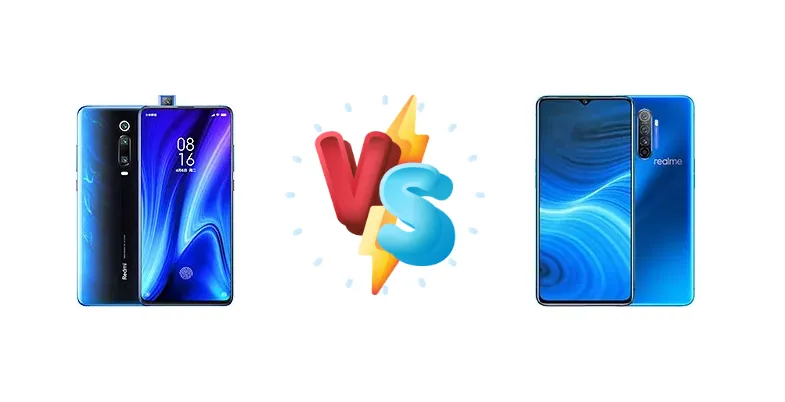
Released within months of each other, the Xiaomi Redmi K20 and Realme X2 Pro represent distinct approaches to the mid-range and upper-mid-range smartphone market. The K20 prioritized affordability with a capable Snapdragon 730, while the X2 Pro aimed for near-flagship performance with the Snapdragon 855+. This comparison dissects their key differences to help you determine which device delivers the best experience for your needs.
🏆 Quick Verdict
For the average user prioritizing raw performance and fast charging, the Realme X2 Pro is the clear winner. Its Snapdragon 855+ chipset and 50W SuperVOOC charging significantly outperform the Redmi K20’s Snapdragon 730 and 18W charging. However, the K20 remains a compelling option for budget-conscious buyers who don't need top-tier processing power.
| Network |
|---|
| 2G bands | GSM 850 / 900 / 1800 / 1900 | GSM 850 / 900 / 1800 / 1900 |
| 3G bands | HSDPA 850 / 900 / 1900 / 2100 | HSDPA 850 / 900 / 1700(AWS) / 1900 / 2100 - China |
| 4G bands | 1, 3, 5, 7, 8, 34, 38, 39, 40, 41 | 1, 2, 3, 4, 5, 7, 8, 12, 17, 18, 19, 20, 26, 34, 38, 39, 40, 41 - China |
| Speed | HSPA, LTE | HSPA, LTE |
| Technology | GSM / HSPA / LTE | GSM / CDMA / HSPA / EVDO / LTE |
| | - | 1, 2, 3, 4, 5, 7, 8, 12, 17, 18, 19, 20, 26, 28, 34, 38, 39, 40, 41 - EMEA |
| Launch |
|---|
| Announced | 2019, May. Released 2019, June | 2019, October 15. Released 2019, October |
| Status | Discontinued | Discontinued |
| Body |
|---|
| Build | Glass front (Gorilla Glass 5), glass back (Gorilla Glass 5), aluminum frame | Glass front (Gorilla Glass 5), glass back (Gorilla Glass 5), aluminum frame |
| Dimensions | 156.7 x 74.3 x 8.8 mm (6.17 x 2.93 x 0.35 in) | 161 x 75.7 x 8.7 mm (6.34 x 2.98 x 0.34 in) |
| SIM | Nano-SIM + Nano-SIM | Nano-SIM + Nano-SIM |
| Weight | 191 g (6.74 oz) | 199 g (7.02 oz) |
| Display |
|---|
| Protection | Corning Gorilla Glass 5 | Corning Gorilla Glass 5 |
| Resolution | 1080 x 2340 pixels, 19.5:9 ratio (~403 ppi density) | 1080 x 2400 pixels, 20:9 ratio (~402 ppi density) |
| Size | 6.39 inches, 100.2 cm2 (~86.1% screen-to-body ratio) | 6.5 inches, 103.5 cm2 (~84.9% screen-to-body ratio) |
| Type | Super AMOLED, HDR | Super AMOLED, 90Hz, HDR10+, 1000 nits (peak) |
| Platform |
|---|
| CPU | Octa-core (2x2.2 GHz Kryo 470 Gold & 6x1.8 GHz Kryo 470 Silver) | Octa-core (1x2.96 GHz Kryo 485 & 3x2.42 GHz Kryo 485 & 4x1.8 GHz Kryo 485) |
| Chipset | Qualcomm SDM730 Snapdragon 730 (8 nm) | Qualcomm SM8150 Snapdragon 855+ (7 nm) |
| GPU | Adreno 618 | Adreno 640 (700 MHz) |
| OS | Android 9.0 (Pie), upgradable to Android 10, MIUI 12 | Android 9.0 (Pie), upgradable to Android 11, Realme UI 2.0 |
| Memory |
|---|
| Card slot | No | No |
| Internal | 64GB 6GB RAM, 128GB 6GB RAM, 256GB 8GB RAM | 64GB 6GB RAM, 128GB 8GB RAM, 256GB 8GB RAM, 256GB 12GB RAM |
| | UFS 2.1 | 64GB UFS 2.1, 128/256GB UFS 3.0 |
| Main Camera |
|---|
| Features | Dual-LED flash, HDR, panorama | Dual-LED flash, HDR, panorama |
| Quad | - | 64 MP, f/1.8, 26mm (wide), 1/1.72", 0.8µm, PDAF
13 MP, f/2.5, 52mm (telephoto), 1/3.4", 1.0µm, PDAF, 2x optical zoom
8 MP, f/2.2, 16mm (ultrawide)
Auxiliary lens |
| Triple | 48 MP, f/1.8, 26mm (wide), 1/2.0", 0.8µm, PDAF
8 MP, f/2.4, 53mm (telephoto), 1/4.0", 1.12µm, PDAF, 2x optical zoom
13 MP, f/2.4, 12mm (ultrawide), 1/3.1", 1.12µm | - |
| Video | 4K@30fps, 1080p@30/120/240fps, 1080p@960fps | 4K@30/60fps, 1080p@30/60/120fps, 720p@960fps, gyro-EIS |
| Selfie camera |
|---|
| Features | HDR | HDR |
| Single | Motorized pop-up 20 MP, f/2.2, (wide), 1/3.4", 0.8µm | 16 MP, f/2.0, 25mm (wide), 1/3.06", 1.0µm |
| Video | 1080p@30fps | 1080p@30fps, gyro-EIS |
| Sound |
|---|
| 3.5mm jack | Yes | Yes |
| 35mm jack | Yes | Yes |
| Loudspeaker | Yes | Yes, with Dolby Atmos stereo speakers (2 dedicated amplifiers) |
| | 24-bit/192kHz audio
| 24-bit/192kHz audio (incl. speakers) |
| Comms |
|---|
| Bluetooth | 5.0, A2DP, LE, aptX HD | 5.0, A2DP, LE |
| NFC | Yes (China only) | Yes |
| Positioning | GPS, GLONASS, GALILEO, BDS | GPS (L1+L5), GLONASS, BDS, GALILEO |
| Radio | FM radio | No |
| USB | USB Type-C 2.0, OTG | USB Type-C 2.0 |
| WLAN | Wi-Fi 802.11 a/b/g/n/ac, dual-band, Wi-Fi Direct | Wi-Fi 802.11 a/b/g/n/ac, dual-band, Wi-Fi Direct |
| Features |
|---|
| Sensors | Fingerprint (under display, optical), accelerometer, gyro, proximity, compass | Fingerprint (under display, optical), accelerometer, gyro, proximity, compass |
| Battery |
|---|
| Charging | 18W wired | 50W wired, 100% in 35 min |
| Type | Li-Po 4000 mAh, non-removable | 4000 mAh, non-removable |
| Misc |
|---|
| Colors | Carbon black, Red flame, Glacier blue, Pearl White | Lunar White, Neptune Blue, Red Master Edition, Gray Master Edition |
| Models | M1903F10I | RMX1931 |
| Price | About 260 EUR | About 440 EUR |
| SAR | 1.07 W/kg (head) 0.72 W/kg (body) | - |
| Tests |
|---|
| Audio quality | - |
Noise -91.3dB / Crosstalk -92.5dB |
| Battery life | - |
Endurance rating 94h
|
| Camera | - |
Photo / Video |
| Display | - |
Contrast ratio: Infinite (nominal) |
| Loudspeaker | - |
Voice 82dB / Noise 75dB / Ring 91dB
|
| Performance | - |
AnTuTu: 396827 (v7), 467653 (v8)
GeekBench: 10373 (v4.4)
GFXBench: 37fps (ES 3.1 onscreen) |
Xiaomi Redmi K20
- More affordable price point
- Decent performance for everyday tasks
- Good battery endurance
- Slower charging speed
- Less powerful processor compared to X2 Pro
- Likely less refined camera system
Realme X2 Pro
- Significantly faster Snapdragon 855+ processor
- Ultra-fast 50W SuperVOOC charging
- Potentially superior camera system
- Higher price tag
- May experience more heat under heavy load (though 7nm helps)
- No specified battery capacity advantage
Display Comparison
Both devices share an 'Infinite' (nominal) contrast ratio, suggesting both utilize AMOLED panels. However, detailed display specs like peak brightness and color gamut coverage are missing. Given the X2 Pro’s positioning, it likely features a slightly more refined panel. The absence of high refresh rate information on either device suggests standard 60Hz panels, common for the era. The focus here isn't on display innovation, but rather on providing a vibrant viewing experience.
Camera Comparison
Both phones are listed as having 'Photo / Video' capabilities, but specific details are lacking. The X2 Pro, positioned as a more premium device, likely features a more sophisticated camera system with a larger sensor and potentially optical image stabilization (OIS). The Redmi K20 likely relies on software processing to enhance image quality. Without sensor size or aperture information, it’s difficult to make a definitive judgment, but the X2 Pro’s higher price point suggests a more capable camera experience. We can assume both phones offer standard features like HDR and portrait modes.
Performance
The core difference lies in the chipsets. The Realme X2 Pro’s Snapdragon 855+ (7nm) is a substantial upgrade over the Redmi K20’s Snapdragon 730 (8nm). The 855+ boasts a Kryo 485 core clocked at 2.96 GHz, compared to the K20’s 2.2 GHz Kryo 470 Gold core. This translates to significantly faster app loading times, smoother multitasking, and superior gaming performance. The 7nm process node of the 855+ also contributes to better thermal efficiency, reducing throttling during sustained workloads. While both phones feature octa-core CPUs, the architectural differences and clock speeds give the X2 Pro a clear advantage.
Battery Life
Interestingly, both phones achieve an endurance rating of 94 hours, despite differing battery capacities (not specified in the data). This suggests efficient power management on both sides. However, the X2 Pro’s 50W SuperVOOC charging is a game-changer, achieving a 100% charge in just 35 minutes. The Redmi K20’s 18W charging is considerably slower. While battery life may be comparable, the X2 Pro’s charging speed offers a significantly more convenient user experience, especially for those who frequently need to top up their battery.
Buying Guide
Buy the Xiaomi Redmi K20 if you need a reliable daily driver with decent performance for everyday tasks and moderate gaming, and if maximizing value for your money is paramount. Buy the Realme X2 Pro if you prioritize demanding gaming, fast charging, and a smoother overall experience, and are willing to spend a bit more for a significant performance boost.
Frequently Asked Questions
❓ Does the Snapdragon 730 in the Redmi K20 struggle with graphically intensive games like PUBG or Call of Duty?
While the Snapdragon 730 is capable, it won't deliver the same smooth experience as the Snapdragon 855+ in the X2 Pro. You'll likely need to lower graphics settings to maintain a stable frame rate in demanding titles. The X2 Pro offers a significantly more fluid gaming experience without compromising visual fidelity.
❓ How much faster is the 50W charging on the Realme X2 Pro compared to the 18W charging on the Redmi K20 in real-world use?
The difference is substantial. The X2 Pro can go from 0% to 100% in approximately 35 minutes, while the Redmi K20 will take well over an hour, potentially closer to two hours. This means you can quickly top up the X2 Pro during short breaks, whereas the K20 requires a longer charging period.
❓ Is the camera on the Realme X2 Pro noticeably better for low-light photography?
While specific camera specs are limited, the X2 Pro's likely larger sensor and potential OIS would give it a significant advantage in low-light conditions. Expect less noise, more detail, and better dynamic range compared to the Redmi K20.