
Redmi K20 vs OnePlus 7T Pro 5G McLaren: A Detailed Performance and Value Showdown
| Phones Images | |||||
|---|---|---|---|---|---|
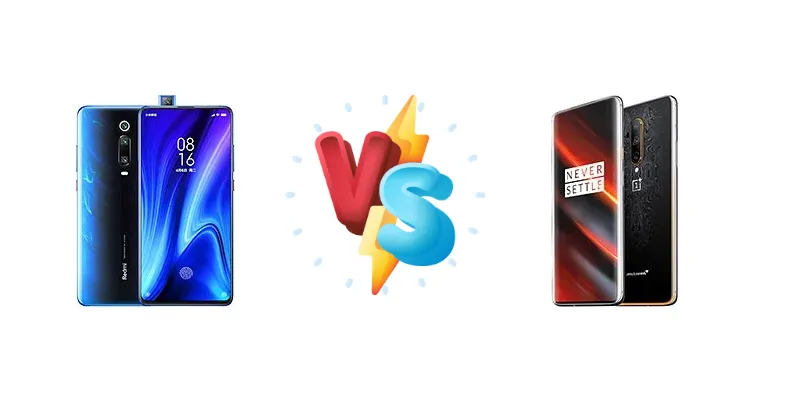
|
🏆 Quick Verdict
For the average user prioritizing raw speed and 5G connectivity, the OnePlus 7T Pro 5G McLaren is the clear winner. Its Snapdragon 855+ chipset delivers significantly higher performance than the Redmi K20’s Snapdragon 730. However, the K20 remains a compelling option for budget-conscious users who don't need the absolute fastest performance.
| PHONES | ||
|---|---|---|
| Phone Names | Xiaomi Redmi K20 | OnePlus 7T Pro 5G McLaren |
| Network | ||
|---|---|---|
| 2G bands | GSM 850 / 900 / 1800 / 1900 | GSM 850 / 900 / 1800 / 1900 |
| 3G bands | HSDPA 850 / 900 / 1900 / 2100 | HSDPA 850 / 900 / 1700(AWS) / 1900 / 2100 |
| 4G bands | 1, 3, 5, 7, 8, 34, 38, 39, 40, 41 | 1, 2, 3, 4, 5, 1, 2, 3, 4, 5, 7, 8, 12, 13, 17, 18, 19, 20, 25, 26, 28, 29, 30, 34, 38, 39, 40, 41, 46, 48, 66, 71 |
| 5G bands | - | 71 SA |
| Speed | HSPA, LTE | HSPA 42.2/5.76 Mbps, LTE (5CA) Cat18 1200/150 Mbps, 5G (2+ Gbps DL) |
| Technology | GSM / HSPA / LTE | GSM / CDMA / HSPA / LTE / 5G |
| - | CDMA 800 / 1900 & TD-SCDMA | |
| Launch | ||
|---|---|---|
| Announced | 2019, May. Released 2019, June | 2019, October 23. Released 2019, November 05 |
| Status | Discontinued | Discontinued |
| Body | ||
|---|---|---|
| Build | Glass front (Gorilla Glass 5), glass back (Gorilla Glass 5), aluminum frame | Glass front (Gorilla Glass 6), glass back (Gorilla Glass 5), aluminum frame |
| Dimensions | 156.7 x 74.3 x 8.8 mm (6.17 x 2.93 x 0.35 in) | 162.6 x 75.9 x 8.8 mm (6.40 x 2.99 x 0.35 in) |
| SIM | Nano-SIM + Nano-SIM | Nano-SIM + Nano-SIM |
| Weight | 191 g (6.74 oz) | 206 g (7.27 oz) |
| Display | ||
|---|---|---|
| Protection | Corning Gorilla Glass 5 | Corning Gorilla Glass 6 |
| Resolution | 1080 x 2340 pixels, 19.5:9 ratio (~403 ppi density) | 1440 x 3120 pixels, 19.5:9 ratio (~516 ppi density) |
| Size | 6.39 inches, 100.2 cm2 (~86.1% screen-to-body ratio) | 6.67 inches, 108.8 cm2 (~88.1% screen-to-body ratio) |
| Type | Super AMOLED, HDR | Fluid AMOLED, 90Hz, HDR10+ |
| Platform | ||
|---|---|---|
| CPU | Octa-core (2x2.2 GHz Kryo 470 Gold & 6x1.8 GHz Kryo 470 Silver) | Octa-core (1x2.96 GHz Kryo 485 & 3x2.42 GHz Kryo 485 & 4x1.78 GHz Kryo 485) |
| Chipset | Qualcomm SDM730 Snapdragon 730 (8 nm) | Qualcomm SM8150 Snapdragon 855+ (7 nm) |
| GPU | Adreno 618 | Adreno 640 (700 MHz) |
| OS | Android 9.0 (Pie), upgradable to Android 10, MIUI 12 | Android 10, OxygenOS 10.0 |
| Memory | ||
|---|---|---|
| Card slot | No | No |
| Internal | 64GB 6GB RAM, 128GB 6GB RAM, 256GB 8GB RAM | 256GB 12GB RAM |
| UFS 2.1 | UFS 3.0 | |
| Main Camera | ||
|---|---|---|
| Features | Dual-LED flash, HDR, panorama | Laser AF, Dual-LED flash, HDR, panorama |
| Triple | 48 MP, f/1.8, 26mm (wide), 1/2.0", 0.8µm, PDAF 8 MP, f/2.4, 53mm (telephoto), 1/4.0", 1.12µm, PDAF, 2x optical zoom 13 MP, f/2.4, 12mm (ultrawide), 1/3.1", 1.12µm | 48 MP, f/1.6, (wide), 1/2.0", 0.8µm, PDAF, OIS 8 MP, f/2.4, (telephoto), 1.0µm, PDAF, OIS, 3x optical zoom 16 MP, f/2.2, 13mm (ultrawide), AF |
| Video | 4K@30fps, 1080p@30/120/240fps, 1080p@960fps | 4K@30/60fps, 1080p@30/60/240fps, 720p@960fps, Auto HDR, gyro-EIS |
| Selfie camera | ||
|---|---|---|
| Features | HDR | HDR |
| Single | Motorized pop-up 20 MP, f/2.2, (wide), 1/3.4", 0.8µm | Motorized pop-up 16 MP, f/2.0, 25mm (wide), 1/3.06", 1.0µm |
| Video | 1080p@30fps | 1080p@30fps, gyro-EIS |
| Sound | ||
|---|---|---|
| 3.5mm jack | Yes | No |
| 35mm jack | Yes | No |
| Loudspeaker | Yes | Yes, with stereo speakers |
| 24-bit/192kHz audio | - | |
| Comms | ||
|---|---|---|
| Bluetooth | 5.0, A2DP, LE, aptX HD | 5.1, A2DP, LE, aptX HD |
| NFC | Yes (China only) | Yes |
| Positioning | GPS, GLONASS, GALILEO, BDS | GPS (L1+L5), GLONASS (G1), BDS (B1), GALILEO (E1+E5a) |
| Radio | FM radio | No |
| USB | USB Type-C 2.0, OTG | USB Type-C 3.1, OTG |
| WLAN | Wi-Fi 802.11 a/b/g/n/ac, dual-band, Wi-Fi Direct | Wi-Fi 802.11 a/b/g/n/ac, dual-band, Wi-Fi Direct, DLNA |
| Features | ||
|---|---|---|
| Sensors | Fingerprint (under display, optical), accelerometer, gyro, proximity, compass | Fingerprint (under display, optical), accelerometer, gyro, compass |
| - | Virtual proximity sensing | |
| Battery | ||
|---|---|---|
| Charging | 18W wired | 30W wired |
| Type | Li-Po 4000 mAh, non-removable | Li-Po 4085 mAh, non-removable |
| Misc | ||
|---|---|---|
| Colors | Carbon black, Red flame, Glacier blue, Pearl White | Papaya Orange |
| Models | M1903F10I | HD1925 |
| Price | About 260 EUR | About 800 EUR |
| SAR | 1.07 W/kg (head) 0.72 W/kg (body) | - |
Xiaomi Redmi K20
- Significantly more affordable
- Decent performance for everyday tasks
- Good value for money
- Slower processor compared to the 855+
- Slower charging speed (18W)
- Likely inferior camera performance
OnePlus 7T Pro 5G McLaren
- Blazing-fast Snapdragon 855+ performance
- 30W Warp Charge for rapid charging
- Likely superior camera quality and features
- Considerably more expensive
- May not represent the best value for budget-conscious users
- Potentially larger size and weight
Display Comparison
While both devices likely feature AMOLED panels (based on brand history), the specifics aren't provided. The OnePlus 7T Pro 5G McLaren, being a higher-end device, likely boasts a higher peak brightness and potentially a higher refresh rate (90Hz was standard for the 7T Pro line). The Redmi K20, while still offering a vibrant display, will likely fall short in peak brightness and refresh rate, impacting outdoor visibility and smoothness. Bezels are expected to be minimal on both, but the McLaren edition likely has a slight edge in build quality and screen-to-body ratio.
Camera Comparison
Without detailed sensor information, a direct comparison is difficult. However, the OnePlus 7T Pro 5G McLaren, as a flagship, likely features a larger main sensor and more sophisticated image processing algorithms. The 855+ also has a more powerful ISP (Image Signal Processor) which aids in faster image capture and better low-light performance. While the Redmi K20 likely offers a respectable camera experience, the McLaren edition will likely deliver superior image quality, particularly in challenging conditions. The inclusion of OIS (Optical Image Stabilization) is more probable on the 7T Pro 5G McLaren, further enhancing image clarity.
Performance
The core difference lies in the chipsets. The OnePlus 7T Pro 5G McLaren’s Snapdragon 855+ (7nm) is a significant leap over the Redmi K20’s Snapdragon 730 (8nm). The 855+ features a Kryo 485 core clocked at 2.96 GHz, compared to the 730’s 2.2 GHz Kryo 470 Gold core. This translates to a substantial performance advantage in CPU-intensive tasks and gaming. The 7nm process node of the 855+ also contributes to better thermal efficiency, reducing throttling during sustained workloads. The 7T Pro 5G McLaren will handle demanding games and multitasking with ease, while the K20 may exhibit some slowdowns under heavy load.
Battery Life
The Redmi K20’s 18W charging is significantly slower than the OnePlus 7T Pro 5G McLaren’s 30W Warp Charge. This means the McLaren edition can replenish its battery much faster, minimizing downtime. While battery capacity isn't specified, the faster charging of the 7T Pro 5G McLaren effectively mitigates any potential disadvantage from a slightly smaller battery. Users who frequently top up their phones will greatly benefit from the McLaren's charging speed.
Buying Guide
Buy the Xiaomi Redmi K20 if you need a capable all-rounder with decent performance for everyday tasks and light gaming, and value affordability above all else. Buy the OnePlus 7T Pro 5G McLaren if you prioritize blazing-fast performance for demanding games and applications, require 5G connectivity, and are willing to pay a premium for a smoother, more responsive experience.