
Redmi K20 vs. Pixel 4a 5G: A Deep Dive into Mid-Range Performance and 5G
| Phones Images | |||||
|---|---|---|---|---|---|
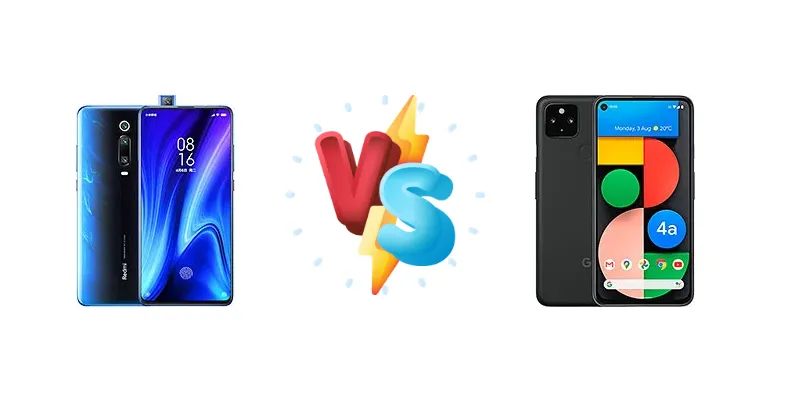
|
🏆 Quick Verdict
For the average user prioritizing software experience and 5G connectivity, the Google Pixel 4a 5G is the better choice. Its Snapdragon 765G offers a performance edge and future-proof 5G support, while Google’s software updates and camera processing provide a refined user experience. However, the Redmi K20 remains a strong contender for budget-conscious buyers.
| PHONES | ||
|---|---|---|
| Phone Names | Xiaomi Redmi K20 | Google Pixel 4a 5G |
| Network | ||
|---|---|---|
| 2G bands | GSM 850 / 900 / 1800 / 1900 | GSM 850 / 900 / 1800 / 1900 |
| 3G bands | HSDPA 850 / 900 / 1900 / 2100 | HSDPA 850 / 900 / 1700(AWS) / 1900 / 2100 |
| 4G bands | 1, 3, 5, 7, 8, 34, 38, 39, 40, 41 | 1, 2, 3, 4, 5, 7, 8, 12, 13, 14, 17, 18, 19, 20, 25, 26, 28, 29, 30, 32, 38, 39, 40, 41, 42, 46, 48, 66, 71 |
| 5G bands | - | 1, 2, 3, 5, 7, 8, 12, 28, 41, 66, 71, 77, 78 Sub6, mmWave (market dependant) |
| Speed | HSPA, LTE | HSPA, LTE, 5G |
| Technology | GSM / HSPA / LTE | GSM / HSPA / LTE / 5G |
| Launch | ||
|---|---|---|
| Announced | 2019, May. Released 2019, June | 2020, September 30 |
| Status | Discontinued | Available. Released 2020, November 05 |
| Body | ||
|---|---|---|
| Build | Glass front (Gorilla Glass 5), glass back (Gorilla Glass 5), aluminum frame | Glass front (Gorilla Glass 3), plastic back, plastic frame |
| Dimensions | 156.7 x 74.3 x 8.8 mm (6.17 x 2.93 x 0.35 in) | 153.9 x 74 x 8.2 mm (Sub-6) or 8.5 mm (Sub-6 and mmWave) |
| SIM | Nano-SIM + Nano-SIM | Nano-SIM + eSIM |
| Weight | 191 g (6.74 oz) | 168 g (5G Sub-6); 171 g ( 5G Sub-6 and mmWave) (5.93 oz) |
| Display | ||
|---|---|---|
| Protection | Corning Gorilla Glass 5 | Corning Gorilla Glass 3 |
| Resolution | 1080 x 2340 pixels, 19.5:9 ratio (~403 ppi density) | 1080 x 2340 pixels, 19.5:9 ratio (~413 ppi density) |
| Size | 6.39 inches, 100.2 cm2 (~86.1% screen-to-body ratio) | 6.2 inches, 95.7 cm2 (~84.1% screen-to-body ratio) |
| Type | Super AMOLED, HDR | OLED, HDR |
| - | Always-on display | |
| Platform | ||
|---|---|---|
| CPU | Octa-core (2x2.2 GHz Kryo 470 Gold & 6x1.8 GHz Kryo 470 Silver) | Octa-core (1x2.4 GHz Kryo 475 Prime & 1x2.2 GHz Kryo 475 Gold & 6x1.8 GHz Kryo 475 Silver) |
| Chipset | Qualcomm SDM730 Snapdragon 730 (8 nm) | Qualcomm SM7250 Snapdragon 765G 5G (7 nm) |
| GPU | Adreno 618 | Adreno 620 |
| OS | Android 9.0 (Pie), upgradable to Android 10, MIUI 12 | Android 11, upgradable to Android 14 |
| Memory | ||
|---|---|---|
| Card slot | No | No |
| Internal | 64GB 6GB RAM, 128GB 6GB RAM, 256GB 8GB RAM | 128GB 6GB RAM |
| UFS 2.1 | UFS 2.1 | |
| Main Camera | ||
|---|---|---|
| Dual | - | 12.2 MP, f/1.7, 27mm (wide), 1/2.55", 1.4µm, dual pixel PDAF, OIS 16 MP, f/2.2, 107˚ (ultrawide), 1.0µm |
| Features | Dual-LED flash, HDR, panorama | LED flash, Pixel Shift, Auto-HDR, panorama |
| Triple | 48 MP, f/1.8, 26mm (wide), 1/2.0", 0.8µm, PDAF 8 MP, f/2.4, 53mm (telephoto), 1/4.0", 1.12µm, PDAF, 2x optical zoom 13 MP, f/2.4, 12mm (ultrawide), 1/3.1", 1.12µm | - |
| Video | 4K@30fps, 1080p@30/120/240fps, 1080p@960fps | 4K@30/60fps, 1080p@30/60/120/240fps; gyro-EIS |
| Selfie camera | ||
|---|---|---|
| Features | HDR | HDR |
| Single | Motorized pop-up 20 MP, f/2.2, (wide), 1/3.4", 0.8µm | 8 MP, f/2.0, 24mm (wide), 1/4.0", 1.12µm |
| Video | 1080p@30fps | 1080p@30fps |
| Sound | ||
|---|---|---|
| 3.5mm jack | Yes | Yes |
| 35mm jack | Yes | Yes |
| Loudspeaker | Yes | Yes, with stereo speakers |
| 24-bit/192kHz audio | - | |
| Comms | ||
|---|---|---|
| Bluetooth | 5.0, A2DP, LE, aptX HD | 5.0, A2DP, LE, aptX HD |
| NFC | Yes (China only) | Yes |
| Positioning | GPS, GLONASS, GALILEO, BDS | GPS, GLONASS, GALILEO, QZSS, BDS |
| Radio | FM radio | No |
| USB | USB Type-C 2.0, OTG | USB Type-C 3.1 |
| WLAN | Wi-Fi 802.11 a/b/g/n/ac, dual-band, Wi-Fi Direct | Wi-Fi 802.11 a/b/g/n/ac, dual-band, Wi-Fi Direct |
| Features | ||
|---|---|---|
| Sensors | Fingerprint (under display, optical), accelerometer, gyro, proximity, compass | Fingerprint (rear-mounted), accelerometer, gyro, proximity, compass, barometer |
| Battery | ||
|---|---|---|
| Charging | 18W wired | 18W wired, PD2.0 |
| Type | Li-Po 4000 mAh, non-removable | Li-Po 3885 mAh |
| Misc | ||
|---|---|---|
| Colors | Carbon black, Red flame, Glacier blue, Pearl White | Just Black, Clearly White |
| Models | M1903F10I | GD1YQ, G025I, G025E, G025H, G6QU3 |
| Price | About 260 EUR | About 140 EUR |
| SAR | 1.07 W/kg (head) 0.72 W/kg (body) | - |
Xiaomi Redmi K20
- Potentially lower price point
- Likely AMOLED display for vibrant colors
- Good value for money
- Lacks 5G connectivity
- Older chipset with less processing power
- MIUI software may not appeal to all users
Google Pixel 4a 5G
- 5G connectivity for future-proofing
- Clean Android experience with guaranteed updates
- Superior image processing capabilities
- Potentially higher price
- Likely LCD display (less vibrant than AMOLED)
- May not offer the absolute lowest price
Display Comparison
While both devices lack detailed display specifications in the provided data, the Redmi K20 historically featured an AMOLED panel, suggesting superior contrast and color vibrancy compared to the Pixel 4a 5G’s likely LCD. The absence of refresh rate data suggests neither boasts a high refresh rate display. Bezels are likely comparable given the market segment, but the AMOLED advantage on the K20 would be noticeable in media consumption.
Camera Comparison
Without detailed sensor information, a direct comparison is difficult. However, Google’s computational photography prowess is a major differentiator. The Pixel 4a 5G leverages Google’s image processing algorithms to deliver consistently excellent photos, particularly in challenging lighting conditions. While the K20 may have a higher megapixel count, the Pixel’s software optimization likely results in superior image quality. The 765G’s ISP also benefits from newer image signal processing capabilities. The absence of OIS data suggests neither phone prioritizes optical image stabilization.
Performance
The core difference lies in the chipsets: the Redmi K20’s Snapdragon 730 (8nm) versus the Pixel 4a 5G’s Snapdragon 765G (7nm). The 7nm process node of the 765G inherently offers better power efficiency and thermal headroom. The 765G’s Kryo 475 Prime core, clocked at 2.4GHz, provides a noticeable CPU performance boost over the K20’s 2.2GHz Kryo 470 Gold cores. This translates to snappier app launches and smoother multitasking. The integrated 5G modem in the 765G is a significant advantage for future-proofing, while the K20 lacks 5G support. Both utilize similar RAM configurations, but the 765G’s architectural advantages will be felt in sustained workloads.
Battery Life
Both phones feature 18W wired charging, but the Pixel 4a 5G adds PD2.0 support for potentially faster and more efficient charging with compatible chargers. Battery capacity isn’t specified, but the 7nm process of the 765G should contribute to better battery life on the Pixel 4a 5G, despite potentially similar battery sizes. The efficiency gains from the 765G will translate to longer screen-on time, especially when utilizing 5G connectivity.
Buying Guide
Buy the Xiaomi Redmi K20 if you need a capable all-rounder at the lowest possible price, and are comfortable with Xiaomi’s MIUI software. It’s ideal for users who prioritize value over bleeding-edge features. Buy the Google Pixel 4a 5G if you prefer a clean Android experience, reliable software updates, and want to take advantage of 5G networks, even if it means spending a bit more.