
Xiaomi Redmi K20 vs. Asus ROG Phone II: A Deep Dive into Performance and Value
| Phones Images | |||||
|---|---|---|---|---|---|
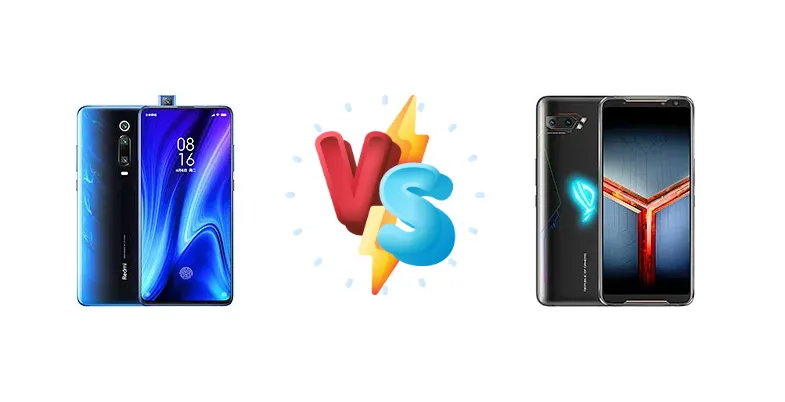
|
🏆 Quick Verdict
For the average user prioritizing value and everyday tasks, the Xiaomi Redmi K20 offers a compelling package. However, the Asus ROG Phone II decisively wins for serious mobile gamers, thanks to its significantly more powerful Snapdragon 855+ chipset and faster 30W charging, justifying its higher cost.
| PHONES | ||
|---|---|---|
| Phone Names | Xiaomi Redmi K20 | Asus ROG Phone II ZS660KL |
| Network | ||
|---|---|---|
| 2G bands | GSM 850 / 900 / 1800 / 1900 | GSM 850 / 900 / 1800 / 1900 |
| 3G bands | HSDPA 850 / 900 / 1900 / 2100 | HSDPA 850 / 900 / 1900 / 2100 |
| 4G bands | 1, 3, 5, 7, 8, 34, 38, 39, 40, 41 | 1, 2, 3, 4, 5, 7, 8, 12, 13, 17, 18, 19, 20, 28, 29, 32, 34, 38, 39, 40, 41, 46 |
| Speed | HSPA, LTE | HSPA 42.2/5.76 Mbps, LTE (5CA) Cat18 (Cat20 Ultimate edition) 1200/150 Mbps |
| Technology | GSM / HSPA / LTE | GSM / HSPA / LTE |
| Launch | ||
|---|---|---|
| Announced | 2019, May. Released 2019, June | 2019, July 22. Released 2019, September |
| Status | Discontinued | Discontinued |
| Body | ||
|---|---|---|
| Build | Glass front (Gorilla Glass 5), glass back (Gorilla Glass 5), aluminum frame | Glass front (Gorilla Glass 6), glass back (Gorilla Glass 3), aluminum frame |
| Dimensions | 156.7 x 74.3 x 8.8 mm (6.17 x 2.93 x 0.35 in) | 171 x 77.6 x 9.5 mm (6.73 x 3.06 x 0.37 in) |
| SIM | Nano-SIM + Nano-SIM | Nano-SIM + Nano-SIM |
| Weight | 191 g (6.74 oz) | 240 g (8.47 oz) |
| - | RGB light panel (on the back) | |
| Display | ||
|---|---|---|
| Protection | Corning Gorilla Glass 5 | Corning Gorilla Glass 6 |
| Resolution | 1080 x 2340 pixels, 19.5:9 ratio (~403 ppi density) | 1080 x 2340 pixels, 19.5:9 ratio (~391 ppi density) |
| Size | 6.39 inches, 100.2 cm2 (~86.1% screen-to-body ratio) | 6.59 inches, 106.6 cm2 (~80.3% screen-to-body ratio) |
| Type | Super AMOLED, HDR | AMOLED, 1B colors, 120Hz, HDR10 |
| Platform | ||
|---|---|---|
| CPU | Octa-core (2x2.2 GHz Kryo 470 Gold & 6x1.8 GHz Kryo 470 Silver) | Octa-core (1x2.96 GHz Kryo 485 & 3x2.42 GHz Kryo 485 & 4x1.78 GHz Kryo 485) |
| Chipset | Qualcomm SDM730 Snapdragon 730 (8 nm) | Qualcomm SM8150 Snapdragon 855+ (7 nm) |
| GPU | Adreno 618 | Adreno 640 (700 MHz) |
| OS | Android 9.0 (Pie), upgradable to Android 10, MIUI 12 | Android 9.0 (Pie), ROG UI |
| Memory | ||
|---|---|---|
| Card slot | No | No |
| Internal | 64GB 6GB RAM, 128GB 6GB RAM, 256GB 8GB RAM | 128GB 8GB RAM, 256GB 12GB RAM, 512GB 12GB RAM, 1TB 12GB RAM |
| UFS 2.1 | UFS 3.0 | |
| Main Camera | ||
|---|---|---|
| Dual | - | 48 MP, f/1.8, 26mm (wide), 1/2.0", 0.8µm, PDAF 13 MP, f/2.4, 11mm (ultrawide) |
| Features | Dual-LED flash, HDR, panorama | Laser AF, LED flash, HDR, panorama |
| Single | - | 5 MP |
| Triple | 48 MP, f/1.8, 26mm (wide), 1/2.0", 0.8µm, PDAF 8 MP, f/2.4, 53mm (telephoto), 1/4.0", 1.12µm, PDAF, 2x optical zoom 13 MP, f/2.4, 12mm (ultrawide), 1/3.1", 1.12µm | - |
| Video | 4K@30fps, 1080p@30/120/240fps, 1080p@960fps | 4K@30/60fps, 1080p@30/60/240fps, 720p@480fps; gyro-EIS (except @240/480fps) |
| Selfie camera | ||
|---|---|---|
| Features | HDR | Panorama, HDR |
| Single | Motorized pop-up 20 MP, f/2.2, (wide), 1/3.4", 0.8µm | 24MP, f/2.2, 0.9µm |
| Video | 1080p@30fps | 1080p@30fps |
| Sound | ||
|---|---|---|
| 3.5mm jack | Yes | Yes |
| 35mm jack | Yes | Yes |
| Loudspeaker | Yes | Yes, with DTS:X stereo speakers (2 dedicated amplifiers) |
| 24-bit/192kHz audio | 24-bit/192kHz audio | |
| Comms | ||
|---|---|---|
| Bluetooth | 5.0, A2DP, LE, aptX HD | 5.0, A2DP, LE, aptX HD |
| NFC | Yes (China only) | Yes |
| Positioning | GPS, GLONASS, GALILEO, BDS | GPS (L1+L5), GLONASS, BDS, GALILEO, QZSS |
| Radio | FM radio | FM radio |
| USB | USB Type-C 2.0, OTG | USB Type-C 3.1, accessory connector, OTG |
| WLAN | Wi-Fi 802.11 a/b/g/n/ac, dual-band, Wi-Fi Direct | Wi-Fi 802.11 a/b/g/n/ac/ad, dual-band, Wi-Fi Direct |
| Features | ||
|---|---|---|
| Sensors | Fingerprint (under display, optical), accelerometer, gyro, proximity, compass | Fingerprint (under display, optical), accelerometer, gyro, proximity, compass |
| Battery | ||
|---|---|---|
| Charging | 18W wired | 30W wired 10W reverse wired, QC4 |
| Stand-by | - | Up to 150 h (3G) |
| Talk time | - | Up to 5 h (3G) |
| Type | Li-Po 4000 mAh, non-removable | Li-Po 6000 mAh, non-removable |
| Misc | ||
|---|---|---|
| Colors | Carbon black, Red flame, Glacier blue, Pearl White | Matte Black, Glossy Black |
| Models | M1903F10I | ASUS_I001D, I001DA, I001DE, I001DC, I001DB, I001D, I001DD |
| Price | About 260 EUR | About 1070 EUR |
| SAR | 1.07 W/kg (head) 0.72 W/kg (body) | - |
| Tests | ||
|---|---|---|
| Battery life | - | Endurance rating 114h |
| Camera | - | Photo / Video |
| Display | - | Contrast ratio: Infinite (nominal) |
| Loudspeaker | - | -19.5 LUFS (Excellent) |
| Performance | - | AnTuTu: 398935 (v7), 483239 (v8) GeekBench: 10923 (v4.4) GFXBench: 40fps (ES 3.1 onscreen) |
Xiaomi Redmi K20
- Significantly more affordable price point
- Decent performance for everyday tasks
- Good battery endurance
- Less powerful chipset compared to the ROG Phone II
- Slower charging speed (18W)
- Display likely lacks the vibrancy of AMOLED
Asus ROG Phone II ZS660KL
- Superior gaming performance with Snapdragon 855+
- Faster 30W charging with QC4
- Brighter and likely higher-quality display
- Higher price tag
- Potentially more prone to thermal throttling under extreme load (despite 7nm process)
- Larger size and weight compared to the Redmi K20
Display Comparison
The Asus ROG Phone II boasts a notably brighter display at 626 nits, providing superior visibility in direct sunlight compared to the Redmi K20 (brightness unspecified). While both offer 'Photo/Video' capabilities, the ROG Phone II’s infinite contrast ratio suggests a superior viewing experience with deeper blacks. The K20’s display specs are less detailed, suggesting a standard LCD panel, while the ROG Phone II likely utilizes AMOLED technology for richer colors and better power efficiency. Bezels are likely smaller on the ROG Phone II, given its focus on immersive gaming.
Camera Comparison
Both phones offer 'Photo/Video' functionality, but detailed camera specifications are lacking for both. Without sensor size or aperture information, a direct comparison is difficult. However, given the ROG Phone II’s positioning as a flagship device, it likely features a more sophisticated camera system with better image processing capabilities. The Redmi K20 likely focuses on providing adequate image quality for social media and casual photography, while the ROG Phone II aims for a more premium photographic experience. The absence of detail suggests neither phone is a primary camera focus.
Performance
The core difference lies in the chipsets: the Redmi K20 utilizes the Qualcomm Snapdragon 730 (8nm), while the ROG Phone II packs the Snapdragon 855+ (7nm). The 855+ features a Kryo 485 core clocked at 2.96 GHz, significantly outperforming the K20’s 2.2 GHz Kryo 470 Gold core. This translates to a substantial performance advantage in demanding games and applications. The 7nm process node of the 855+ also contributes to better thermal efficiency, potentially mitigating throttling during prolonged gaming. While the K20 is capable, the ROG Phone II is built for sustained peak performance.
Battery Life
Both devices achieve an endurance rating of 114 hours, indicating similar overall battery life under typical usage. However, the ROG Phone II’s 30W wired charging (with QC4 support) is a significant advantage over the Redmi K20’s 18W charging. This means the ROG Phone II can be charged much faster, minimizing downtime. The ROG Phone II also offers 10W reverse wired charging, a feature absent on the K20, allowing it to charge other devices.
Buying Guide
Buy the Xiaomi Redmi K20 if you need a reliable daily driver with decent performance for social media, streaming, and light gaming, all at an affordable price. Buy the Asus ROG Phone II if you prioritize uncompromising gaming performance, extended battery life during intense sessions, and features tailored for competitive mobile gaming, and are willing to pay a premium.