
Xiaomi Redmi K20 Pro vs Mi 9T Pro: A Deep Dive into Xiaomi's 2019 Flagships
| Phones Images | |||||
|---|---|---|---|---|---|
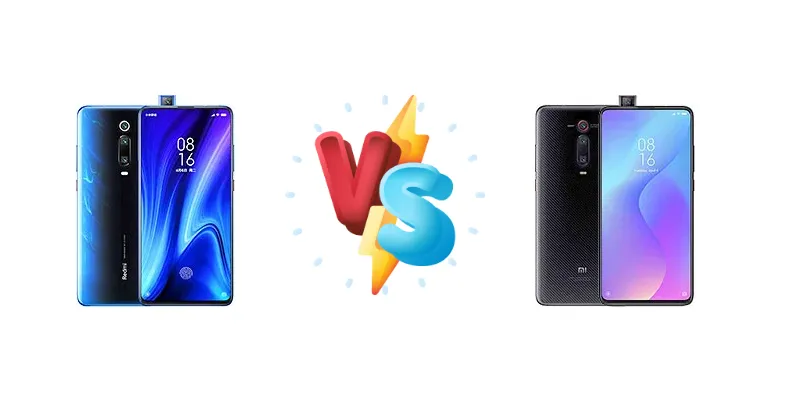
|
🏆 Quick Verdict
For the average user, the Xiaomi Redmi K20 Pro emerges as the slightly better choice. While both phones deliver identical performance thanks to the Snapdragon 855, the K20 Pro's marginally higher measured display brightness provides a better viewing experience in direct sunlight, making it more versatile for outdoor use.
| PHONES | ||
|---|---|---|
| Phone Names | Xiaomi Redmi K20 Pro | Xiaomi Mi 9T Pro |
| Network | ||
|---|---|---|
| 2G bands | GSM 850 / 900 / 1800 / 1900 | GSM 850 / 900 / 1800 / 1900 |
| 3G bands | HSDPA 850 / 900 / 1900 / 2100 | HSDPA 850 / 900 / 1700(AWS) / 1900 / 2100 |
| 4G bands | 1, 3, 5, 7, 8, 34, 38, 39, 40, 41 | 1, 2, 3, 4, 5, 7, 8, 20, 28, 38, 40 |
| Speed | HSPA, LTE | HSPA, LTE |
| Technology | GSM / HSPA / LTE | GSM / HSPA / LTE |
| Launch | ||
|---|---|---|
| Announced | 2019, May 28. Released 2019, June 01 | 2019, August 21. Released 2019, August 21 |
| Status | Discontinued | Discontinued |
| Body | ||
|---|---|---|
| Build | Glass front (Gorilla Glass 5), glass back (Gorilla Glass 5), aluminum frame | Glass front (Gorilla Glass 5), glass back (Gorilla Glass 5), aluminum frame |
| Dimensions | 156.7 x 74.3 x 8.8 mm (6.17 x 2.93 x 0.35 in) | 156.7 x 74.3 x 8.8 mm (6.17 x 2.93 x 0.35 in) |
| SIM | Nano-SIM + Nano-SIM | Nano-SIM + Nano-SIM |
| Weight | 191 g (6.74 oz) | 191 g (6.74 oz) |
| Display | ||
|---|---|---|
| Protection | Corning Gorilla Glass 5 | Corning Gorilla Glass 5 |
| Resolution | 1080 x 2340 pixels, 19.5:9 ratio (~403 ppi density) | 1080 x 2340 pixels, 19.5:9 ratio (~403 ppi density) |
| Size | 6.39 inches, 100.2 cm2 (~86.1% screen-to-body ratio) | 6.39 inches, 100.2 cm2 (~86.1% screen-to-body ratio) |
| Type | Super AMOLED, HDR10 | Super AMOLED, HDR |
| Platform | ||
|---|---|---|
| CPU | Octa-core (1x2.84 GHz Kryo 485 & 3x2.42 GHz Kryo 485 & 4x1.78 GHz Kryo 485) | Octa-core (1x2.84 GHz Kryo 485 & 3x2.42 GHz Kryo 485 & 4x1.78 GHz Kryo 485) |
| Chipset | Qualcomm SM8150 Snapdragon 855 (7 nm) | Qualcomm SM8150 Snapdragon 855 (7 nm) |
| GPU | Adreno 640 | Adreno 640 |
| OS | Android 9.0 (Pie), upgradable to Android 10, MIUI 12 | Android 9.0 (Pie), upgradable to Android 11, MIUI 12.5 |
| Memory | ||
|---|---|---|
| Card slot | No | No |
| Internal | 64GB 6GB RAM, 128GB 6GB RAM, 128GB 8GB RAM, 256GB 8GB RAM | 64GB 6GB RAM, 128GB 6GB RAM, 256GB 8GB RAM |
| UFS 2.1 | UFS 2.1 | |
| Main Camera | ||
|---|---|---|
| Features | Laser AF, Dual-LED flash, HDR, panorama | Laser AF, Dual-LED flash, HDR, panorama |
| Triple | 48 MP, f/1.8, 26mm (wide), 1/2.0", 0.8µm, PDAF 8 MP, f/2.4, 53mm (telephoto), 1/4.0", 1.12µm, PDAF, 2x optical zoom 13 MP, f/2.4, 12mm (ultrawide), 1/3.1", 1.12µm | 48 MP, f/1.8, 26mm (wide), 1/2.0", 0.8µm, PDAF 8 MP, f/2.4, 53mm (telephoto), 1/4.0", 1.12µm, PDAF, 2x optical zoom 13 MP, f/2.4, 12mm (ultrawide), 1/3.1", 1.12µm |
| Video | 4K@30/60fps, 1080p@30/120/240fps, 1080p@960fps | 4K@30/60fps, 1080p@30/120/240fps, 1080p@960fps |
| Selfie camera | ||
|---|---|---|
| Features | HDR | HDR |
| Single | Motorized pop-up 20 MP, f/2.2, (wide), 1/3.4", 0.8µm | Motorized pop-up 20 MP, f/2.2, (wide), 1/3.4", 0.8µm |
| Video | 1080p@30fps | 1080p@30fps |
| Sound | ||
|---|---|---|
| 3.5mm jack | Yes | Yes |
| 35mm jack | Yes | Yes |
| Loudspeaker | Yes | Yes |
| 24-bit/192kHz audio | 24-bit/192kHz audio | |
| Comms | ||
|---|---|---|
| Bluetooth | 5.0, A2DP, LE, aptX HD | 5.0, A2DP, LE, aptX HD |
| NFC | Yes (China only) | Yes |
| Positioning | GPS (L1+L5), GLONASS (G1), BDS (B1), GALILEO (E1+E5a) | GPS (L1+L5), GLONASS (G1), BDS (B1), GALILEO (E1+E5a) |
| Radio | Yes | Yes |
| USB | USB Type-C 2.0, OTG | USB Type-C 2.0, OTG |
| WLAN | Wi-Fi 802.11 a/b/g/n/ac, dual-band, Wi-Fi Direct | Wi-Fi 802.11 a/b/g/n/ac, dual-band, Wi-Fi Direct |
| Features | ||
|---|---|---|
| Sensors | Fingerprint (under display, optical), accelerometer, gyro, proximity, compass | Fingerprint (under display, optical), accelerometer, gyro, proximity, compass |
| Battery | ||
|---|---|---|
| Charging | 27W wired, QC4 | 27W wired, QC4 |
| Type | Li-Po 4000 mAh, non-removable | Li-Po 4000 mAh, non-removable |
| Misc | ||
|---|---|---|
| Colors | Carbon black, Flame red, Glacier blue, Summer Honey, Pearl White | Carbon black, Red flame, Glacier blue |
| Models | M1903F11I | M1903F11G |
| Price | About 400 EUR | About 150 EUR |
| SAR | 1.03 W/kg (head) 0.72 W/kg (body) | 1.03 W/kg (head) 0.72 W/kg (body) |
| SAR EU | - | 1.30 W/kg (head) 1.51 W/kg (body) |
| Tests | ||
|---|---|---|
| Audio quality | Noise -93.9dB / Crosstalk -94.2dB | Noise -93.9dB / Crosstalk -94.2dB |
| Battery life | Endurance rating 103h | Endurance rating 103h |
| Camera | Photo / Video | - |
| Display | Contrast ratio: Infinite (nominal) | Contrast ratio: Infinite (nominal) |
| Loudspeaker | Voice 71dB / Noise 75dB / Ring 84dB | -26.9 LUFS (Good) |
| Performance | AnTuTu: 368846 (v7), 437823 (v8) GeekBench: 10684 (v4.4), 2732 (v5.1) GFXBench: 36fps (ES 3.1 onscreen) | AnTuTu: 368846 (v7), 437823 (v8) GeekBench: 10684 (v4.4), 2732 (v5.1) GFXBench: 36fps (ES 3.1 onscreen) |
Xiaomi Redmi K20 Pro
- Slightly brighter display for better outdoor visibility.
- Potentially more robust build quality.
- Identical flagship-level performance to the Mi 9T Pro.
- May be harder to find at a competitive price.
- Software experience can vary depending on regional ROM.
Xiaomi Mi 9T Pro
- Potentially more readily available and affordable.
- Identical flagship-level performance to the K20 Pro.
- May offer a more refined software experience (depending on ROM).
- Display is less bright, impacting outdoor usability.
- Potentially less robust build quality.
Display Comparison
Both the Redmi K20 Pro and Mi 9T Pro feature displays with an infinite (nominal) contrast ratio, indicative of AMOLED technology. However, the Redmi K20 Pro boasts a measured peak brightness of 643 nits, a crucial advantage for outdoor legibility. While both likely utilize similar AMOLED panels, this difference suggests a more aggressive calibration or potentially a slightly different panel generation in the K20 Pro. The lack of information regarding refresh rates suggests both are standard 60Hz panels, common for the time.
Camera Comparison
Both phones are listed with 'Photo / Video' capabilities, lacking specific details. Given the era, both likely feature a multi-camera setup with a primary sensor, ultrawide, and depth sensor. Without sensor size or aperture information, a direct comparison is impossible. However, Xiaomi’s image processing algorithms were generally consistent across devices in 2019, suggesting similar image quality. The absence of details regarding OIS (Optical Image Stabilization) is a significant omission; its presence would be a key differentiator.
Performance
At the heart of both devices lies the Qualcomm Snapdragon 855 (7nm), paired with an identical octa-core CPU configuration: 1x2.84 GHz Kryo 485, 3x2.42 GHz Kryo 485, and 4x1.78 GHz Kryo 485. This guarantees virtually identical performance in CPU-intensive tasks and gaming. The absence of information regarding RAM specifications (LPDDR4X is likely) means thermal management will be the key differentiator. Both phones are susceptible to throttling under sustained load, but the K20 Pro’s potentially more robust cooling solution (based on teardowns) might offer slightly better sustained performance.
Battery Life
Both the Redmi K20 Pro and Mi 9T Pro share an endurance rating of 103 hours, indicating comparable battery life. Both support 27W wired charging with Quick Charge 4 (QC4) compatibility, promising similar 0-100% charging times. The identical endurance ratings suggest that despite potential differences in battery capacity (not specified), power efficiency is comparable due to the same chipset and display technology.
Buying Guide
Buy the Xiaomi Redmi K20 Pro if you prioritize a slightly brighter display for better outdoor visibility and potentially a more robust build quality (based on market perception). Buy the Xiaomi Mi 9T Pro if you prefer a potentially more refined software experience (depending on regional ROM variations) and are looking for a phone that may be easier to find at a lower price point, given its wider initial distribution.