
Xiaomi Redmi K20 Pro vs OnePlus 7T Pro 5G McLaren: A Deep Dive Comparison
| Phones Images | |||||
|---|---|---|---|---|---|
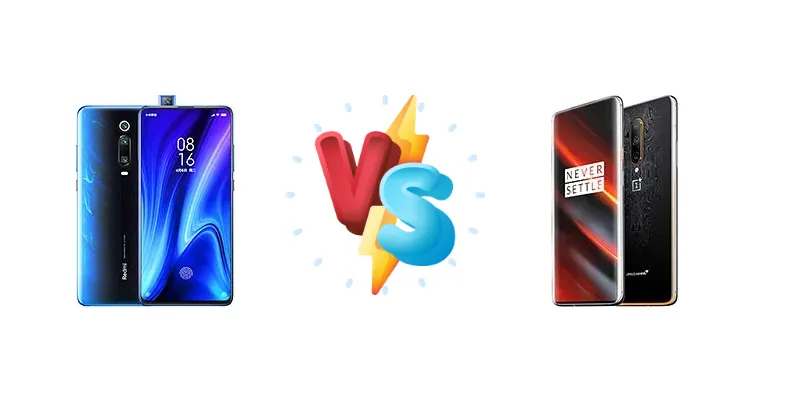
|
🏆 Quick Verdict
For the average user in 2024, the Xiaomi Redmi K20 Pro emerges as the stronger recommendation. Its impressive 103-hour endurance rating, coupled with a comparable Snapdragon 855 processor, delivers excellent performance and longevity at a significantly lower price point than the OnePlus 7T Pro 5G McLaren.
| PHONES | ||
|---|---|---|
| Phone Names | Xiaomi Redmi K20 Pro | OnePlus 7T Pro 5G McLaren |
| Network | ||
|---|---|---|
| 2G bands | GSM 850 / 900 / 1800 / 1900 | GSM 850 / 900 / 1800 / 1900 |
| 3G bands | HSDPA 850 / 900 / 1900 / 2100 | HSDPA 850 / 900 / 1700(AWS) / 1900 / 2100 |
| 4G bands | 1, 3, 5, 7, 8, 34, 38, 39, 40, 41 | 1, 2, 3, 4, 5, 1, 2, 3, 4, 5, 7, 8, 12, 13, 17, 18, 19, 20, 25, 26, 28, 29, 30, 34, 38, 39, 40, 41, 46, 48, 66, 71 |
| 5G bands | - | 71 SA |
| Speed | HSPA, LTE | HSPA 42.2/5.76 Mbps, LTE (5CA) Cat18 1200/150 Mbps, 5G (2+ Gbps DL) |
| Technology | GSM / HSPA / LTE | GSM / CDMA / HSPA / LTE / 5G |
| - | CDMA 800 / 1900 & TD-SCDMA | |
| Launch | ||
|---|---|---|
| Announced | 2019, May 28. Released 2019, June 01 | 2019, October 23. Released 2019, November 05 |
| Status | Discontinued | Discontinued |
| Body | ||
|---|---|---|
| Build | Glass front (Gorilla Glass 5), glass back (Gorilla Glass 5), aluminum frame | Glass front (Gorilla Glass 6), glass back (Gorilla Glass 5), aluminum frame |
| Dimensions | 156.7 x 74.3 x 8.8 mm (6.17 x 2.93 x 0.35 in) | 162.6 x 75.9 x 8.8 mm (6.40 x 2.99 x 0.35 in) |
| SIM | Nano-SIM + Nano-SIM | Nano-SIM + Nano-SIM |
| Weight | 191 g (6.74 oz) | 206 g (7.27 oz) |
| Display | ||
|---|---|---|
| Protection | Corning Gorilla Glass 5 | Corning Gorilla Glass 6 |
| Resolution | 1080 x 2340 pixels, 19.5:9 ratio (~403 ppi density) | 1440 x 3120 pixels, 19.5:9 ratio (~516 ppi density) |
| Size | 6.39 inches, 100.2 cm2 (~86.1% screen-to-body ratio) | 6.67 inches, 108.8 cm2 (~88.1% screen-to-body ratio) |
| Type | Super AMOLED, HDR10 | Fluid AMOLED, 90Hz, HDR10+ |
| Platform | ||
|---|---|---|
| CPU | Octa-core (1x2.84 GHz Kryo 485 & 3x2.42 GHz Kryo 485 & 4x1.78 GHz Kryo 485) | Octa-core (1x2.96 GHz Kryo 485 & 3x2.42 GHz Kryo 485 & 4x1.78 GHz Kryo 485) |
| Chipset | Qualcomm SM8150 Snapdragon 855 (7 nm) | Qualcomm SM8150 Snapdragon 855+ (7 nm) |
| GPU | Adreno 640 | Adreno 640 (700 MHz) |
| OS | Android 9.0 (Pie), upgradable to Android 10, MIUI 12 | Android 10, OxygenOS 10.0 |
| Memory | ||
|---|---|---|
| Card slot | No | No |
| Internal | 64GB 6GB RAM, 128GB 6GB RAM, 128GB 8GB RAM, 256GB 8GB RAM | 256GB 12GB RAM |
| UFS 2.1 | UFS 3.0 | |
| Main Camera | ||
|---|---|---|
| Features | Laser AF, Dual-LED flash, HDR, panorama | Laser AF, Dual-LED flash, HDR, panorama |
| Triple | 48 MP, f/1.8, 26mm (wide), 1/2.0", 0.8µm, PDAF 8 MP, f/2.4, 53mm (telephoto), 1/4.0", 1.12µm, PDAF, 2x optical zoom 13 MP, f/2.4, 12mm (ultrawide), 1/3.1", 1.12µm | 48 MP, f/1.6, (wide), 1/2.0", 0.8µm, PDAF, OIS 8 MP, f/2.4, (telephoto), 1.0µm, PDAF, OIS, 3x optical zoom 16 MP, f/2.2, 13mm (ultrawide), AF |
| Video | 4K@30/60fps, 1080p@30/120/240fps, 1080p@960fps | 4K@30/60fps, 1080p@30/60/240fps, 720p@960fps, Auto HDR, gyro-EIS |
| Selfie camera | ||
|---|---|---|
| Features | HDR | HDR |
| Single | Motorized pop-up 20 MP, f/2.2, (wide), 1/3.4", 0.8µm | Motorized pop-up 16 MP, f/2.0, 25mm (wide), 1/3.06", 1.0µm |
| Video | 1080p@30fps | 1080p@30fps, gyro-EIS |
| Sound | ||
|---|---|---|
| 3.5mm jack | Yes | No |
| 35mm jack | Yes | No |
| Loudspeaker | Yes | Yes, with stereo speakers |
| 24-bit/192kHz audio | - | |
| Comms | ||
|---|---|---|
| Bluetooth | 5.0, A2DP, LE, aptX HD | 5.1, A2DP, LE, aptX HD |
| NFC | Yes (China only) | Yes |
| Positioning | GPS (L1+L5), GLONASS (G1), BDS (B1), GALILEO (E1+E5a) | GPS (L1+L5), GLONASS (G1), BDS (B1), GALILEO (E1+E5a) |
| Radio | Yes | No |
| USB | USB Type-C 2.0, OTG | USB Type-C 3.1, OTG |
| WLAN | Wi-Fi 802.11 a/b/g/n/ac, dual-band, Wi-Fi Direct | Wi-Fi 802.11 a/b/g/n/ac, dual-band, Wi-Fi Direct, DLNA |
| Features | ||
|---|---|---|
| Sensors | Fingerprint (under display, optical), accelerometer, gyro, proximity, compass | Fingerprint (under display, optical), accelerometer, gyro, compass |
| - | Virtual proximity sensing | |
| Battery | ||
|---|---|---|
| Charging | 27W wired, QC4 | 30W wired |
| Type | Li-Po 4000 mAh, non-removable | Li-Po 4085 mAh, non-removable |
| Misc | ||
|---|---|---|
| Colors | Carbon black, Flame red, Glacier blue, Summer Honey, Pearl White | Papaya Orange |
| Models | M1903F11I | HD1925 |
| Price | About 400 EUR | About 800 EUR |
| SAR | 1.03 W/kg (head) 0.72 W/kg (body) | - |
| Tests | ||
|---|---|---|
| Audio quality | Noise -93.9dB / Crosstalk -94.2dB | - |
| Battery life | Endurance rating 103h | - |
| Camera | Photo / Video | - |
| Display | Contrast ratio: Infinite (nominal) | - |
| Loudspeaker | Voice 71dB / Noise 75dB / Ring 84dB | - |
| Performance | AnTuTu: 368846 (v7), 437823 (v8) GeekBench: 10684 (v4.4), 2732 (v5.1) GFXBench: 36fps (ES 3.1 onscreen) | - |
Xiaomi Redmi K20 Pro
- Exceptional 103-hour battery life
- Excellent value for money
- Capable Snapdragon 855 performance
- Lacks 5G connectivity
- Charging speed is slower than the competition
OnePlus 7T Pro 5G McLaren
- Faster Snapdragon 855+ processor
- 30W fast charging
- 5G connectivity
- Likely shorter battery life
- Higher price point
Display Comparison
Both devices feature displays designed for immersive content consumption, but key differences exist. The Redmi K20 Pro boasts a measured peak brightness of 643 nits, a respectable figure for outdoor visibility. While the 7T Pro 5G McLaren’s display specs aren’t provided, OnePlus historically prioritized color accuracy and smoothness. The K20 Pro’s ‘Infinite’ contrast ratio (nominal) suggests a typical AMOLED panel, delivering deep blacks. The absence of refresh rate data for both devices means neither can compete with modern 120Hz+ displays, but they were competitive for their time.
Camera Comparison
Both devices are equipped with capable camera systems, but detailed specifications are limited. Both are described as having Photo/Video capabilities. Without sensor size or aperture data, a direct comparison is difficult. However, given OnePlus’s history, the 7T Pro 5G McLaren likely emphasizes computational photography and image processing for a more polished, albeit potentially less natural, look. The Redmi K20 Pro, typical of Xiaomi, may offer more manual control and a wider range of shooting modes. The lack of information regarding OIS (Optical Image Stabilization) is a significant omission, impacting low-light performance and video stabilization.
Performance
The core of both phones is the Qualcomm Snapdragon 855 platform, but the OnePlus 7T Pro 5G McLaren utilizes the slightly enhanced Snapdragon 855+ variant. This translates to a marginal CPU clock speed increase – 2.96 GHz on the 7T Pro 5G McLaren versus 2.84 GHz on the K20 Pro. While this difference is measurable in benchmarks, real-world performance gains will be subtle for most users. Both phones share the same Kryo 485 core configuration (1x2.84/2.96 GHz, 3x2.42 GHz, 4x1.78 GHz). The 7T Pro 5G McLaren’s inclusion of 5G connectivity adds a layer of future-proofing, but its relevance depends on 5G availability in the user’s region.
Battery Life
Battery life is a key differentiator. The Redmi K20 Pro achieves an impressive endurance rating of 103 hours, indicating excellent efficiency. The OnePlus 7T Pro 5G McLaren’s battery capacity isn’t specified, but its 30W wired charging is faster than the K20 Pro’s 27W QC4 charging. This means the 7T Pro 5G McLaren can replenish its battery more quickly, but the K20 Pro’s superior endurance means it requires charging less frequently. The 3W difference in charging speed is unlikely to be a major factor for most users, given the K20 Pro’s longer runtimes.
Buying Guide
Buy the Xiaomi Redmi K20 Pro if you prioritize exceptional battery life and value for money, and don't require 5G connectivity. It's ideal for users who heavily consume media, game casually, and want a reliable daily driver. Buy the OnePlus 7T Pro 5G McLaren if you specifically need 5G support and are willing to pay a premium for slightly faster processing speeds and potentially better software support (though this is diminishing with age).