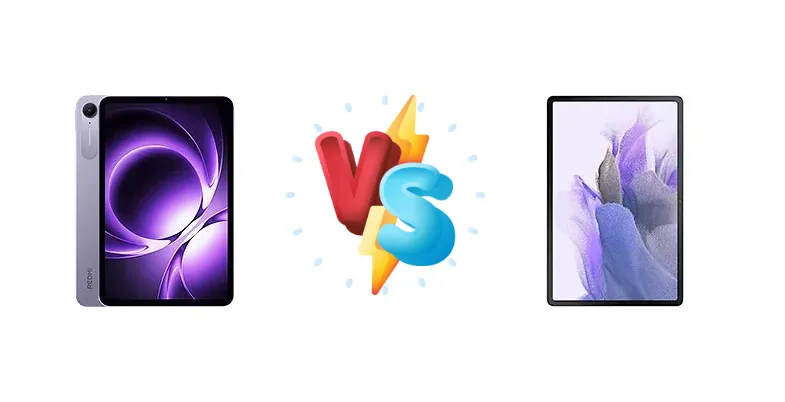
The Android tablet market is heating up, with Xiaomi’s Redmi K Pad aiming to disrupt the established order. We pit it against Samsung’s well-regarded Galaxy Tab S7 FE, a device that’s been a mainstay for those seeking a balance of features and affordability. This comparison focuses on how the K Pad’s modern chipset stacks up against the Tab S7 FE’s Snapdragon offerings, and whether that translates into a better user experience.
🏆 Quick Verdict
For users prioritizing raw performance and future-proofing, the Xiaomi Redmi K Pad is the clear winner. Its Dimensity 9400+ chipset offers a significant leap in processing power over both Snapdragon 750G and 778G variants of the Tab S7 FE. However, the Tab S7 FE remains a compelling option for those deeply embedded in the Samsung ecosystem or prioritizing stylus support.
| Network |
|---|
| 2G bands | N/A | GSM 850 / 900 / 1800 / 1900 |
| 3G bands | N/A | HSDPA 850 / 900 / 1700(AWS) / 1900 / 2100 |
| 4G bands | - | 1, 2, 3, 4, 5, 7, 8, 12, 13, 17, 20, 25, 26, 28, 32, 38, 40, 41, 66 |
| 5G bands | - | 1, 3, 5, 7, 8, 20, 28, 38, 40, 41, 77, 78 SA/NSA/Sub6 |
| EDGE | N/A | - |
| GPRS | N/A | - |
| Speed | - | HSPA, LTE, 5G - cellular model only |
| Technology | No cellular connectivity | GSM / HSPA / LTE / 5G |
| Launch |
|---|
| Announced | 2025, June 26 | 2021, May 25 |
| Status | Available. Released 2025, June 26 | Available. Released 2021, June 18 |
| Body |
|---|
| Build | - | Glass front, aluminum back, aluminum frame |
| Dimensions | 205.1 x 132 x 6.5 mm (8.07 x 5.20 x 0.26 in) | 284.8 x 185 x 6.3 mm (11.21 x 7.28 x 0.25 in) |
| SIM | No | Nano-SIM (cellular model only) |
| Weight | 326 g (11.50 oz) | 608 g (1.34 lb) |
| | - | Stylus support |
| Display |
|---|
| Resolution | 1880 x 3008 pixels, 16:10 ratio (~403 ppi density) | 1600 x 2560 pixels, 16:10 ratio (~243 ppi density) |
| Size | 8.8 inches, 224.5 cm2 (~82.9% screen-to-body ratio) | 12.4 inches, 445.8 cm2 (~84.6% screen-to-body ratio) |
| Type | IPS LCD, 68B colors, 165Hz, HDR Vivid, Dolby Vision, 700 nits (HBM) | TFT LCD |
| Platform |
|---|
| CPU | Octa-core (1x3.73 GHz Cortex-X925 & 3x3.3 GHz Cortex-X4 & 4x2.4 GHz Cortex-A720) | Octa-core (2x2.2 GHz Kryo 570 & 6x1.8 GHz Kryo 570) - 5G modelOcta-core (1x2.4 GHz Cortex-A78 & 3x2.2 GHz Cortex-A78 & 4x1.9 GHz Cortex-A55) - Wi-Fi model |
| Chipset | Mediatek Dimensity 9400+ (3 nm) | Qualcomm SM7225 Snapdragon 750G 5G (8 nm) - 5G modelQualcomm SM7325 Snapdragon 778G 5G (6 nm) - Wi-Fi model |
| GPU | Immortalis-G925 | Adreno 619 - 5G modelAdreno 642L - Wi-Fi model |
| OS | Android 15, HyperOS 2 | Android 11, upgradable to Android 14, One UI 6 |
| Memory |
|---|
| Card slot | No | microSDXC (dedicated slot) |
| Internal | 256GB 8GB RAM, 256GB 12GB RAM, 512GB 12GB RAM, 512GB 16GB RAM, 1TB 16GB RAM | 64GB 4GB RAM, 128GB 6GB RAM, 256GB 8GB RAM |
| Main Camera |
|---|
| Features | LED flash, HDR | - |
| Single | 13 MP, f/2.2, (wide), 1/3.06" 1.12μm, PDAF | 8 MP, AF |
| Video | 4K@30fps, 1080p@30/60fps | 1080p@30fps |
| Selfie camera |
|---|
| Features | HDR | - |
| Single | 8 MP, f/2.3, (wide), 1/4" 1.12μm | 5 MP |
| Video | 1080p@30fps | 1080p@30fps |
| Sound |
|---|
| 3.5mm jack | - | No |
| 35mm jack | No | No |
| Loudspeaker | Yes, with stereo speakers (with Dolby Atmos) | Yes, with stereo speakers |
| | - | Tuned by AKG |
| Comms |
|---|
| Bluetooth | 5.4, LHDC 5 | 5.2, A2DP, LE (Wi-Fi), 5.2, A2DP, LE (5G) |
| Infrared port | Yes | - |
| NFC | No | No |
| Positioning | No | GPS, GLONASS, BDS, GALILEO - cellular model only |
| Radio | No | No |
| USB | 1x USB Type-C 3.2, 1x USB Type-C 2.0, Display Port 1.4, accessory connector | USB Type-C 3.2, magnetic connector |
| WLAN | Wi-Fi 802.11 a/b/g/n/ac/6/7, dual-band, Wi-Fi Direct | Wi-Fi 802.11 a/b/g/n/ac/6 (Wi-Fi), Wi-Fi 802.11 a/b/g/n/ac (5G) |
| Features |
|---|
| Sensors | Accelerometer, gyro, proximity, compass | Accelerometer, proximity, compass, gyro (5G model only) |
| | - | Samsung DeX |
| Battery |
|---|
| Charging | 67W wired, PD3.0, QC3+
18W reverse wired
Bypass charging | 45W wired, 100% in 190 min |
| Type | 7500 mAh | Li-Po 10090 mAh |
| Misc |
|---|
| Colors | Black, Green, Purple | Mystic Black, Mystic Silver, Mystic Green, Mystic Pink |
| Models | - | SM-T730, SM-T733, SM-T736B, SM-T735 |
| Price | About 330 EUR | About 650 EUR |
| SAR EU | - | 1.15 W/kg (body) |
| Tests |
|---|
| Display | - | Contrast ratio: 1886:1 (nominal) |
| Loudspeaker | - | -27.2 LUFS (Good) |
| Performance | - | AnTuTu: 292530 (v8), 355430 (v9)
GeekBench: 1904 (v5.1)
GFXBench: 9.7fps (ES 3.1 onscreen) |
Xiaomi Redmi K Pad
- Significantly faster processor (Dimensity 9400+)
- Ultra-fast 67W charging
- Reverse wired charging support
- Display specifications currently unknown
- Camera details not yet available
Samsung Galaxy Tab S7 FE
- Bright and vibrant display (522 nits)
- Established Samsung ecosystem integration
- Stylus support (S Pen sold separately)
- Slower Snapdragon 750G/778G processors
- Slow 45W charging (190 minutes to full)
- Less future-proof chipset
Display Comparison
The Samsung Galaxy Tab S7 FE boasts a measured peak brightness of 522 nits and a 1886:1 contrast ratio, making it well-suited for outdoor visibility and vibrant content consumption. While the Redmi K Pad’s display specifications are currently unavailable, it’s reasonable to expect a high-quality panel given Xiaomi’s recent focus on display technology. However, the Tab S7 FE’s established brightness and contrast figures provide a clear advantage for users who frequently use their tablets in brightly lit environments. The Tab S7 FE’s larger 10.5-inch display also offers a more immersive viewing experience compared to the K Pad’s 10.61-inch screen.
Camera Comparison
Neither tablet is positioned as a photography powerhouse. The Tab S7 FE’s camera specifications are not provided, and it’s unlikely to compete with flagship smartphone cameras. Similarly, the Redmi K Pad’s camera details are currently unknown. Given the market segment, we can anticipate both tablets offering adequate cameras for video calls and casual snapshots, but not for serious photography. Without specific sensor details, it’s difficult to declare a clear winner in this category.
Performance
The performance gap is substantial. The Redmi K Pad’s Mediatek Dimensity 9400+ (3nm) is a flagship-level chipset featuring a Cortex-X925 prime core clocked at 3.73 GHz, alongside Cortex-X4 and Cortex-A720 cores. This architecture, built on a cutting-edge 3nm process, promises significant gains in both CPU and GPU performance compared to the Tab S7 FE’s Snapdragon 750G (8nm) or 778G (6nm). The Snapdragon 778G, while a capable mid-range chip, utilizes older Cortex-A78 cores and a less efficient 6nm process. The Dimensity 9400+’s superior architecture and process node translate to faster app loading times, smoother multitasking, and a more responsive overall experience. The K Pad is likely to excel in graphically intensive tasks like gaming and video editing.
Battery Life
The Redmi K Pad’s 67W wired charging with PD3.0 and QC3+ support is a significant advantage. This allows for incredibly fast charging speeds, potentially reaching full charge in under an hour. The Tab S7 FE, with its 45W charging, takes a considerably longer 190 minutes to reach 100%. The K Pad also offers 18W reverse wired charging, a feature absent on the Tab S7 FE. While battery capacity figures are missing for the K Pad, the faster charging speed mitigates concerns about battery life, allowing for quick top-ups throughout the day. The Tab S7 FE’s slower charging is a notable drawback for users who frequently need to recharge their device.
Buying Guide
Buy the Xiaomi Redmi K Pad if you need a tablet for demanding tasks like video editing, gaming, or multitasking, and value the latest processor technology. Buy the Samsung Galaxy Tab S7 FE if you prefer a more established brand with a focus on stylus integration, a brighter display for outdoor use, and seamless compatibility with other Samsung devices.
Frequently Asked Questions
❓ Will the Dimensity 9400+ in the Redmi K Pad experience thermal throttling during extended gaming sessions?
The Dimensity 9400+'s 3nm process node and advanced thermal management features are designed to minimize throttling. While sustained peak performance will inevitably generate heat, the K Pad should maintain higher average frame rates for longer periods compared to the Tab S7 FE's Snapdragon chips, which are more prone to throttling under heavy load.
❓ Does the Samsung Galaxy Tab S7 FE's S Pen support offer a significant advantage for note-taking and creative tasks?
The S Pen is a key feature of the Tab S7 FE, providing a natural and precise writing experience. Its low latency and pressure sensitivity make it ideal for note-taking, sketching, and digital art. While the Redmi K Pad may support third-party styluses, it won't offer the same level of integration and optimized experience as the S Pen.
❓ Which tablet is better suited for running multiple apps simultaneously (multitasking)?
The Xiaomi Redmi K Pad, with its Dimensity 9400+ chipset and likely higher RAM capacity, is significantly better equipped for multitasking. The more powerful processor and efficient memory management will allow for smoother switching between apps and reduced lag when running demanding applications concurrently.