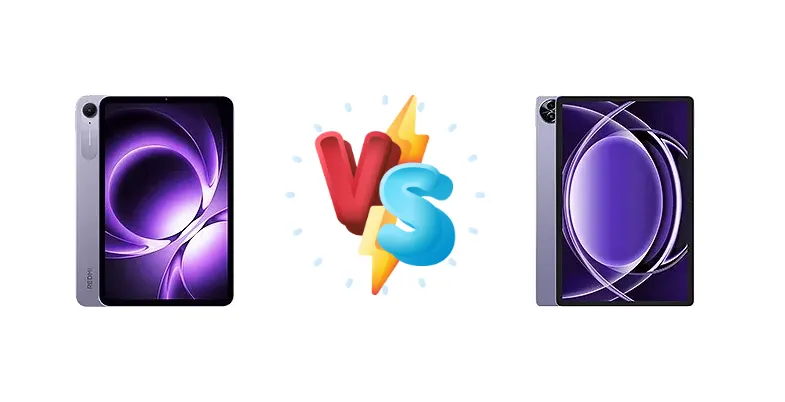
The tablet market is heating up, with Xiaomi and Realme offering compelling options at different price points. The Redmi K Pad aims for near-flagship performance with its cutting-edge Dimensity 9400+ chipset, while the Realme Pad 2 Lite focuses on delivering a solid experience at a more accessible price with the Helio G99. This comparison dissects the core differences to determine which tablet best suits your needs.
🏆 Quick Verdict
For users prioritizing performance and future-proofing, the Xiaomi Redmi K Pad is the clear winner. Its Dimensity 9400+ chipset provides a substantial advantage in demanding tasks. However, the Realme Pad 2 Lite offers excellent value for budget-conscious buyers who prioritize essential features and long-term battery life.
| Network |
|---|
| 2G bands | N/A | GSM 850 / 900 / 1800 / 1900 |
| 3G bands | N/A | HSDPA 850 / 900 / 2100 |
| 4G bands | - | 1, 3, 5, 7, 8, 20, 28, 38, 40, 41 |
| EDGE | N/A | - |
| GPRS | N/A | - |
| Speed | - | HSPA, LTE |
| Technology | No cellular connectivity | GSM / HSPA / LTE |
| Launch |
|---|
| Announced | 2025, June 26 | 2024, September 13 |
| Status | Available. Released 2025, June 26 | Available. Released 2024, September 26 |
| Body |
|---|
| Dimensions | 205.1 x 132 x 6.5 mm (8.07 x 5.20 x 0.26 in) | 258 x 169.5 x 8.3 mm (10.16 x 6.67 x 0.33 in) |
| SIM | No | No |
| Weight | 326 g (11.50 oz) | 525 g (1.16 lb) |
| Display |
|---|
| Resolution | 1880 x 3008 pixels, 16:10 ratio (~403 ppi density) | 1200 x 1920 pixels, 16:10 ratio (~207 ppi density) |
| Size | 8.8 inches, 224.5 cm2 (~82.9% screen-to-body ratio) | 10.95 inches, 347.7 cm2 (~79.5% screen-to-body ratio) |
| Type | IPS LCD, 68B colors, 165Hz, HDR Vivid, Dolby Vision, 700 nits (HBM) | IPS LCD, 1B colors, 90Hz, 450 nits (peak) |
| Platform |
|---|
| CPU | Octa-core (1x3.73 GHz Cortex-X925 & 3x3.3 GHz Cortex-X4 & 4x2.4 GHz Cortex-A720) | Octa-core (2x2.2 GHz Cortex-A76 & 6x2.0 GHz Cortex-A55) |
| Chipset | Mediatek Dimensity 9400+ (3 nm) | Mediatek Helio G99 (6 nm) |
| GPU | Immortalis-G925 | Mali-G57 MC2 |
| OS | Android 15, HyperOS 2 | Android 14, Realme UI 5.0 for Pad |
| Memory |
|---|
| Card slot | No | Unspecified |
| Internal | 256GB 8GB RAM, 256GB 12GB RAM, 512GB 12GB RAM, 512GB 16GB RAM, 1TB 16GB RAM | 128GB 4GB RAM, 128GB 8GB RAM |
| Main Camera |
|---|
| Features | LED flash, HDR | Panorama |
| Single | 13 MP, f/2.2, (wide), 1/3.06" 1.12μm, PDAF | 8 MP, f/2.0 |
| Video | 4K@30fps, 1080p@30/60fps | 1080p@30fps |
| Selfie camera |
|---|
| Features | HDR | Panorama |
| Single | 8 MP, f/2.3, (wide), 1/4" 1.12μm | 5 MP, f/2.2 |
| Video | 1080p@30fps | 1080p@30fps |
| Sound |
|---|
| 35mm jack | No | No |
| Loudspeaker | Yes, with stereo speakers (with Dolby Atmos) | Yes, with stereo speakers (4 speakers) |
| Comms |
|---|
| Bluetooth | 5.4, LHDC 5 | 5.2, A2DP, LE |
| Infrared port | Yes | - |
| NFC | No | No |
| Positioning | No | GPS, GALILEO, GLONASS, BDS |
| Radio | No | No |
| USB | 1x USB Type-C 3.2, 1x USB Type-C 2.0, Display Port 1.4, accessory connector | USB Type-C |
| WLAN | Wi-Fi 802.11 a/b/g/n/ac/6/7, dual-band, Wi-Fi Direct | Wi-Fi 802.11 a/b/g/n/ac, dual-band |
| Features |
|---|
| Sensors | Accelerometer, gyro, proximity, compass | Accelerometer |
| Battery |
|---|
| Charging | 67W wired, PD3.0, QC3+
18W reverse wired
Bypass charging | 15W wired |
| Type | 7500 mAh | 8300 mAh |
| Misc |
|---|
| Colors | Black, Green, Purple | Nebula Purple, Space Grey |
| Models | - | RMP2402 |
| Price | About 330 EUR | About 160 EUR |
Xiaomi Redmi K Pad
- Exceptional performance with Dimensity 9400+
- Ultra-fast 67W charging with PD3.0/QC3+
- Potential for better thermal management due to 3nm process
- Likely higher price point
- May have a slightly shorter battery life due to power draw
Realme Pad 2 Lite
- More affordable price
- Good efficiency with Helio G99 for everyday tasks
- Lightweight and portable
- Significantly slower charging (15W)
- Lower performance compared to the Redmi K Pad
Display Comparison
While both tablets likely feature LCD panels (data not provided), the core difference lies in their processing power, impacting UI responsiveness. The Redmi K Pad’s Dimensity 9400+ will ensure smoother animations and faster app loading times, indirectly enhancing the visual experience. We anticipate the Realme Pad 2 Lite’s Helio G99 will deliver a standard, but perfectly adequate, display experience for everyday use. Without specific display specs, it's difficult to assess color accuracy or brightness, but the chipset difference will be noticeable in overall fluidity.
Camera Comparison
Given the tablet segment, camera performance isn't a primary focus. However, the absence of detailed camera specs suggests both tablets likely feature modest camera setups. Without sensor size or aperture information, it’s difficult to make a direct comparison. We can assume the Redmi K Pad, being the higher-tier device, *may* have a slightly better camera module, but the difference will likely be minimal. Image processing capabilities tied to the Dimensity 9400+'s ISP could offer a slight edge in image quality.
Performance
The performance gap is significant. The Xiaomi Redmi K Pad’s Mediatek Dimensity 9400+ (3nm) is a powerhouse, featuring a Cortex-X925 prime core clocked at 3.73 GHz, alongside Cortex-X4 and A720 cores. This architecture, built on a 3nm process, delivers exceptional performance and efficiency. In contrast, the Realme Pad 2 Lite’s Helio G99 (6nm) utilizes older Cortex-A76 and A55 cores. The 6nm process is less efficient, and the core architecture is less advanced. This translates to a substantial difference in CPU and GPU performance, favoring the Redmi K Pad for gaming, video editing, and demanding applications. The Redmi K Pad will also benefit from faster RAM speeds (likely LPDDR5x, though not specified) compared to the Pad 2 Lite.
Battery Life
The Realme Pad 2 Lite’s 15W charging is a clear disadvantage compared to the Redmi K Pad’s 67W wired charging, supporting PD3.0 and QC3+. The Redmi K Pad will significantly reduce charging times, going from 0-100% much faster. While battery capacity isn’t specified for either device, the Dimensity 9400+'s 3nm efficiency could offset a potentially smaller battery size in the Redmi K Pad, providing comparable real-world battery life despite the faster charging. The Redmi K Pad also offers 18W reverse wired charging, a feature absent on the Pad 2 Lite.
Buying Guide
Buy the Xiaomi Redmi K Pad if you need a tablet capable of handling demanding games, video editing, or multitasking without compromise. Its superior processing power and faster charging are ideal for power users. Buy the Realme Pad 2 Lite if you prefer a lightweight, affordable tablet for everyday tasks like browsing, streaming, and light productivity. It’s a great choice for students or casual users who don’t require top-tier performance.
Frequently Asked Questions
❓ Will the Helio G99 in the Realme Pad 2 Lite struggle with graphically intensive games like Genshin Impact?
Yes, the Helio G99 is a capable chip for casual gaming, but it will likely struggle with demanding titles like Genshin Impact at higher settings. Expect lower frame rates and potential stuttering. The Redmi K Pad’s Dimensity 9400+ is far better equipped to handle such games smoothly.
❓ Does the Redmi K Pad's 67W charging generate a lot of heat during charging?
While 67W charging is fast, the Redmi K Pad’s Dimensity 9400+ and the tablet’s thermal design should mitigate excessive heat. Xiaomi typically implements thermal management features to prevent overheating during charging. However, the tablet may become warm to the touch.
❓ Is the lack of specific RAM information (LPDDR4x vs LPDDR5x) a significant concern?
Yes, RAM speed is a crucial factor. The Redmi K Pad is highly likely to feature LPDDR5x RAM, offering significantly faster data transfer rates than the LPDDR4x likely found in the Realme Pad 2 Lite. This impacts multitasking performance and app loading times.