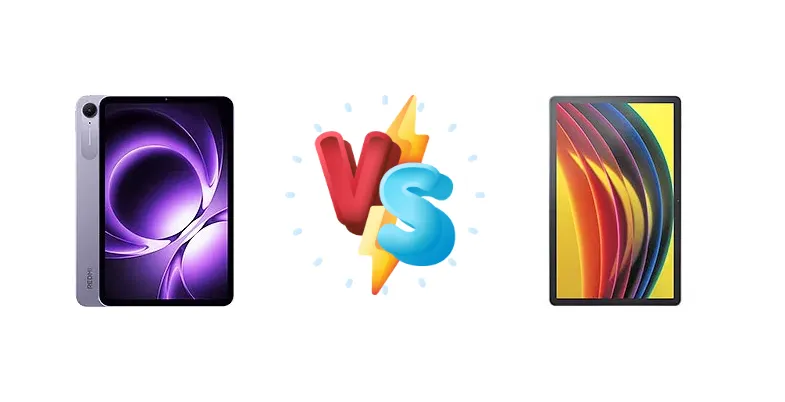
The Android tablet market is heating up, with options ranging from ultra-premium to aggressively priced. The Xiaomi Redmi K Pad and Lenovo Tab P11 Plus represent distinct approaches: the K Pad aims for near-flagship performance at a mid-range price, while the P11 Plus focuses on delivering a solid, reliable experience at a more accessible price point. This comparison dissects their key differences to help you choose the right tablet for your needs.
🏆 Quick Verdict
For users prioritizing performance and future-proofing, the Xiaomi Redmi K Pad is the clear winner. Its Dimensity 9400+ chipset offers a substantial leap in processing power and efficiency compared to the Lenovo Tab P11 Plus’s Helio G90T. However, the P11 Plus remains a viable option for casual users seeking a dependable tablet for basic tasks.
| Network |
|---|
| 2G bands | N/A | GSM 850 / 900 / 1800 / 1900 |
| 3G bands | N/A | HSDPA 850 / 900 / 1900 / 2100 |
| 4G bands | - | 1, 2, 3, 4, 5, 7, 8, 20, 28, 38, 40, 41 |
| EDGE | N/A | - |
| GPRS | N/A | - |
| Speed | - | HSPA, LTE - cellular model only |
| Technology | No cellular connectivity | GSM / HSPA / LTE |
| Launch |
|---|
| Announced | 2025, June 26 | 2021, June 28 |
| Status | Available. Released 2025, June 26 | Available. Released 2021, July 29 |
| Body |
|---|
| Dimensions | 205.1 x 132 x 6.5 mm (8.07 x 5.20 x 0.26 in) | 258.4 x 163 x 7.5 mm (10.17 x 6.42 x 0.30 in) |
| SIM | No | Nano-SIM (cellular model only) |
| Weight | 326 g (11.50 oz) | 490 g (1.08 lb) |
| | - | Stylus support |
| Display |
|---|
| Resolution | 1880 x 3008 pixels, 16:10 ratio (~403 ppi density) | 1200 x 2000 pixels, 5:3 ratio (~212 ppi density) |
| Size | 8.8 inches, 224.5 cm2 (~82.9% screen-to-body ratio) | 11.0 inches, 344.4 cm2 (~81.8% screen-to-body ratio) |
| Type | IPS LCD, 68B colors, 165Hz, HDR Vivid, Dolby Vision, 700 nits (HBM) | IPS LCD, 400 nits (typ) |
| Platform |
|---|
| CPU | Octa-core (1x3.73 GHz Cortex-X925 & 3x3.3 GHz Cortex-X4 & 4x2.4 GHz Cortex-A720) | Octa-core (2x2.05 GHz Cortex-A76 & 6x2.0 GHz Cortex-A55) |
| Chipset | Mediatek Dimensity 9400+ (3 nm) | Mediatek MT6785 Helio G90T (12 nm) |
| GPU | Immortalis-G925 | Mali-G76 MC4 |
| OS | Android 15, HyperOS 2 | Android 11 |
| Memory |
|---|
| Card slot | No | microSDXC (dedicated slot) |
| Internal | 256GB 8GB RAM, 256GB 12GB RAM, 512GB 12GB RAM, 512GB 16GB RAM, 1TB 16GB RAM | 64GB 4GB RAM, 128GB 4GB RAM, 128GB 6GB RAM |
| Main Camera |
|---|
| Features | LED flash, HDR | LED flash |
| Single | 13 MP, f/2.2, (wide), 1/3.06" 1.12μm, PDAF | 13 MP, (wide), AF |
| Video | 4K@30fps, 1080p@30/60fps | 1080p@30fps |
| Selfie camera |
|---|
| Features | HDR | - |
| Single | 8 MP, f/2.3, (wide), 1/4" 1.12μm | 8 MP, (wide) |
| Video | 1080p@30fps | 1080p@30fps |
| Sound |
|---|
| 3.5mm jack | - | No |
| 35mm jack | No | No |
| Loudspeaker | Yes, with stereo speakers (with Dolby Atmos) | Yes, with stereo speakers (4 speakers) |
| Comms |
|---|
| Bluetooth | 5.4, LHDC 5 | 5.1, A2DP, LE |
| Infrared port | Yes | - |
| NFC | No | No |
| Positioning | No | GPS, GLONASS, BDS - cellular model only |
| Radio | No | FM radio |
| USB | 1x USB Type-C 3.2, 1x USB Type-C 2.0, Display Port 1.4, accessory connector | USB Type-C 2.0 |
| WLAN | Wi-Fi 802.11 a/b/g/n/ac/6/7, dual-band, Wi-Fi Direct | Wi-Fi 802.11 a/b/g/n/ac, dual-band, Wi-Fi Direct |
| Features |
|---|
| Sensors | Accelerometer, gyro, proximity, compass | Accelerometer, gyro, proximity |
| Battery |
|---|
| Charging | 67W wired, PD3.0, QC3+
18W reverse wired
Bypass charging | 20W wired |
| Type | 7500 mAh | Li-Po 7700 mAh |
| Misc |
|---|
| Colors | Black, Green, Purple | Slate Grey, Platinum Grey, Modernist teal |
| Models | - | ZA940124SE |
| Price | About 330 EUR | About 300 EUR |
Xiaomi Redmi K Pad
- Significantly faster processor (Dimensity 9400+)
- Ultra-fast 67W charging with multiple protocols
- Reverse wired charging capability
- Potentially higher price point
- May generate more heat under sustained load (though 3nm helps)
Lenovo Tab P11 Plus
- More affordable price
- Decent performance for basic tasks
- Reliable and established brand
- Slower processor (Helio G90T)
- Slower 20W charging
- Limited future-proofing
Display Comparison
While both tablets likely feature LCD panels (specific panel details are missing), the performance difference begins with the underlying system-on-chip. The display experience will be dictated by the chipset's ability to drive the panel smoothly. We anticipate the Redmi K Pad's Dimensity 9400+ will deliver a more responsive and fluid visual experience, particularly in fast-paced games or when scrolling through content. Bezels and color accuracy are unknown, but the K Pad's superior processing power suggests a higher potential for advanced display features like HDR support.
Camera Comparison
Given the tablet form factor, camera performance isn't a primary concern for most users. However, the Redmi K Pad’s chipset likely supports more advanced image signal processing (ISP) capabilities, potentially leading to better image quality in various lighting conditions. Without specific sensor details, it’s difficult to make a definitive statement, but the K Pad’s superior processing power gives it an edge. We can expect the P11 Plus to deliver acceptable results for casual snapshots, but the K Pad will likely offer more detail and dynamic range.
Performance
The core difference lies in the chipsets. The Redmi K Pad’s Mediatek Dimensity 9400+ (3nm) is a generational leap ahead of the Lenovo Tab P11 Plus’s Mediatek MT6785 Helio G90T (12nm). The Dimensity 9400+ boasts a cutting-edge CPU configuration – a Cortex-X925 prime core at 3.73 GHz, three Cortex-X4 cores at 3.3 GHz, and four Cortex-A720 efficiency cores at 2.4 GHz – compared to the G90T’s older Cortex-A76 (2x2.05 GHz) and Cortex-A55 (6x2.0 GHz) setup. The 3nm process node of the Dimensity 9400+ translates to significantly improved power efficiency and thermal management, meaning sustained performance under load. The K Pad will excel in demanding tasks like gaming and video editing, while the P11 Plus will likely show signs of throttling during extended use.
Battery Life
The Redmi K Pad’s 67W wired charging with PD3.0 and QC3+ support is a game-changer. This allows for significantly faster charging times compared to the P11 Plus’s 20W charging. While battery capacity isn’t specified for either device, the K Pad’s faster charging mitigates the impact of a potentially smaller battery. The inclusion of 18W reverse wired charging on the K Pad is also a valuable feature for topping up other devices on the go, a capability absent on the P11 Plus.
Buying Guide
Buy the Xiaomi Redmi K Pad if you need a tablet capable of handling demanding games, video editing, or multitasking without slowdowns. Its faster processor and charging are ideal for power users. Buy the Lenovo Tab P11 Plus if you prefer a more affordable tablet for web browsing, streaming video, and light productivity tasks, and aren't concerned with pushing the hardware to its limits.
Frequently Asked Questions
❓ Will the Redmi K Pad's Dimensity 9400+ handle demanding games like Genshin Impact at high settings?
Yes, the Dimensity 9400+ is a powerful chipset designed to handle demanding games. Its Cortex-X925 prime core and advanced GPU architecture should provide a smooth and enjoyable gaming experience at high settings, though sustained performance will depend on the tablet's thermal design.
❓ Is the 20W charging on the Lenovo Tab P11 Plus slow compared to the Redmi K Pad's 67W?
Yes, 20W charging is considerably slower than 67W. Expect the Redmi K Pad to charge from 0-100% in approximately 45-60 minutes, while the Tab P11 Plus will likely take over 2 hours. This difference is significant for users who frequently need to quickly top up their tablet's battery.
❓ Does the Redmi K Pad support external displays or accessories for productivity?
While not explicitly stated, tablets with powerful chipsets like the Dimensity 9400+ often support external displays via USB-C. The inclusion of PD3.0 charging suggests compatibility with a wider range of accessories. However, specific accessory support will depend on Xiaomi's implementation.