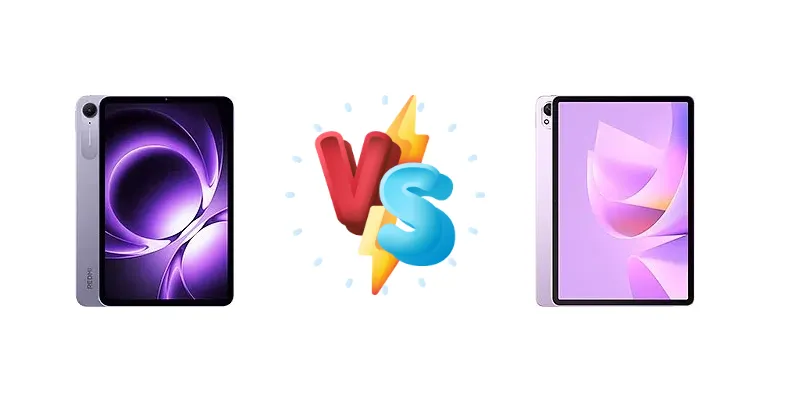
The tablet market is heating up, with Xiaomi and Huawei offering compelling options at different price points. The Redmi K Pad aims for flagship-level performance with its new Mediatek Dimensity 9400+ chipset, while the Huawei MatePad 11.5 S (2025) focuses on a balanced user experience. This comparison dissects their key differences to help you choose the right tablet for your needs.
🏆 Quick Verdict
For users prioritizing raw processing power and future-proofing, the Xiaomi Redmi K Pad is the clear winner. Its Dimensity 9400+ chipset offers a significant performance advantage. However, the Huawei MatePad 11.5 S (2025) provides a more streamlined experience and may appeal to those seeking a balance between performance and efficiency.
| Network |
|---|
| 2G bands | N/A | N/A |
| 3G bands | N/A | N/A |
| 4G bands | - | N/A |
| EDGE | N/A | No |
| GPRS | N/A | No |
| Technology | No cellular connectivity | No cellular connectivity |
| Launch |
|---|
| Announced | 2025, June 26 | 2025, August 15 |
| Status | Available. Released 2025, June 26 | Available. Released 2025, August 21 |
| Body |
|---|
| Dimensions | 205.1 x 132 x 6.5 mm (8.07 x 5.20 x 0.26 in) | 261 x 177.3 x 6.1 mm (10.28 x 6.98 x 0.24 in) |
| SIM | No | No |
| Weight | 326 g (11.50 oz) | 515 g (1.14 lb) |
| Display |
|---|
| Resolution | 1880 x 3008 pixels, 16:10 ratio (~403 ppi density) | 1840 x 2800 pixels, 3:2 ratio (~291 ppi density) |
| Size | 8.8 inches, 224.5 cm2 (~82.9% screen-to-body ratio) | 11.5 inches, 391.6 cm2 (~84.6% screen-to-body ratio) |
| Type | IPS LCD, 68B colors, 165Hz, HDR Vivid, Dolby Vision, 700 nits (HBM) | TFT LCD, 144Hz, HDR Vivid |
| Platform |
|---|
| CPU | Octa-core (1x3.73 GHz Cortex-X925 & 3x3.3 GHz Cortex-X4 & 4x2.4 GHz Cortex-A720) | Octa-core |
| Chipset | Mediatek Dimensity 9400+ (3 nm) | - |
| GPU | Immortalis-G925 | - |
| OS | Android 15, HyperOS 2 | Harmony OS 5.0 |
| Memory |
|---|
| Card slot | No | No |
| Internal | 256GB 8GB RAM, 256GB 12GB RAM, 512GB 12GB RAM, 512GB 16GB RAM, 1TB 16GB RAM | 256GB 8GB RAM, 256GB 12GB RAM, 512GB 12GB RAM |
| Main Camera |
|---|
| Features | LED flash, HDR | LED flash, panorama |
| Single | 13 MP, f/2.2, (wide), 1/3.06" 1.12μm, PDAF | 13 MP, f/1.8, (wide), AF |
| Video | 4K@30fps, 1080p@30/60fps | 1080p@30fps |
| Selfie camera |
|---|
| Features | HDR | - |
| Single | 8 MP, f/2.3, (wide), 1/4" 1.12μm | 8 MP, f/2.0 |
| Video | 1080p@30fps | 1080p@30fps |
| Sound |
|---|
| 35mm jack | No | No |
| Loudspeaker | Yes, with stereo speakers (with Dolby Atmos) | Yes, with stereo speakers (4 speakers) |
| Comms |
|---|
| Bluetooth | 5.4, LHDC 5 | 5.2, A2DP, LE, L2HC |
| Infrared port | Yes | - |
| NFC | No | No |
| Positioning | No | No |
| Radio | No | No |
| USB | 1x USB Type-C 3.2, 1x USB Type-C 2.0, Display Port 1.4, accessory connector | USB Type-C 3.1, OTG, magnetic accessory connector |
| WLAN | Wi-Fi 802.11 a/b/g/n/ac/6/7, dual-band, Wi-Fi Direct | Wi-Fi 802.11 a/b/g/n/ac/6, dual-band |
| Features |
|---|
| Sensors | Accelerometer, gyro, proximity, compass | Accelerometer, proximity (accessories only), gyro |
| Battery |
|---|
| Charging | 67W wired, PD3.0, QC3+
18W reverse wired
Bypass charging | 40W wired
5W reverse wired |
| Type | 7500 mAh | 8800 mAh |
| Misc |
|---|
| Colors | Black, Green, Purple | Gray, Silver, Mint, Purple |
| Models | - | SLG-W50, SLG-W10 |
| Price | About 330 EUR | About 250 EUR |
Xiaomi Redmi K Pad
- Significantly faster processor with the Dimensity 9400+ (3nm)
- 67W fast charging with PD3.0 and QC3+ support
- 18W reverse wired charging for convenient device top-ups
- Potentially higher price point
- May generate more heat under sustained load
Huawei MatePad 11.5 S (2025)
- Potentially more affordable price
- Balanced performance for everyday tasks
- Likely optimized for power efficiency
- Slower 40W charging
- Less powerful processor for demanding applications
Display Comparison
While specific display details are missing for both devices, the focus here is on processing power. However, given Huawei's history, the MatePad 11.5 S likely employs an IPS LCD panel optimized for color accuracy and viewing angles. The Redmi K Pad, targeting a more enthusiast audience, may feature a higher refresh rate panel to complement its powerful chipset. The absence of LTPO information suggests neither device prioritizes variable refresh rate for power saving.
Camera Comparison
Camera specifications are absent for both devices. Given the tablet form factor, camera quality is typically less of a priority. However, Huawei historically emphasizes image processing, so the MatePad 11.5 S may offer more refined image quality despite potentially having similar hardware. The Redmi K Pad, geared towards performance, may prioritize speed in image capture over extensive post-processing.
Performance
The core difference lies in the chipsets. The Xiaomi Redmi K Pad’s Mediatek Dimensity 9400+ (3nm) is a significant leap forward. Its octa-core configuration – 1x3.73 GHz Cortex-X925, 3x3.3 GHz Cortex-X4, and 4x2.4 GHz Cortex-A720 – promises exceptional performance in both single-core and multi-core tasks. The 3nm process node is crucial, offering improved power efficiency and reduced thermal throttling compared to older 4nm or 5nm chips. The Huawei MatePad 11.5 S (2025) utilizes an unspecified octa-core CPU. Without knowing the architecture or clock speeds, it’s safe to assume it’s positioned as a mid-range performer, prioritizing efficiency over raw power. The Redmi K Pad will excel in demanding applications and gaming, while the MatePad 11.5 S will handle everyday tasks smoothly.
Battery Life
The Redmi K Pad’s 67W wired charging with PD3.0 and QC3+ support is a major advantage, enabling significantly faster charging times compared to the MatePad 11.5 S’s 40W wired charging. The Redmi K Pad also offers 18W reverse wired charging, a useful feature for topping up other devices. While battery capacity isn’t specified, the faster charging speed of the Redmi K Pad mitigates any potential disadvantage from a smaller battery size. The bypass charging feature on the Redmi K Pad allows for charging while simultaneously using the device, minimizing heat buildup and extending battery lifespan.
Buying Guide
Buy the Xiaomi Redmi K Pad if you need a tablet for demanding tasks like gaming, video editing, or running multiple applications simultaneously. Its powerful processor and fast charging will keep you productive on the go. Buy the Huawei MatePad 11.5 S (2025) if you prefer a tablet for everyday tasks like browsing, streaming, and light productivity. Its focus on efficiency and potentially lower price point make it a compelling option for casual users.
Frequently Asked Questions
❓ Will the Dimensity 9400+ in the Redmi K Pad overheat during extended gaming sessions?
The Dimensity 9400+'s 3nm process node is designed to improve thermal efficiency. However, sustained high loads will inevitably generate heat. The Redmi K Pad's thermal management system will be crucial, but it's likely to experience some throttling under extreme conditions. The MatePad 11.5 S, with its less powerful processor, will likely run cooler.
❓ Does the Huawei MatePad 11.5 S (2025) support stylus input or keyboard accessories?
While not explicitly stated, Huawei frequently offers stylus and keyboard accessories for its MatePad series. It's highly probable that compatible accessories will be available for the MatePad 11.5 S (2025), enhancing its productivity capabilities. Check Huawei's official website for confirmed accessory compatibility.
❓ How does the reverse wired charging on the Redmi K Pad compare to the MatePad 11.5 S?
The Redmi K Pad offers 18W reverse wired charging, allowing you to charge other devices using the tablet's battery. The MatePad 11.5 S only provides 5W reverse wired charging, making it significantly slower and less practical for charging larger devices like smartphones.