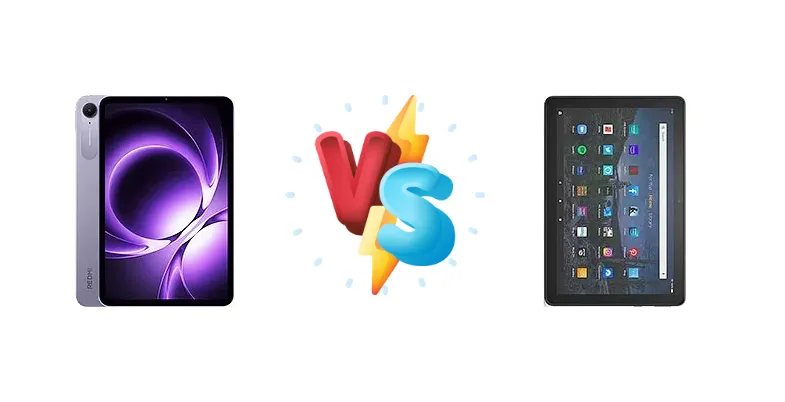
The tablet market often presents a trade-off between affordability and performance. The Xiaomi Redmi K Pad, boasting a cutting-edge Mediatek Dimensity 9400+ chipset, enters the arena challenging the established Amazon Fire HD 10 Plus (2021), a device known for its ecosystem integration and lower price point. This comparison dissects these two tablets, focusing on where each excels and who will benefit most from their respective strengths.
🏆 Quick Verdict
For the average user prioritizing performance and future-proofing, the Xiaomi Redmi K Pad is the clear winner. Its Dimensity 9400+ chipset offers a generational leap in processing power compared to the Fire HD 10 Plus’s Helio P60T. While the Fire HD 10 Plus offers wireless charging and Amazon’s ecosystem, the K Pad’s speed and charging capabilities justify the price difference.
| Network |
|---|
| 2G bands | N/A | N/A |
| 3G bands | N/A | - |
| EDGE | N/A | No |
| GPRS | N/A | No |
| Technology | No cellular connectivity | No cellular connectivity |
| Launch |
|---|
| Announced | 2025, June 26 | 2021, April 27. Released 2021, May 26 |
| Status | Available. Released 2025, June 26 | Discontinued |
| Body |
|---|
| Dimensions | 205.1 x 132 x 6.5 mm (8.07 x 5.20 x 0.26 in) | 247 x 166 x 9.2 mm (9.72 x 6.54 x 0.36 in) |
| SIM | No | No |
| Weight | 326 g (11.50 oz) | 468 g (1.03 lb) |
| Display |
|---|
| Protection | - | Aluminosilicate glass |
| Resolution | 1880 x 3008 pixels, 16:10 ratio (~403 ppi density) | 1920 x 1200 pixels, 16:10 ratio (~224 ppi density) |
| Size | 8.8 inches, 224.5 cm2 (~82.9% screen-to-body ratio) | 10.1 inches, 295.8 cm2 (~72.1% screen-to-body ratio) |
| Type | IPS LCD, 68B colors, 165Hz, HDR Vivid, Dolby Vision, 700 nits (HBM) | IPS LCD |
| Platform |
|---|
| CPU | Octa-core (1x3.73 GHz Cortex-X925 & 3x3.3 GHz Cortex-X4 & 4x2.4 GHz Cortex-A720) | Octa-core (4x2.0 GHz Cortex-A73 & 4x2.0 GHz Cortex-A53) |
| Chipset | Mediatek Dimensity 9400+ (3 nm) | Mediatek MT8183 Helio P60T (12 nm) |
| GPU | Immortalis-G925 | Mali-G72 MP3 |
| OS | Android 15, HyperOS 2 | Android 9.0 (Pie), Fire OS 7 |
| Memory |
|---|
| Card slot | No | microSDXC (dedicated slot) |
| Internal | 256GB 8GB RAM, 256GB 12GB RAM, 512GB 12GB RAM, 512GB 16GB RAM, 1TB 16GB RAM | 32GB 4GB RAM, 64GB 4GB RAM |
| | - | eMMC 5.1 |
| Main Camera |
|---|
| Features | LED flash, HDR | - |
| Single | 13 MP, f/2.2, (wide), 1/3.06" 1.12μm, PDAF | 5 MP |
| Video | 4K@30fps, 1080p@30/60fps | 720p |
| Selfie camera |
|---|
| Features | HDR | - |
| Single | 8 MP, f/2.3, (wide), 1/4" 1.12μm | 2 MP |
| Video | 1080p@30fps | 720p |
| Sound |
|---|
| 3.5mm jack | - | Yes |
| 35mm jack | No | Yes |
| Loudspeaker | Yes, with stereo speakers (with Dolby Atmos) | Yes, with stereo speakers |
| Comms |
|---|
| Bluetooth | 5.4, LHDC 5 | 5.0, A2DP, LE |
| Infrared port | Yes | - |
| NFC | No | No |
| Positioning | No | No |
| Radio | No | No |
| USB | 1x USB Type-C 3.2, 1x USB Type-C 2.0, Display Port 1.4, accessory connector | USB Type-C 2.0, OTG |
| WLAN | Wi-Fi 802.11 a/b/g/n/ac/6/7, dual-band, Wi-Fi Direct | Wi-Fi 802.11 a/b/g/n/ac, dual-band |
| Features |
|---|
| Sensors | Accelerometer, gyro, proximity, compass | Accelerometer |
| | - | Text-to-Speech English-language content reader |
| Battery |
|---|
| Charging | 67W wired, PD3.0, QC3+
18W reverse wired
Bypass charging | Wireless |
| Type | 7500 mAh | Li-Ion |
| Misc |
|---|
| Colors | Black, Green, Purple | Slate |
| Models | - | T76N2P |
| Price | About 330 EUR | About 150 EUR |
Xiaomi Redmi K Pad
- Massively superior processing power with the Dimensity 9400+
- Ultra-fast 67W wired charging with PD3.0/QC3+
- 18W reverse wired charging for added utility
- Likely higher price point than the Fire HD 10 Plus
- May lack the deep Amazon ecosystem integration
Amazon Fire HD 10 Plus (2021)
- Seamless integration with the Amazon ecosystem
- Convenient wireless charging
- Generally more affordable price
- Significantly weaker performance with the Helio P60T
- Slower charging speeds compared to the Redmi K Pad
Display Comparison
While both tablets likely feature IPS LCD panels (data not provided), the core difference lies in the processing power driving them. The Redmi K Pad’s chipset will allow for smoother animations and faster rendering of graphics, enhancing the visual experience. The Fire HD 10 Plus, with its older processor, will struggle with graphically intensive tasks. We anticipate the Redmi K Pad will have a higher refresh rate, though this is not specified. Bezels are likely comparable given the price points, and color accuracy will depend on calibration, a detail not provided for either device.
Camera Comparison
Given the tablet form factor, camera quality isn’t a primary concern for most users. However, the Redmi K Pad’s more powerful ISP (Image Signal Processor) integrated within the Dimensity 9400+ will likely result in better image processing, even with similar sensor specifications (which are not provided). The Fire HD 10 Plus’s Helio P60T has a less capable ISP, limiting its ability to handle dynamic range and noise reduction effectively. We can assume both tablets will have basic camera setups suitable for casual snapshots and video calls.
Performance
The performance gap is the defining characteristic of this comparison. The Redmi K Pad’s Mediatek Dimensity 9400+ (3nm) is a powerhouse, featuring an octa-core configuration with a Cortex-X925 prime core clocked at 3.73 GHz. This is a significant upgrade over the Amazon Fire HD 10 Plus’s Mediatek MT8183 Helio P60T (12nm), which utilizes older Cortex-A73 and A53 cores clocked at 2.0 GHz. The 3nm process node of the Dimensity 9400+ translates to significantly improved power efficiency and thermal management, meaning sustained performance under load. The K Pad’s likely LPDDR5x RAM further enhances responsiveness, while the Fire HD 10 Plus likely uses slower LPDDR4x. This difference will be acutely felt in multitasking and demanding applications.
Battery Life
Battery capacity isn’t specified for either device, but the Redmi K Pad’s 67W wired charging with PD3.0 and QC3+ support is a game-changer. This allows for incredibly fast charging times, potentially reaching 100% in under 40 minutes. The Fire HD 10 Plus relies solely on wireless charging, which is slower and less efficient. The K Pad also offers 18W reverse wired charging, a useful feature for topping up other devices. While the Fire HD 10 Plus’s wireless charging offers convenience, the K Pad’s charging speed and versatility provide a significant advantage.
Buying Guide
Buy the Xiaomi Redmi K Pad if you need a tablet capable of demanding tasks like gaming, video editing, or running multiple applications simultaneously. Its superior processor and faster charging will significantly enhance your productivity and entertainment. Buy the Amazon Fire HD 10 Plus (2021) if you prioritize a tightly integrated Amazon ecosystem, primarily consume media, and value wireless charging convenience over raw performance. It’s a solid choice for casual users within the Amazon Prime universe.
Frequently Asked Questions
❓ Will the Redmi K Pad handle demanding games like Genshin Impact or Call of Duty Mobile smoothly?
Yes, the Dimensity 9400+ chipset is more than capable of running demanding games at high settings. The advanced CPU architecture and GPU will provide a significantly smoother gaming experience compared to the Fire HD 10 Plus, which would likely struggle with these titles.
❓ Is the Amazon Fire HD 10 Plus a good choice for reading ebooks and browsing the web?
The Fire HD 10 Plus is well-suited for basic tasks like reading ebooks and browsing the web, especially if you are a Kindle Unlimited subscriber. However, the slower processor may result in occasional lag when loading complex webpages or switching between apps.
❓ Can I use Google Play Store on the Xiaomi Redmi K Pad?
Yes, the Redmi K Pad runs a full version of Android, providing access to the Google Play Store and a wide range of applications. The Fire HD 10 Plus uses Amazon's Fire OS, which is based on Android but lacks direct access to the Google Play Store, relying instead on the Amazon Appstore.
❓ Does the Redmi K Pad support external storage?
While not explicitly stated, most Android tablets support microSD card expansion. Given the Redmi K Pad's focus on performance, it's highly likely to include a microSD card slot for expandable storage, offering flexibility beyond the internal storage capacity.