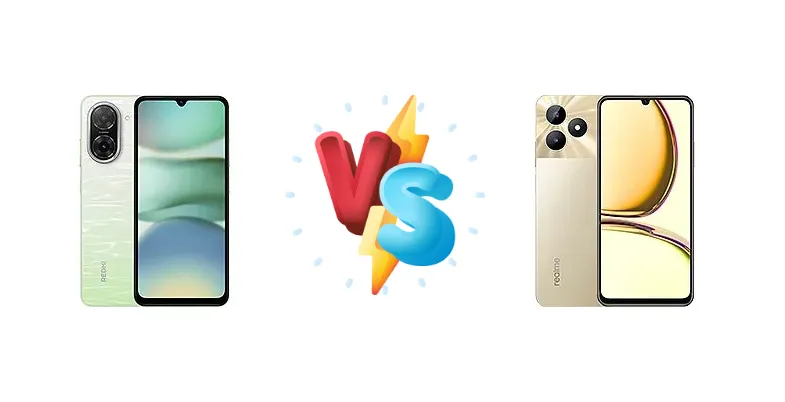
The sub-$150 smartphone market is fiercely competitive, and the Xiaomi Redmi A5 4G and Realme C53 (India) are two contenders vying for your attention. Both leverage Unisoc chipsets to deliver affordability, but subtle differences in CPU configuration and charging capabilities create distinct user experiences. This comparison dissects these nuances to determine which device offers the best value.
🏆 Quick Verdict
For the average user prioritizing sustained performance and longevity, the Realme C53 (India) is the better choice. While the Redmi A5 4G boasts impressive battery endurance, the Realme C53’s slightly faster CPU and 18W charging provide a more responsive and convenient experience.
| Network |
|---|
| 2G bands | GSM 850 / 900 / 1800 / 1900 | GSM 850 / 900 / 1800 / 1900 |
| 3G bands | HSDPA 850 / 900 / 2100 | HSDPA 850 / 900 / 2100 |
| 4G bands | 1, 3, 5, 7, 8, 20, 28, 38, 40, 41 | 1, 3, 5, 8, 38, 40, 41 |
| Speed | HSPA, LTE | HSPA, LTE |
| Technology | GSM / HSPA / LTE | GSM / HSPA / LTE |
| Launch |
|---|
| Announced | 2025, March 21 | 2023, July 19 |
| Status | Available. Released 2025, March 21 | Available. Released 2023, July 26 |
| Body |
|---|
| Build | - | Glass front, plastic frame, plastic back |
| Dimensions | 171.7 x 77.8 x 8.3 mm (6.76 x 3.06 x 0.33 in) | 167.2 x 76.7 x 8 mm (6.58 x 3.02 x 0.31 in) |
| SIM | Nano-SIM + Nano-SIM | Nano-SIM + Nano-SIM |
| Weight | 193 g (6.81 oz) | 186 g (6.56 oz) |
| Display |
|---|
| Protection | Mohs level 5 | - |
| Resolution | 720 x 1640 pixels (~260 ppi density) | 1080 x 2400 pixels, 20:9 ratio (~390 ppi density) |
| Size | 6.88 inches, 112.4 cm2 (~84.1% screen-to-body ratio) | 6.74 inches, 109.7 cm2 (~85.5% screen-to-body ratio) |
| Type | IPS LCD, 120Hz, 450 nits (typ) | IPS LCD, 90Hz, 560 nits (peak) |
| Platform |
|---|
| CPU | Octa-core (2x1.8 GHz Cortex-A75 & 6x1.6 GHz Cortex-A55) | Octa-core (2x1.8 GHz Cortex-A75 & 6x1.8 GHz Cortex-A55) |
| Chipset | Unisoc T7250 (12 nm) | Unisoc Tiger T612 (12 nm) |
| GPU | Mali-G57 MP1 | Mali-G57 |
| OS | Android 15 (Go edition), up to 2 major Android upgrades | Android 13, Realme UI |
| Memory |
|---|
| Card slot | microSDXC (dedicated slot) | microSDXC (dedicated slot) |
| Internal | 64GB 3GB RAM, 64GB 4GB RAM, 128GB 4GB RAM, 128GB 6GB RAM | 64GB 6GB RAM, 128GB 4GB RAM, 128GB 6GB RAM |
| Main Camera |
|---|
| Dual | - | 108 MP, (wide), PDAF
Auxiliary lens |
| Features | LED flash, HDR | LED flash, HDR, panorama |
| Single | 32 MP, f/2.0, (wide)
Auxiliary lens | - |
| Video | 1080p@30fps | 1080p@30fps |
| Selfie camera |
|---|
| Features | HDR | HDR |
| Single | 8 MP, f/2.0, (wide) | 8 MP, (wide) |
| Video | 1080p@30fps | 720p@30fps |
| Sound |
|---|
| 35mm jack | Yes | Yes |
| Loudspeaker | Yes | Yes |
| Comms |
|---|
| Bluetooth | 5.2, A2DP, LE | 5.0, A2DP, LE |
| NFC | No | No |
| Positioning | GPS, GALILEO, GLONASS, BDS | GPS, GLONASS, GALILEO |
| Radio | FM radio | Unspecified |
| USB | USB Type-C 2.0 | USB Type-C 2.0 |
| WLAN | Wi-Fi 802.11 a/b/g/n/ac, dual-band | Wi-Fi 802.11 a/b/g/n/ac, dual-band |
| Features |
|---|
| Sensors | Fingerprint (side-mounted), accelerometer, compass | Fingerprint (side-mounted), accelerometer, gyro, proximity, compass |
| Battery |
|---|
| Charging | 15W wired | 18W wired |
| Type | 5200 mAh | 5000 mAh |
| Misc |
|---|
| Colors | Ocean Blue, Lake Green, Sandy Gold, Midnight Black | Gold, Black |
| Models | 25028PC03G, 25028RN03A, 25028RN03I, 25028RN03Y | RMX3762 |
| Price | € 69.85 / $ 75.09 / £ 54.99 / ₹ 6,499 | About 110 EUR |
| EU LABEL |
|---|
| Battery | 45:26h endurance, 1000 cycles | - |
| Energy | Class B | - |
| Free fall | Class A (270 falls) | - |
| Repairability | Class C | - |
Xiaomi Redmi A5 4G
- Exceptional battery endurance (45:26h)
- Long-term battery health (1000 charge cycles)
- Affordable price point
- Slower CPU clock speed on efficiency cores
- Slower 15W charging
Realme C53 (India)
- Slightly faster CPU clock speed on efficiency cores
- Faster 18W charging
- Potentially newer chipset architecture
- Likely shorter battery life compared to Redmi A5 4G
- Battery longevity unknown
Display Comparison
Neither device boasts a standout display. Both are likely utilizing LCD panels common in this price bracket, and detailed specifications like resolution and peak brightness are absent. The focus here is on core performance, not visual fidelity. Bezels are expected to be noticeable on both, impacting the overall screen-to-body ratio. Color accuracy will likely be standard for the segment, prioritizing power efficiency over color calibration.
Camera Comparison
Camera performance is likely to be similar on both devices, relying heavily on software processing. Detailed sensor information is unavailable, but given the price point, expect a primary sensor around 13MP. The inclusion of a 2MP macro lens on either device is largely a marketing tactic, offering limited practical benefit due to the low resolution and fixed focus. Image quality will be acceptable in good lighting conditions, but struggle in low-light scenarios. The image processing style will likely differ between Xiaomi and Realme, potentially influencing color saturation and sharpness.
Performance
The Realme C53 (India) holds a slight edge in CPU configuration. Both devices utilize an octa-core setup with 2x1.8 GHz Cortex-A75 and 6x Cortex-A55 cores, but the Realme C53 bumps the A55 cores up to 1.8 GHz versus the Redmi A5’s 1.6 GHz. This subtle increase in clock speed on the efficiency cores could translate to slightly snappier multitasking and background app performance. Both are built on a 12nm process, indicating similar power efficiency. The Unisoc Tiger T612 in the Realme C53 is a newer iteration, potentially benefiting from minor architectural improvements. However, RAM configurations are unknown, which significantly impacts real-world performance.
Battery Life
The Xiaomi Redmi A5 4G shines in battery endurance, boasting a tested 45:26h of usage. While the Realme C53’s battery capacity is unknown, the Redmi A5’s longevity is a significant advantage for users prioritizing all-day battery life. However, the Realme C53 compensates with 18W wired charging, a step up from the Redmi A5’s 15W. This faster charging speed will reduce downtime, allowing users to quickly top up their battery when needed. The Redmi A5’s 1000 charge cycles suggest a focus on long-term battery health.
Buying Guide
Buy the Xiaomi Redmi A5 4G if you absolutely prioritize maximizing battery life and are willing to accept slightly slower performance. This phone is ideal for users who primarily use their device for calls, texts, and light social media. Buy the Realme C53 (India) if you prefer a more responsive user experience, faster charging, and don't mind potentially slightly shorter battery life. This is the better option for those who enjoy occasional gaming or multitasking.
Frequently Asked Questions
❓ Will the Unisoc Tiger T612 in the Realme C53 handle demanding games like PUBG Mobile?
While the Tiger T612 can run PUBG Mobile, expect to play at lower graphics settings and frame rates to maintain a stable experience. The chipset isn't designed for high-end gaming, but it's sufficient for casual gaming sessions. The Redmi A5 4G will offer a similar gaming experience.
❓ How long will it take to fully charge the Realme C53 with the 18W charger?
While a precise 0-100% charging time is unavailable, the 18W charging should significantly reduce charging times compared to the Redmi A5 4G’s 15W charging. Expect a full charge in approximately 2-2.5 hours, depending on usage during charging.
❓ Is the difference in CPU clock speed between the two phones noticeable in everyday use?
The difference of 0.2 GHz on the efficiency cores is subtle, but it can contribute to slightly smoother multitasking and faster app loading times on the Realme C53. Users upgrading from older devices will likely notice the improvement, while those coming from similar-spec phones may find the difference minimal.