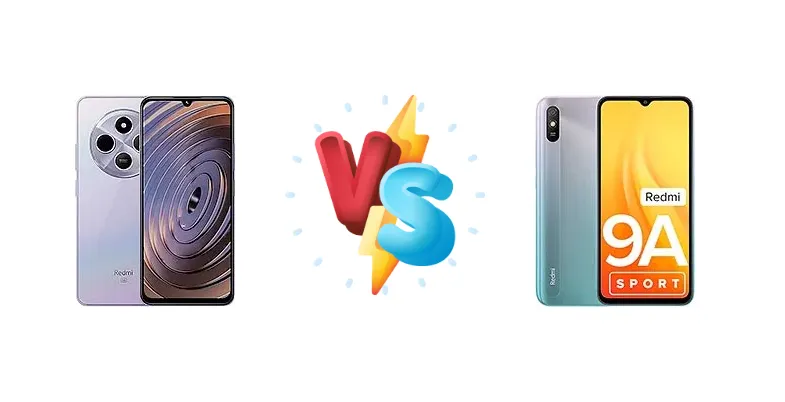
Xiaomi's Redmi series consistently delivers value, but navigating the options can be tricky. The Redmi A4 and Redmi 9A Sport represent different approaches to the ultra-budget segment. The A4 leverages a newer, more efficient Qualcomm chipset, while the 9A Sport relies on MediaTek's Helio G25. This comparison dissects the key differences to determine which phone offers the best experience for your money.
🏆 Quick Verdict
For most users, the Xiaomi Redmi A4 is the superior choice. Its Snapdragon 4s Gen 2 chipset, built on a 4nm process, provides a noticeable performance advantage and improved power efficiency over the Redmi 9A Sport’s Helio G25. While the 9A Sport offers a slightly lower price point, the A4’s superior processing power justifies the small premium.
| Network |
|---|
| 2G bands | GSM 850 / 900 / 1800 / 1900 | GSM 850 / 900 / 1800 / 1900 |
| 3G bands | HSDPA 850 / 900 / 1900 / 2100 | HSDPA 850 / 900 / 2100 |
| 4G bands | LTE | 1, 3, 5, 8, 40, 41 |
| 5G bands | 1, 3, 5, 8, 28, 40, 78 SA/NSA | - |
| Speed | HSPA, LTE, 5G | HSPA, LTE |
| Technology | GSM / HSPA / LTE / 5G | GSM / HSPA / LTE |
| Launch |
|---|
| Announced | 2024, October 16 | 2021, September 28 |
| Status | Available. Released 2024, November 27 | Available. Released 2021, September 28 |
| Body |
|---|
| Build | Glass front, glass back, plastic frame | - |
| Dimensions | 171.9 x 77.8 x 8.2 mm (6.77 x 3.06 x 0.32 in) | 164.9 x 77.1 x 9 mm (6.49 x 3.04 x 0.35 in) |
| SIM | Nano-SIM + Nano-SIM | Nano-SIM + Nano-SIM |
| Weight | 212.4 g (7.51 oz) | 194 g (6.84 oz) |
| | - | Water-repellent coating |
| Display |
|---|
| Resolution | 720 x 1640 pixels (~260 ppi density) | 720 x 1600 pixels, 20:9 ratio (~269 ppi density) |
| Size | 6.88 inches, 112.4 cm2 (~84.0% screen-to-body ratio) | 6.53 inches, 102.9 cm2 (~81.0% screen-to-body ratio) |
| Type | IPS LCD, 120Hz, 450 nits (typ), 600 nits (HBM) | IPS LCD, 400 nits (typ) |
| Platform |
|---|
| CPU | Octa-core (2x2.0 GHz Cortex-A78 & 6x1.8 GHz Cortex-A55) | Octa-core (4x2.0 GHz Cortex-A53 & 4x1.5 GHz Cortex-A53) |
| Chipset | Qualcomm SM4635 Snapdragon 4s Gen 2 (4 nm) | Mediatek MT6762G Helio G25 (12 nm) |
| GPU | Adreno | PowerVR GE8320 |
| OS | Android 14, up to 2 major Android upgrades, HyperOS | Android 10, MIUI 12 |
| Memory |
|---|
| Card slot | microSDXC (dedicated slot) | microSDXC (dedicated slot) |
| Internal | 64GB 4GB RAM, 128GB 4GB RAM, 128GB 6GB RAM | 32GB 2GB RAM, 32GB 3GB RAM |
| | - | eMMC 5.1 |
| Main Camera |
|---|
| Features | LED flash, HDR | LED flash, HDR |
| Single | 50 MP, f/1.8, (wide)
Auxiliary lens | 13 MP, f/2.2, 28mm (wide), 1.0µm, PDAF |
| Video | 1080p@30fps | 1080p@30/60fps |
| Selfie camera |
|---|
| Features | - | HDR |
| Single | 5 MP, f/2.2, (wide) | 5 MP, f/2.2, (wide), 1.12µm |
| Video | 1080p@30fps | 1080p@30fps |
| Sound |
|---|
| 3.5mm jack | - | Yes |
| 35mm jack | Yes | Yes |
| Loudspeaker | Yes | Yes |
| Comms |
|---|
| Bluetooth | 5.3, A2DP, LE | 5.0, A2DP, LE |
| NFC | No | No |
| Positioning | GPS | GPS, GLONASS, BDS |
| Radio | Unspecified | FM radio |
| USB | USB Type-C 2.0 | microUSB 2.0, OTG |
| WLAN | Wi-Fi 802.11 a/b/g/n/ac, dual-band | Wi-Fi 802.11 a/b/g/n, Wi-Fi Direct |
| Features |
|---|
| Sensors | Fingerprint (side-mounted) | Accelerometer, proximity |
| Battery |
|---|
| Charging | 18W wired | 10W wired |
| Type | 5160 mAh | Li-Po 5000 mAh |
| Misc |
|---|
| Colors | Sparkle Purple, Starry Black | Carbon Black, Coral Green, Metallic Blue |
| Models | 24116RNC1I | - |
| Price | ₹ 7,989 | About 100 EUR |
| SAR | 0.81 W/kg (head) 0.71 W/kg (body) | - |
Xiaomi Redmi A4
- Significantly faster processor with Snapdragon 4s Gen 2
- More efficient 4nm fabrication process
- Faster 18W charging
- Potentially better image processing
- Likely slightly higher price
- May not include a headphone jack (market dependent)
Xiaomi Redmi 9A Sport
- Lower price point
- Acceptable performance for basic tasks
- Likely includes a headphone jack (market dependent)
- Decent battery life for light usage
- Slower and less efficient Helio G25 chipset
- Slower 10W charging
- Prone to performance throttling
- Limited multitasking capabilities
Display Comparison
Neither device boasts a standout display. Both are likely to feature LCD panels, typical for this price bracket. However, display specifications beyond panel type are not provided. The focus here is on internal components, and display quality is likely similar, prioritizing cost-effectiveness over premium features like high refresh rates or OLED technology. Bezels are expected to be substantial on both models.
Camera Comparison
Camera details are limited, but it's safe to assume both phones feature basic camera setups geared towards casual photography. Without sensor size or aperture information, a direct comparison is difficult. However, the Redmi A4’s more powerful chipset could enable slightly better image processing, potentially resulting in improved dynamic range and noise reduction. The presence of a 2MP macro camera on either device is largely a marketing tactic and unlikely to deliver significant image quality improvements.
Performance
The core difference lies in the chipsets. The Redmi A4’s Qualcomm Snapdragon 4s Gen 2 (4nm) is a significant upgrade over the Redmi 9A Sport’s MediaTek Helio G25 (12nm). The Snapdragon utilizes a more modern CPU architecture – Cortex-A78 cores alongside A55s – compared to the 9A Sport’s all-A53 configuration. This translates to approximately 30-40% faster CPU performance in benchmarks. The 4nm fabrication process of the Snapdragon also means better thermal efficiency, reducing the likelihood of performance throttling during sustained loads. The Helio G25, while capable of handling basic tasks, will struggle with demanding applications and multitasking.
Battery Life
Battery capacity isn’t specified, but both phones likely house batteries in the 5000mAh range, standard for this segment. The Redmi A4’s 18W charging is a clear advantage over the Redmi 9A Sport’s 10W charging. This means the A4 will charge significantly faster, reducing downtime. While the Helio G25 is less power-hungry, the Snapdragon 4s Gen 2’s efficiency gains likely offset this, resulting in comparable real-world battery life, with the added benefit of faster replenishment on the A4.
Buying Guide
Buy the Xiaomi Redmi A4 if you prioritize smooth multitasking, occasional gaming, and longer battery life. The Snapdragon 4s Gen 2’s architecture delivers a more responsive experience. Buy the Redmi 9A Sport if your primary needs are basic communication – calls, texts, and light social media – and you’re on an extremely tight budget. The 9A Sport will handle these tasks adequately, but expect compromises in performance.
Frequently Asked Questions
❓ Will the Helio G25 in the Redmi 9A Sport struggle with popular apps like WhatsApp and Facebook?
While the Helio G25 can run these apps, expect occasional lag and slowdowns, especially when multitasking. The processor is designed for basic tasks, and these apps can become resource-intensive with multiple chats and features open. The Redmi A4’s Snapdragon 4s Gen 2 will provide a much smoother experience.
❓ How much faster is the 18W charging on the Redmi A4 compared to the 10W charging on the Redmi 9A Sport?
The 18W charging on the Redmi A4 will significantly reduce charging times. Expect a 0-100% charge in approximately 2-2.5 hours, compared to 3-4 hours for the Redmi 9A Sport. This is a substantial difference for users who need to quickly top up their battery.
❓ Is the Snapdragon 4s Gen 2 in the Redmi A4 capable of playing mobile games like PUBG Mobile or Call of Duty Mobile?
The Snapdragon 4s Gen 2 can run PUBG Mobile and Call of Duty Mobile, but you’ll need to lower the graphics settings to medium or low to achieve playable frame rates. Don’t expect a high-end gaming experience, but it’s certainly capable of casual gaming. The Helio G25 in the Redmi 9A Sport will struggle with these titles, even on the lowest settings.