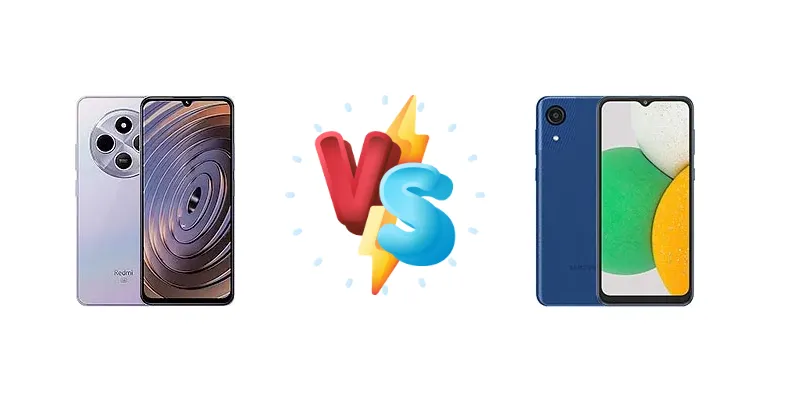
The sub-$150 smartphone market is fiercely competitive. Both the Xiaomi Redmi A4 and Samsung Galaxy A03 Core aim to deliver essential smartphone functionality at an accessible price. However, a significant divergence in chipset architecture separates these two devices, impacting performance and efficiency. This comparison dissects those differences to determine which phone offers the best experience for the money.
🏆 Quick Verdict
For the average user prioritizing responsiveness and future-proofing, the Xiaomi Redmi A4 is the clear winner. Its Snapdragon 4s Gen 2 chipset, built on a modern 4nm process, provides a substantial performance advantage over the Samsung Galaxy A03 Core’s older, less efficient Unisoc SC9863A. While the A03 Core may offer a slightly more recognizable brand name, the A4 delivers a smoother, more capable experience.
| Network |
|---|
| 2G bands | GSM 850 / 900 / 1800 / 1900 | GSM 850 / 900 / 1800 / 1900 |
| 3G bands | HSDPA 850 / 900 / 1900 / 2100 | HSDPA 850 / 900 / 2100 |
| 4G bands | LTE | 1, 3, 5, 7, 8, 20, 28, 38, 40, 41 |
| 5G bands | 1, 3, 5, 8, 28, 40, 78 SA/NSA | - |
| Speed | HSPA, LTE, 5G | HSPA 21.1/5.76 Mbps, LTE |
| Technology | GSM / HSPA / LTE / 5G | GSM / HSPA / LTE |
| Launch |
|---|
| Announced | 2024, October 16 | 2021, November 15 |
| Status | Available. Released 2024, November 27 | Available. Released 2021, December 06 |
| Body |
|---|
| Build | Glass front, glass back, plastic frame | Plastic back, plastic frame |
| Dimensions | 171.9 x 77.8 x 8.2 mm (6.77 x 3.06 x 0.32 in) | 164.2 x 75.9 x 9.1 mm (6.46 x 2.99 x 0.36 in) |
| SIM | Nano-SIM + Nano-SIM | · Nano-SIM· Nano-SIM + Nano-SIM |
| Weight | 212.4 g (7.51 oz) | 211 g (7.44 oz) |
| Display |
|---|
| Resolution | 720 x 1640 pixels (~260 ppi density) | 720 x 1600 pixels, 20:9 ratio (~270 ppi density) |
| Size | 6.88 inches, 112.4 cm2 (~84.0% screen-to-body ratio) | 6.5 inches, 102.0 cm2 (~81.8% screen-to-body ratio) |
| Type | IPS LCD, 120Hz, 450 nits (typ), 600 nits (HBM) | PLS LCD |
| Platform |
|---|
| CPU | Octa-core (2x2.0 GHz Cortex-A78 & 6x1.8 GHz Cortex-A55) | Octa-core (4x1.6 GHz Cortex-A55 & 4x1.2 GHz Cortex-A55) |
| Chipset | Qualcomm SM4635 Snapdragon 4s Gen 2 (4 nm) | Unisoc SC9863A (28 nm) |
| GPU | Adreno | IMG8322 |
| OS | Android 14, up to 2 major Android upgrades, HyperOS | Android 11 (Go edition) |
| Memory |
|---|
| Card slot | microSDXC (dedicated slot) | microSDXC (dedicated slot) |
| Internal | 64GB 4GB RAM, 128GB 4GB RAM, 128GB 6GB RAM | 32GB 2GB RAM |
| | - | eMMC 5.1 |
| Main Camera |
|---|
| Features | LED flash, HDR | LED flash |
| Single | 50 MP, f/1.8, (wide)
Auxiliary lens | 8 MP, f/2.0, AF |
| Video | 1080p@30fps | 1080p@30fps |
| Selfie camera |
|---|
| Single | 5 MP, f/2.2, (wide) | 5 MP, f/2.2 |
| Video | 1080p@30fps | - |
| Sound |
|---|
| 3.5mm jack | - | Yes |
| 35mm jack | Yes | Yes |
| Loudspeaker | Yes | Yes |
| Comms |
|---|
| Bluetooth | 5.3, A2DP, LE | 4.2, A2DP |
| NFC | No | No |
| Positioning | GPS | GPS, GLONASS |
| Radio | Unspecified | Unspecified |
| USB | USB Type-C 2.0 | microUSB 2.0, OTG |
| WLAN | Wi-Fi 802.11 a/b/g/n/ac, dual-band | Wi-Fi 802.11 b/g/n, Wi-Fi Direct |
| Features |
|---|
| Sensors | Fingerprint (side-mounted) | Accelerometer, proximity |
| Battery |
|---|
| Charging | 18W wired | - |
| Type | 5160 mAh | Li-Ion 5000 mAh |
| Misc |
|---|
| Colors | Sparkle Purple, Starry Black | Black, Blue |
| Models | 24116RNC1I | SM-A032F, SM-A032F/DS, SM-A032M |
| Price | ₹ 7,989 | £ 74.99 |
| SAR | 0.81 W/kg (head) 0.71 W/kg (body) | 0.30 W/kg (head) |
| SAR EU | - | 0.24 W/kg (head) 1.39 W/kg (body) |
Xiaomi Redmi A4
- Significantly faster processor (Snapdragon 4s Gen 2)
- More efficient 4nm process for better battery life
- Faster charging (18W)
- Potential for future software updates and feature enhancements
- Xiaomi’s MIUI software can be heavily customized
- May lack certain Samsung-specific features
Samsung Galaxy A03 Core
- Samsung brand recognition
- Simple and streamlined user interface (One UI Go)
- Potentially wider carrier compatibility
- Generally reliable build quality
- Significantly slower processor (Unisoc SC9863A)
- Less efficient 28nm process leading to shorter battery life
- Limited performance headroom for future software updates
- May experience noticeable lag with multitasking
Display Comparison
Neither device boasts a standout display. Both are likely to feature LCD panels, typical for this price bracket. However, details like resolution and peak brightness are missing. The key difference lies under the hood: the Redmi A4’s chipset has the processing power to potentially support more advanced display features in future software updates, while the A03 Core’s Unisoc chip is likely limited in this regard. Bezels are expected to be substantial on both, minimizing the immersive experience.
Camera Comparison
Camera performance is likely to be similar in real-world usage, given the expected low-resolution sensors on both devices. Details are missing, but both will likely feature a primary camera and potentially a depth or macro sensor. The Redmi A4’s more powerful ISP (Image Signal Processor) within the Snapdragon chipset *could* offer slightly better image processing, particularly in low-light conditions, but the difference will be marginal. Focusing on the main sensor’s megapixel count is misleading; the chipset’s processing capabilities are more crucial at this price point.
Performance
The performance gap is the defining characteristic of this comparison. The Xiaomi Redmi A4’s Qualcomm SM4635 Snapdragon 4s Gen 2, fabricated on a 4nm process, is a significant leap ahead of the Samsung Galaxy A03 Core’s Unisoc SC9863A (28nm). The Snapdragon’s octa-core CPU, featuring two Cortex-A78 cores, provides considerably more processing power than the A03 Core’s four Cortex-A55 cores. This translates to faster app loading times, smoother multitasking, and a more responsive user interface. The 4nm process also contributes to better thermal efficiency, reducing the likelihood of throttling during sustained use. The A03 Core’s older architecture will struggle with demanding applications and may exhibit noticeable lag.
Battery Life
Battery life will depend heavily on usage patterns. While specific mAh capacities are unknown, the Redmi A4’s more efficient 4nm chipset will likely result in longer battery life for a given workload compared to the A03 Core’s power-hungry 28nm Unisoc chip. The Redmi A4 also supports 18W wired charging, potentially offering faster charging speeds than the A03 Core, though actual charging speeds will depend on the included charger.
Buying Guide
Buy the Xiaomi Redmi A4 if you need a phone that feels responsive for everyday tasks, handles multitasking without significant slowdown, and offers a degree of future-proofing thanks to its newer chipset. Buy the Samsung Galaxy A03 Core if you prioritize brand recognition and are primarily focused on extremely basic smartphone functions like calls, texts, and light social media browsing, and are willing to accept noticeable performance limitations.
Frequently Asked Questions
❓ Will the Unisoc SC9863A in the Galaxy A03 Core struggle with popular apps like WhatsApp and Facebook?
While the A03 Core can *run* these apps, the Unisoc SC9863A’s limited processing power may result in slower loading times, occasional lag, and a less fluid experience, especially when multitasking or using the apps for extended periods. The Snapdragon 4s Gen 2 in the Redmi A4 will handle these apps with significantly more ease.
❓ Is the 18W charging on the Redmi A4 a significant advantage over the Galaxy A03 Core’s charging speed?
Yes, 18W charging is faster than the likely 10W or 15W charging on the A03 Core. While neither phone will charge incredibly quickly, the Redmi A4 will likely reach a full charge in a noticeably shorter timeframe, reducing downtime.
❓ Can the Xiaomi Redmi A4 handle basic mobile gaming?
The Redmi A4, with its Snapdragon 4s Gen 2, can handle less demanding mobile games at lower settings. While it won’t deliver a high-end gaming experience, it’s capable of running titles like PUBG Mobile or Call of Duty Mobile at reduced graphics settings and frame rates. The A03 Core will struggle with even basic gaming.