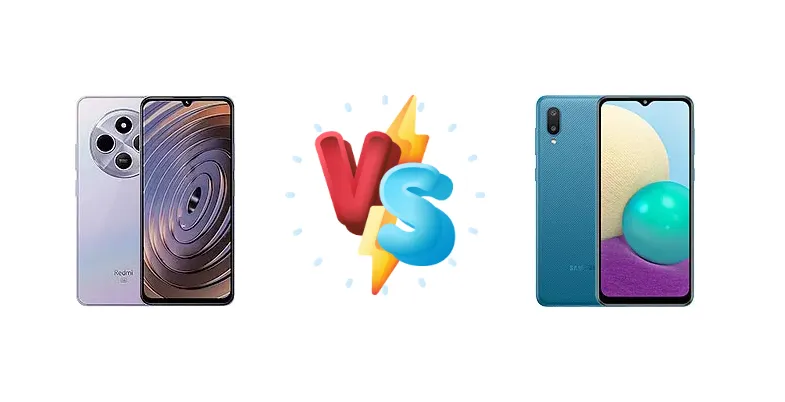
The sub-$200 smartphone market is fiercely competitive. The Xiaomi Redmi A4 and Samsung Galaxy A02 represent two distinct approaches to affordability. The A02 relies on Samsung's brand recognition and a range of storage/RAM configurations, while the A4 attempts to disrupt with a significantly newer and more efficient Qualcomm Snapdragon 4s Gen 2 chipset. This comparison will dissect the key differences to determine which device delivers the best value.
🏆 Quick Verdict
For the average user prioritizing responsiveness and future-proofing, the Xiaomi Redmi A4 is the clear winner. Its Snapdragon 4s Gen 2 chipset offers a substantial performance leap over the Galaxy A02’s Mediatek MT6739W, translating to smoother multitasking and a better overall user experience. While the A02 offers lower entry prices, the A4’s efficiency and power justify the price difference.
| Network |
|---|
| 2G bands | GSM 850 / 900 / 1800 / 1900 | GSM 850 / 900 / 1800 / 1900 |
| 3G bands | HSDPA 850 / 900 / 1900 / 2100 | HSDPA 850 / 900 / 2100 |
| 4G bands | LTE | 1, 3, 5, 7, 8, 20, 28, 38, 40, 41 |
| 5G bands | 1, 3, 5, 8, 28, 40, 78 SA/NSA | - |
| Speed | HSPA, LTE, 5G | HSPA 42.2/5.76 Mbps, LTE Cat4 150/50 Mbps |
| Technology | GSM / HSPA / LTE / 5G | GSM / HSPA / LTE |
| Launch |
|---|
| Announced | 2024, October 16 | 2021, January 27 |
| Status | Available. Released 2024, November 27 | Available. Released 2021, January 27 |
| Body |
|---|
| Build | Glass front, glass back, plastic frame | Glass front, plastic back, plastic frame |
| Dimensions | 171.9 x 77.8 x 8.2 mm (6.77 x 3.06 x 0.32 in) | 164 x 75.9 x 9.1 mm (6.46 x 2.99 x 0.36 in) |
| SIM | Nano-SIM + Nano-SIM | · Nano-SIM· Nano-SIM + Nano-SIM |
| Weight | 212.4 g (7.51 oz) | 206 g (7.27 oz) |
| Display |
|---|
| Resolution | 720 x 1640 pixels (~260 ppi density) | 720 x 1600 pixels, 20:9 ratio (~270 ppi density) |
| Size | 6.88 inches, 112.4 cm2 (~84.0% screen-to-body ratio) | 6.5 inches, 102.0 cm2 (~81.9% screen-to-body ratio) |
| Type | IPS LCD, 120Hz, 450 nits (typ), 600 nits (HBM) | PLS LCD |
| Platform |
|---|
| CPU | Octa-core (2x2.0 GHz Cortex-A78 & 6x1.8 GHz Cortex-A55) | Quad-core 1.5 GHz Cortex-A53 |
| Chipset | Qualcomm SM4635 Snapdragon 4s Gen 2 (4 nm) | Mediatek MT6739W (28 nm) |
| GPU | Adreno | PowerVR GE8100 |
| OS | Android 14, up to 2 major Android upgrades, HyperOS | Android 10, upgradable to Android 11, One UI Core 3.1 |
| Memory |
|---|
| Card slot | microSDXC (dedicated slot) | microSDXC (dedicated slot) |
| Internal | 64GB 4GB RAM, 128GB 4GB RAM, 128GB 6GB RAM | 32GB 2GB RAM, 32GB 3GB RAM, 32GB 4GB RAM, 64GB 3GB RAM |
| | - | eMMC 5.1 |
| Main Camera |
|---|
| Dual | - | 13 MP, f/1.9, (wide), AF
2 MP (macro) |
| Features | LED flash, HDR | LED flash |
| Single | 50 MP, f/1.8, (wide)
Auxiliary lens | - |
| Video | 1080p@30fps | 1080p@30fps |
| Selfie camera |
|---|
| Single | 5 MP, f/2.2, (wide) | 5 MP, f/2.0 |
| Video | 1080p@30fps | - |
| Sound |
|---|
| 3.5mm jack | - | Yes |
| 35mm jack | Yes | Yes |
| Loudspeaker | Yes | Yes |
| Comms |
|---|
| Bluetooth | 5.3, A2DP, LE | 5.1, A2DP, LE |
| NFC | No | No |
| Positioning | GPS | GPS, GLONASS |
| Radio | Unspecified | FM radio |
| USB | USB Type-C 2.0 | microUSB 2.0 |
| WLAN | Wi-Fi 802.11 a/b/g/n/ac, dual-band | Wi-Fi 802.11 b/g/n, Wi-Fi Direct |
| Features |
|---|
| Sensors | Fingerprint (side-mounted) | Accelerometer |
| | - | Virtual proximity sensing |
| Battery |
|---|
| Charging | 18W wired | - |
| Type | 5160 mAh | Li-Po 5000 mAh |
| Misc |
|---|
| Colors | Sparkle Purple, Starry Black | Black, Blue |
| Models | 24116RNC1I | SM-A022F, SM-A022F/DS, SM-A022M, SM-A022M/DS, SM-A022G, SM-A022G/DS |
| Price | ₹ 7,989 | € 97.46 |
| SAR | 0.81 W/kg (head) 0.71 W/kg (body) | - |
| SAR EU | - | 0.65 W/kg (head) 1.71 W/kg (body) |
| Pricing |
|---|
| 32GB 2GB RAM | - | $ 149.99 |
| 32GB 3GB RAM | - | $ 129.99 |
| 64GB 3GB RAM | - | $ 199.99 |
| RENEWED | - | £ 113.00 |
Xiaomi Redmi A4
- Significantly faster processor (Snapdragon 4s Gen 2)
- More power-efficient chipset (4nm process)
- Faster charging (18W)
- Potentially better long-term software support
- Price is slightly higher than the base Galaxy A02 configuration
- Camera specs currently unknown
Samsung Galaxy A02
- Lower starting price
- Multiple storage/RAM configurations
- Samsung brand recognition
- Widely available
- Outdated and slow processor (Mediatek MT6739W)
- Less power-efficient chipset (28nm process)
- Limited performance for multitasking and gaming
- 2MP macro camera is largely ineffective
Display Comparison
Neither device is expected to deliver a premium display experience. Specifics like panel type (IPS vs. TFT) and resolution are missing, but the focus here is on processing power, not visual fidelity. Bezels are likely substantial on both. The lack of high refresh rates is standard for this segment. The A02’s display is likely tuned for Samsung’s typical vibrant color profile, while the A4’s display characteristics are unknown, but likely more neutral.
Camera Comparison
Both phones likely feature basic camera setups. The Galaxy A02’s available configurations (32GB/2GB, 32GB/3GB, 64GB/3GB) suggest a focus on storage options rather than camera prowess. The A4’s camera specs are currently unknown, but given the price point, it’s unlikely to feature a significantly superior sensor. The presence of a 2MP macro camera on the A02 is largely a marketing gimmick, offering limited practical benefit due to the low resolution and lack of optical image stabilization (OIS). Image processing will likely be more refined on the A4 due to the more powerful chipset.
Performance
The performance gap is the most significant differentiator. The Xiaomi Redmi A4’s Qualcomm Snapdragon 4s Gen 2 (4nm) is a generational leap ahead of the Samsung Galaxy A02’s Mediatek MT6739W (28nm). The 4nm process node of the Snapdragon offers vastly improved power efficiency, reducing heat and extending battery life. The Snapdragon’s octa-core CPU (2x2.0 GHz Cortex-A78 & 6x1.8 GHz Cortex-A55) provides significantly more processing power than the A02’s quad-core 1.5 GHz Cortex-A53. The Cortex-A78 cores in the A4 are high-performance cores, capable of handling demanding tasks, while the A53 cores in the A02 are older, less efficient designs. This translates to faster app loading times, smoother multitasking, and a more responsive user interface on the A4.
Battery Life
Battery capacity is not specified for either device. However, the Snapdragon 4s Gen 2’s 4nm process gives the Redmi A4 a significant advantage in power efficiency. This means the A4 will likely achieve comparable or better battery life with a smaller battery capacity than the A02. The A4’s 18W wired charging is also faster than what is typically offered in this price range for the A02, allowing for quicker top-ups.
Buying Guide
Buy the Xiaomi Redmi A4 if you need a phone that feels responsive in everyday tasks, can handle light gaming without significant lag, and benefits from a more modern and power-efficient processor. Buy the Samsung Galaxy A02 if you are on an extremely tight budget and primarily need a device for basic communication – calls, texts, and light social media – and value Samsung’s brand ecosystem.
Frequently Asked Questions
❓ Will the Mediatek MT6739W in the Galaxy A02 struggle with popular apps like Facebook or WhatsApp?
Yes, the Mediatek MT6739W is a relatively weak processor. While it can handle basic apps like Facebook and WhatsApp, you may experience noticeable lag and slowdowns, especially when multitasking or using the apps for extended periods. The Xiaomi Redmi A4’s Snapdragon 4s Gen 2 will provide a much smoother experience.
❓ Is the Xiaomi Redmi A4 a good choice for playing mobile games like PUBG Mobile or Call of Duty Mobile?
The Redmi A4 can handle light gaming, but don't expect a high-performance experience. You'll likely need to lower graphics settings to achieve playable frame rates in demanding games like PUBG Mobile or Call of Duty Mobile. The Galaxy A02 will struggle even more with these titles.
❓ How much does the 4nm process of the Snapdragon 4s Gen 2 impact real-world battery life on the Redmi A4?
The 4nm process is a significant advantage for the Redmi A4. It means the processor consumes less power for the same level of performance compared to the 28nm process used in the Galaxy A02. This translates to longer battery life, less heat generation, and a more consistent user experience throughout the day.