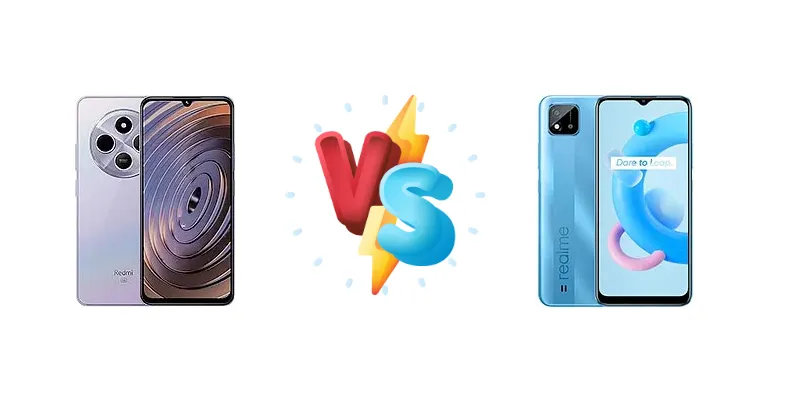
The Xiaomi Redmi A4 and Realme C20A represent the fiercely competitive entry-level smartphone market. Both aim to deliver essential smartphone functionality at an incredibly affordable price point, but they take distinctly different approaches to achieving this. The Redmi A4 leverages Qualcomm's newer, more efficient Snapdragon 4s Gen 2, while the Realme C20A relies on MediaTek's Helio G35. This comparison will dissect the key differences to help you determine which device best suits your needs.
🏆 Quick Verdict
For the average user prioritizing overall performance and future-proofing, the Xiaomi Redmi A4 emerges as the stronger contender. Its Snapdragon 4s Gen 2 chipset, built on a 4nm process, offers a significant advantage in both CPU and GPU performance, alongside improved power efficiency compared to the Realme C20A's Helio G35.
| Network |
|---|
| 2G bands | GSM 850 / 900 / 1800 / 1900 | GSM 850 / 900 / 1800 / 1900 |
| 3G bands | HSDPA 850 / 900 / 1900 / 2100 | HSDPA 850 / 900 / 2100 |
| 4G bands | LTE | 1, 3, 5, 7, 8, 20, 28, 38, 40, 41 |
| 5G bands | 1, 3, 5, 8, 28, 40, 78 SA/NSA | - |
| Speed | HSPA, LTE, 5G | HSPA, LTE |
| Technology | GSM / HSPA / LTE / 5G | GSM / HSPA / LTE |
| Launch |
|---|
| Announced | 2024, October 16 | 2021, May 11 |
| Status | Available. Released 2024, November 27 | Available. Released 2021, May 11 |
| Body |
|---|
| Build | Glass front, glass back, plastic frame | Glass front, plastic frame, plastic back |
| Dimensions | 171.9 x 77.8 x 8.2 mm (6.77 x 3.06 x 0.32 in) | 165.2 x 76.4 x 8.9 mm (6.50 x 3.01 x 0.35 in) |
| SIM | Nano-SIM + Nano-SIM | Nano-SIM + Nano-SIM |
| Weight | 212.4 g (7.51 oz) | 190 g (6.70 oz) |
| | - | Splash-resistant design |
| Display |
|---|
| Resolution | 720 x 1640 pixels (~260 ppi density) | 720 x 1600 pixels, 20:9 ratio (~270 ppi density) |
| Size | 6.88 inches, 112.4 cm2 (~84.0% screen-to-body ratio) | 6.5 inches, 102.0 cm2 (~80.8% screen-to-body ratio) |
| Type | IPS LCD, 120Hz, 450 nits (typ), 600 nits (HBM) | IPS LCD, 400 nits (typ) |
| Platform |
|---|
| CPU | Octa-core (2x2.0 GHz Cortex-A78 & 6x1.8 GHz Cortex-A55) | Octa-core (4x2.3 GHz Cortex-A53 & 4x1.8 GHz Cortex-A53) |
| Chipset | Qualcomm SM4635 Snapdragon 4s Gen 2 (4 nm) | Mediatek MT6765G Helio G35 (12 nm) |
| GPU | Adreno | PowerVR GE8320 |
| OS | Android 14, up to 2 major Android upgrades, HyperOS | Android 10, Realme UI |
| Memory |
|---|
| Card slot | microSDXC (dedicated slot) | microSDXC (dedicated slot) |
| Internal | 64GB 4GB RAM, 128GB 4GB RAM, 128GB 6GB RAM | 32GB 2GB RAM |
| | - | eMMC 5.1 |
| Main Camera |
|---|
| Features | LED flash, HDR | LED flash, HDR, panorama |
| Single | 50 MP, f/1.8, (wide)
Auxiliary lens | 8 MP, f/2.0, (wide), 1/4.0", 1.12µm, AF |
| Video | 1080p@30fps | 1080p@30fps |
| Selfie camera |
|---|
| Features | - | HDR |
| Single | 5 MP, f/2.2, (wide) | 5 MP, f/2.2, (wide), 1/5.0", 1.12µm |
| Video | 1080p@30fps | 1080p@30fps |
| Sound |
|---|
| 3.5mm jack | - | Yes |
| 35mm jack | Yes | Yes |
| Loudspeaker | Yes | Yes |
| Comms |
|---|
| Bluetooth | 5.3, A2DP, LE | 5.0, A2DP |
| NFC | No | No |
| Positioning | GPS | GPS, GLONASS, GALILEO, BDS |
| Radio | Unspecified | FM radio |
| USB | USB Type-C 2.0 | microUSB 2.0, OTG |
| WLAN | Wi-Fi 802.11 a/b/g/n/ac, dual-band | Wi-Fi 802.11 b/g/n, Wi-Fi Direct |
| Features |
|---|
| Sensors | Fingerprint (side-mounted) | Accelerometer, proximity, compass |
| Battery |
|---|
| Charging | 18W wired | Reverse wired |
| Type | 5160 mAh | 5000 mAh |
| Misc |
|---|
| Colors | Sparkle Purple, Starry Black | Iron Grey, Lake Blue |
| Models | 24116RNC1I | - |
| Price | ₹ 7,989 | About 90 EUR |
| SAR | 0.81 W/kg (head) 0.71 W/kg (body) | - |
Xiaomi Redmi A4
- Superior CPU and GPU performance thanks to Snapdragon 4s Gen 2
- More power-efficient chipset for longer battery life
- Faster 18W wired charging
- Lacks reverse wired charging functionality
- May have a slightly higher price point
Realme C20A
- Unique reverse wired charging capability
- Potentially lower price point
- Simpler software experience (potentially)
- Significantly weaker CPU and GPU performance
- Less power-efficient chipset
- Slower charging speeds (likely)
Display Comparison
Neither device boasts a standout display. Given the context data focuses on processing power, we can infer both likely feature basic LCD panels. However, the chipset difference hints at potential display driver optimizations on the Redmi A4. The Realme C20A's Helio G35, being an older architecture, may lack the advanced display features found in newer MediaTek or Qualcomm chipsets. Expect similar resolutions (likely 720p+) and refresh rates (60Hz) on both, with the Redmi A4 potentially offering slightly better color accuracy due to the more modern processing pipeline.
Camera Comparison
Without specific camera specs, it's difficult to make a definitive statement. However, given the price bracket, both phones likely feature basic camera setups. The Realme C20A’s Helio G35 has a basic image signal processor (ISP), limiting its ability to handle complex image processing. The Snapdragon 4s Gen 2 in the Redmi A4, while still entry-level, benefits from Qualcomm’s more advanced ISP, potentially resulting in better image quality, especially in low-light conditions. Expect both to struggle with dynamic range and detail, but the Redmi A4 has a higher ceiling for software-based improvements.
Performance
The core difference lies in the chipsets. The Xiaomi Redmi A4’s Qualcomm Snapdragon 4s Gen 2 (4nm) is a clear upgrade over the Realme C20A’s MediaTek Helio G35 (12nm). The Snapdragon 4s Gen 2 utilizes a more modern CPU architecture – Cortex-A78 cores alongside A55s – compared to the C20A’s all-A53 configuration. This translates to a noticeable performance boost in CPU-intensive tasks. Furthermore, the 4nm fabrication process of the Snapdragon offers superior power efficiency, reducing heat and potentially improving sustained performance. While both are octa-core, the architectural differences and process node give the Redmi A4 a significant edge in both single-core and multi-core benchmarks. The GPU performance will also favor the Redmi A4, making it the better choice for casual gaming.
Battery Life
The Realme C20A’s inclusion of reverse wired charging is a unique feature, allowing it to act as a power bank for other devices. However, the Redmi A4’s 18W wired charging is likely faster than the C20A’s charging speed (spec not provided, but typically slower on Helio G35 devices). The Snapdragon 4s Gen 2’s superior power efficiency also means the Redmi A4 may achieve comparable or even better battery life despite potentially having a similar battery capacity to the C20A. The faster charging on the Redmi A4 will reduce downtime, making it more convenient for users who need to quickly top up their battery.
Buying Guide
Buy the Xiaomi Redmi A4 if you need a phone capable of handling everyday tasks smoothly, with a degree of headroom for light gaming and multitasking. Its more modern chipset provides a better user experience and potentially longer software support. Buy the Realme C20A if your primary concern is reverse wired charging – a feature absent on the Redmi A4 – and you prioritize a slightly simpler, potentially more streamlined software experience, accepting a performance trade-off.
Frequently Asked Questions
❓ Will the Realme C20A struggle with popular apps like WhatsApp and Facebook?
While the Realme C20A can run basic apps like WhatsApp and Facebook, the Helio G35's limited processing power may result in noticeable lag and slower loading times, especially with multiple apps open simultaneously. The Redmi A4's Snapdragon 4s Gen 2 will provide a smoother, more responsive experience.
❓ Is the Snapdragon 4s Gen 2 in the Redmi A4 capable of playing any mobile games?
The Snapdragon 4s Gen 2 can handle light mobile games like *Candy Crush* or *Angry Birds* without issue. However, demanding titles like *PUBG Mobile* or *Call of Duty: Mobile* will likely require significantly reduced graphics settings and may still experience frame drops. The Helio G35 in the C20A will struggle even more with these games.
❓ How important is reverse charging, and is the Realme C20A's implementation effective?
Reverse charging is a niche feature, useful for topping up accessories like wireless earbuds or smartwatches in emergencies. The Realme C20A's implementation is likely slow, and will significantly drain its own battery. It's a convenience feature, not a primary reason to choose this phone.
❓ Which phone is likely to receive more software updates?
Xiaomi generally provides more consistent software updates and longer support cycles for its devices compared to Realme, particularly in the entry-level segment. The Redmi A4 is therefore likely to receive updates for a longer period.