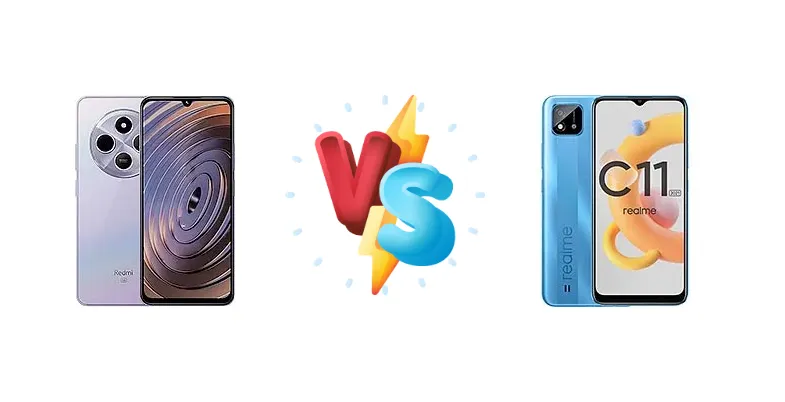
The Xiaomi Redmi A4 and Realme C11 (2021) represent the fiercely competitive entry-level smartphone market. While both aim to deliver essential smartphone functionality at an accessible price, they diverge significantly in their core hardware. This comparison dissects those differences, focusing on the impact of the Redmi A4’s modern Snapdragon 4s Gen 2 chipset against the Realme C11’s older Unisoc SC9863A, and how these choices affect real-world performance and user experience.
🏆 Quick Verdict
For the average user prioritizing responsiveness and future-proofing, the Xiaomi Redmi A4 is the clear winner. Its Snapdragon 4s Gen 2 chipset delivers a substantially faster experience, despite a slightly slower charging speed. However, the Realme C11 (2021) remains a viable option for those on an extremely tight budget and prioritizing basic functionality.
| Network |
|---|
| 2G bands | GSM 850 / 900 / 1800 / 1900 | GSM 850 / 900 / 1800 / 1900 |
| 3G bands | HSDPA 850 / 900 / 1900 / 2100 | HSDPA 850 / 900 / 1900 / 2100 |
| 4G bands | LTE | 1, 3, 5, 8, 38, 40, 41 |
| 5G bands | 1, 3, 5, 8, 28, 40, 78 SA/NSA | - |
| Speed | HSPA, LTE, 5G | HSPA, LTE |
| Technology | GSM / HSPA / LTE / 5G | GSM / HSPA / LTE |
| Launch |
|---|
| Announced | 2024, October 16 | 2021, June 28 |
| Status | Available. Released 2024, November 27 | Available. Released 2021, June 28 |
| Body |
|---|
| Build | Glass front, glass back, plastic frame | Glass front, plastic frame, plastic back |
| Dimensions | 171.9 x 77.8 x 8.2 mm (6.77 x 3.06 x 0.32 in) | 165.2 x 76.4 x 8.9 mm (6.50 x 3.01 x 0.35 in) |
| SIM | Nano-SIM + Nano-SIM | Nano-SIM + Nano-SIM |
| Weight | 212.4 g (7.51 oz) | 190 g (6.70 oz) |
| | - | Splash resistant design |
| Display |
|---|
| Resolution | 720 x 1640 pixels (~260 ppi density) | 720 x 1600 pixels, 20:9 ratio (~269 ppi density) |
| Size | 6.88 inches, 112.4 cm2 (~84.0% screen-to-body ratio) | 6.52 inches, 102.6 cm2 (~81.3% screen-to-body ratio) |
| Type | IPS LCD, 120Hz, 450 nits (typ), 600 nits (HBM) | IPS LCD, 400 nits (typ) |
| Platform |
|---|
| CPU | Octa-core (2x2.0 GHz Cortex-A78 & 6x1.8 GHz Cortex-A55) | Octa-core (4x1.6 GHz Cortex-A55 & 4x1.2 GHz Cortex-A55) |
| Chipset | Qualcomm SM4635 Snapdragon 4s Gen 2 (4 nm) | Unisoc SC9863A (28 nm) |
| GPU | Adreno | IMG8322 |
| OS | Android 14, up to 2 major Android upgrades, HyperOS | Android 11, Realme Go UI |
| Memory |
|---|
| Card slot | microSDXC (dedicated slot) | microSDXC (dedicated slot) |
| Internal | 64GB 4GB RAM, 128GB 4GB RAM, 128GB 6GB RAM | 32GB 2GB RAM, 64GB 4GB RAM |
| | - | eMMC 5.1 |
| Main Camera |
|---|
| Features | LED flash, HDR | LED flash, HDR, panorama |
| Single | 50 MP, f/1.8, (wide)
Auxiliary lens | 8 MP, f/2.0, (wide), AF |
| Video | 1080p@30fps | 1080p@30fps |
| Selfie camera |
|---|
| Features | - | HDR, panorama |
| Single | 5 MP, f/2.2, (wide) | 5 MP, f/2.2, (wide) |
| Video | 1080p@30fps | 1080p@30fps |
| Sound |
|---|
| 3.5mm jack | - | Yes |
| 35mm jack | Yes | Yes |
| Loudspeaker | Yes | Yes |
| Comms |
|---|
| Bluetooth | 5.3, A2DP, LE | 4.2, A2DP |
| NFC | No | No |
| Positioning | GPS | GPS, GLONASS, GALILEO, BDS |
| Radio | Unspecified | Unspecified |
| USB | USB Type-C 2.0 | microUSB 2.0, OTG |
| WLAN | Wi-Fi 802.11 a/b/g/n/ac, dual-band | Wi-Fi 802.11 b/g/n |
| Features |
|---|
| Sensors | Fingerprint (side-mounted) | Accelerometer, gyro, proximity, compass |
| Battery |
|---|
| Charging | 18W wired | 10W wired
Reverse wired |
| Type | 5160 mAh | 5000 mAh |
| Misc |
|---|
| Colors | Sparkle Purple, Starry Black | Cool Blue, Cool Grey |
| Models | 24116RNC1I | RMX3231 |
| Price | ₹ 7,989 | About 80 EUR |
| SAR | 0.81 W/kg (head) 0.71 W/kg (body) | - |
Xiaomi Redmi A4
- Significantly faster processor for smoother performance
- More efficient 4nm chipset for better battery life and less throttling
- Faster 18W wired charging
- Potential for longer software support due to newer chipset
- May be slightly more expensive than the Realme C11 (2021)
- Lacks reverse wired charging
Realme C11 (2021)
- More affordable price point
- Reverse wired charging capability
- Simple and easy-to-use interface
- Acceptable for basic communication tasks
- Slow and outdated Unisoc chipset
- Slower 10W charging
- Limited performance for multitasking and gaming
- Potentially shorter software support lifespan
Display Comparison
Neither device boasts a standout display. Both are likely to feature LCD panels, typical for this price bracket. However, detailed display specs (resolution, brightness, color gamut) are missing. The Realme C11 (2021) may benefit from slightly better outdoor visibility if it has a higher peak brightness, but this is speculative. The focus here isn't on visual fidelity, but on basic usability.
Camera Comparison
Camera performance is likely to be similar, with both phones featuring basic camera setups. Without specific sensor details, it’s difficult to make a definitive judgment. However, the Redmi A4’s more powerful ISP (Image Signal Processor) within the Snapdragon chipset *could* offer slightly better image processing, particularly in low-light conditions. Expect both phones to struggle with detail and dynamic range, and any 2MP macro lenses included are likely to be of limited practical use.
Performance
The performance gap is the most significant differentiator. The Xiaomi Redmi A4’s Qualcomm SM4635 Snapdragon 4s Gen 2, built on a 4nm process, is a generational leap ahead of the Realme C11 (2021)’s Unisoc SC9863A (28nm). The Snapdragon’s octa-core CPU, featuring 2x2.0 GHz Cortex-A78 and 6x1.8 GHz Cortex-A55 cores, provides significantly more processing power than the Unisoc’s 4x1.6 GHz Cortex-A55 and 4x1.2 GHz Cortex-A55 configuration. This translates to faster app loading times, smoother multitasking, and a more responsive user interface on the Redmi A4. The 4nm process also contributes to better thermal efficiency, reducing the likelihood of performance throttling during sustained use. Gamers will find the Redmi A4 far more capable, even with moderately demanding titles.
Battery Life
The Realme C11 (2021) has a slight advantage in charging versatility with its reverse wired charging capability, allowing it to act as a power bank for other devices. However, its 10W charging is significantly slower than the Redmi A4’s 18W wired charging. While battery capacity isn’t specified, the more efficient 4nm Snapdragon chipset in the Redmi A4 could offset a potentially smaller battery, delivering comparable or even better real-world battery life. The faster charging speed of the Redmi A4 also means less time tethered to a wall outlet.
Buying Guide
Buy the Xiaomi Redmi A4 if you need a phone capable of handling everyday tasks smoothly, enjoy occasional gaming, and appreciate a more modern chipset for longer software support. Buy the Realme C11 (2021) if you prioritize absolute affordability and only require a phone for basic communication – calls, texts, and light social media – and are comfortable with a slower overall experience.
Frequently Asked Questions
❓ Will the Snapdragon 4s Gen 2 in the Redmi A4 handle popular games like PUBG Mobile?
While not a gaming powerhouse, the Snapdragon 4s Gen 2 is capable of running PUBG Mobile at lower settings. Expect playable frame rates with reduced graphics quality. The Unisoc SC9863A in the Realme C11 (2021) will struggle significantly with this title.
❓ Does the Realme C11 (2021)'s reverse wired charging actually make it useful as a power bank?
The 10W output of the Realme C11 (2021)'s reverse wired charging is very slow. It's best suited for emergency top-ups of very small devices like Bluetooth earbuds, not for significantly charging a smartphone.
❓ How much of a difference will the 4nm process make in real-world battery life on the Redmi A4?
The 4nm process is significantly more power-efficient than the 28nm process used in the Realme C11 (2021). This means the Redmi A4 will consume less power for the same tasks, potentially resulting in several hours of additional battery life, especially during demanding activities like gaming or video streaming.