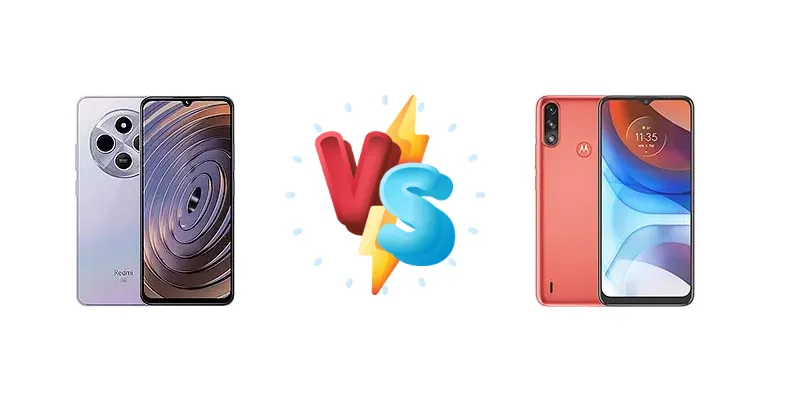
The sub-$150 smartphone market is fiercely competitive. The Xiaomi Redmi A4 and Motorola Moto E7i Power both aim to deliver essential smartphone functionality at an accessible price. However, they take drastically different approaches under the hood, with the Redmi A4 leveraging Qualcomm's newer, more efficient Snapdragon 4s Gen 2, while the Moto E7i Power relies on the older Unisoc SC9863A. This comparison will dissect these differences to determine which device offers the best value.
🏆 Quick Verdict
For the average user prioritizing responsiveness and future-proofing, the Xiaomi Redmi A4 is the clear winner. Its Snapdragon 4s Gen 2 chipset provides a significantly more fluid experience, especially in multitasking and demanding apps, despite the Moto E7i Power's slightly larger battery. The Redmi A4’s faster charging also adds to its appeal.
| Network |
|---|
| 2G bands | GSM 850 / 900 / 1800 / 1900 | GSM 850 / 900 / 1800 / 1900 |
| 3G bands | HSDPA 850 / 900 / 1900 / 2100 | HSDPA 850 / 900 / 1700(AWS) / 1900 / 2100 |
| 4G bands | LTE | LTE |
| 5G bands | 1, 3, 5, 8, 28, 40, 78 SA/NSA | - |
| Speed | HSPA, LTE, 5G | HSPA, LTE |
| Technology | GSM / HSPA / LTE / 5G | GSM / HSPA / LTE |
| Launch |
|---|
| Announced | 2024, October 16 | 2021, February 23 |
| Status | Available. Released 2024, November 27 | Available. Released 2021, March 15 |
| Body |
|---|
| Build | Glass front, glass back, plastic frame | Glass front, plastic back, plastic frame |
| Dimensions | 171.9 x 77.8 x 8.2 mm (6.77 x 3.06 x 0.32 in) | 165.1 x 75.9 x 9.2 mm (6.5 x 2.99 x 0.36 in) |
| SIM | Nano-SIM + Nano-SIM | Nano-SIM + Nano-SIM |
| Weight | 212.4 g (7.51 oz) | 200 g (7.05 oz) |
| | - | Water-repellent design |
| Display |
|---|
| Resolution | 720 x 1640 pixels (~260 ppi density) | 720 x 1600 pixels, 20:9 ratio (~270 ppi density) |
| Size | 6.88 inches, 112.4 cm2 (~84.0% screen-to-body ratio) | 6.51 inches, 102.3 cm2 (~81.7% screen-to-body ratio) |
| Type | IPS LCD, 120Hz, 450 nits (typ), 600 nits (HBM) | IPS LCD, 380 nits (typ) |
| Platform |
|---|
| CPU | Octa-core (2x2.0 GHz Cortex-A78 & 6x1.8 GHz Cortex-A55) | Octa-core (4x1.6 GHz Cortex-A55 & 4x1.2 GHz Cortex-A55) |
| Chipset | Qualcomm SM4635 Snapdragon 4s Gen 2 (4 nm) | Unisoc SC9863A (28 nm) |
| GPU | Adreno | IMG8322 |
| OS | Android 14, up to 2 major Android upgrades, HyperOS | Android 10 (Go edition) |
| Memory |
|---|
| Card slot | microSDXC (dedicated slot) | microSDXC (uses shared SIM slot) |
| Internal | 64GB 4GB RAM, 128GB 4GB RAM, 128GB 6GB RAM | 32GB 2GB RAM |
| | - | eMMC 5.1 |
| Main Camera |
|---|
| Dual | - | 13 MP, f/2.0, 26mm (wide), 1/3.1", 1.12µm, PDAF
2 MP (macro) |
| Features | LED flash, HDR | LED flash, HDR, panorama |
| Single | 50 MP, f/1.8, (wide)
Auxiliary lens | - |
| Video | 1080p@30fps | 1080p@30fps |
| Selfie camera |
|---|
| Features | - | HDR |
| Single | 5 MP, f/2.2, (wide) | 5 MP, f/2.2, 27mm (wide), 1.12µm |
| Video | 1080p@30fps | 1080p@30fps |
| Sound |
|---|
| 3.5mm jack | - | Yes |
| 35mm jack | Yes | Yes |
| Loudspeaker | Yes | Yes |
| Comms |
|---|
| Bluetooth | 5.3, A2DP, LE | 4.2, A2DP |
| NFC | No | No |
| Positioning | GPS | GPS, GLONASS, GALILEO |
| Radio | Unspecified | Unspecified |
| USB | USB Type-C 2.0 | USB Type-C 2.0 |
| WLAN | Wi-Fi 802.11 a/b/g/n/ac, dual-band | Wi-Fi 802.11 b/g/n |
| Features |
|---|
| Sensors | Fingerprint (side-mounted) | Fingerprint (rear-mounted), accelerometer, proximity |
| Battery |
|---|
| Charging | 18W wired | 10W wired |
| Type | 5160 mAh | Li-Ion 5000 mAh |
| Misc |
|---|
| Colors | Sparkle Purple, Starry Black | Tahiti Blue, Coral Red |
| Models | 24116RNC1I | XT2097-13 |
| Price | ₹ 7,989 | About 120 EUR |
| SAR | 0.81 W/kg (head) 0.71 W/kg (body) | - |
Xiaomi Redmi A4
- Significantly faster and more efficient Snapdragon 4s Gen 2 chipset
- Faster 18W wired charging
- Potentially better camera image processing
- Battery capacity may be smaller than the Moto E7i Power
- May be slightly more expensive
Motorola Moto E7i Power
- Potentially larger battery capacity for extended runtime
- Lower price point (likely)
- Simple and straightforward user experience
- Significantly slower Unisoc SC9863A chipset
- Slower 10W wired charging
- Limited performance for demanding apps and games
Display Comparison
Neither device boasts a standout display. Both are likely to feature LCD panels, typical for this price bracket. However, details like resolution and peak brightness are missing. The key difference lies in the processing power driving the display; the Snapdragon 4s Gen 2’s integrated GPU will likely handle UI animations and video playback more smoothly. Bezels are expected to be substantial on both, and color accuracy will likely be standard for budget phones.
Camera Comparison
Camera performance is likely to be similar, leaning towards basic functionality on both devices. Details on sensor sizes and apertures are unavailable, but given the price point, expectations should be tempered. Both phones likely feature a primary camera and potentially a secondary depth or macro sensor (often of limited utility). Image processing will be the key differentiator, and Qualcomm’s ISP (Image Signal Processor) within the Snapdragon 4s Gen 2 is likely to produce more detailed and vibrant images, especially in challenging lighting conditions. The Moto E7i Power’s Unisoc chipset will likely offer more basic image processing capabilities.
Performance
The performance gap is the most significant differentiator. The Qualcomm SM4635 Snapdragon 4s Gen 2, built on a 4nm process, is a substantial upgrade over the Unisoc SC9863A’s 28nm fabrication. The Snapdragon’s octa-core CPU, featuring two Cortex-A78 cores, provides a noticeable boost in single-core and multi-core performance compared to the Moto E7i Power’s four Cortex-A55 cores and another four slower Cortex-A55 cores. This translates to faster app loading times, smoother multitasking, and a more enjoyable overall user experience. The 4nm process also contributes to better thermal efficiency, reducing the likelihood of throttling during sustained use. The Unisoc chip, while adequate for basic tasks, will struggle with more demanding applications and games.
Battery Life
The Motorola Moto E7i Power likely has a larger battery capacity (details missing) to compensate for the less efficient Unisoc chipset. However, the Redmi A4’s Snapdragon 4s Gen 2, with its 4nm process, offers significantly better power efficiency. While the Moto E7i Power supports only 10W charging, the Redmi A4 supports 18W wired charging, meaning faster top-ups. This faster charging, combined with the Snapdragon’s efficiency, could result in comparable real-world battery life despite the potential capacity difference.
Buying Guide
Buy the Xiaomi Redmi A4 if you need a phone that feels responsive for everyday tasks, enjoys occasional gaming, and benefits from faster charging speeds. It’s ideal for users who want a phone that won’t feel sluggish after a few months of use. Buy the Motorola Moto E7i Power if your absolute top priority is maximizing battery life above all else, and you primarily use your phone for basic communication – calls, texts, and light social media – and are willing to accept slower performance.
Frequently Asked Questions
❓ Will the Unisoc SC9863A in the Moto E7i Power struggle with popular apps like WhatsApp and Facebook after a few months of use?
The Unisoc SC9863A is a basic processor. While it will run these apps initially, the performance will likely degrade over time as the phone fills with cached data and background processes. Updates to these apps may also become increasingly sluggish. The Redmi A4’s Snapdragon 4s Gen 2 offers significantly more headroom to handle these issues.
❓ How much faster is the 18W charging on the Redmi A4 compared to the 10W charging on the Moto E7i Power in real-world use?
The 18W charging on the Redmi A4 will significantly reduce charging times. Expect a 0-50% charge in approximately 30-45 minutes, compared to potentially over an hour and a half on the Moto E7i Power. This makes a substantial difference for users who need to quickly top up their phone throughout the day.
❓ Can I play games like PUBG Mobile or Call of Duty Mobile on either of these phones?
While technically possible on both, the experience will be vastly different. The Redmi A4, with its Snapdragon 4s Gen 2, can run these games at low settings with acceptable frame rates. The Moto E7i Power will struggle significantly, likely resulting in very low frame rates and frequent stuttering, making the experience unenjoyable.