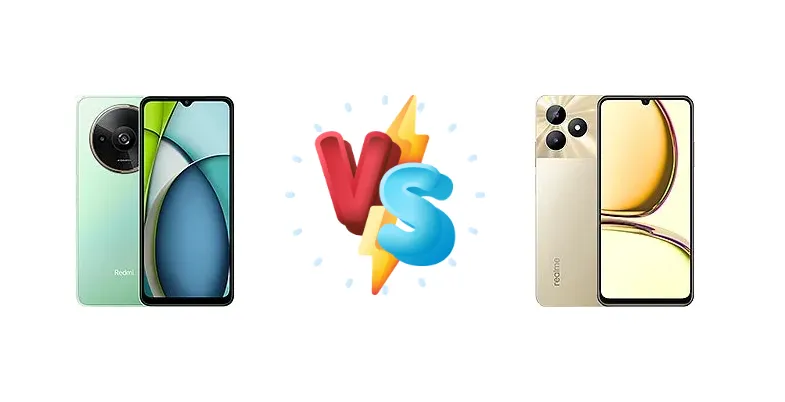
The sub-$150 smartphone market is fiercely competitive, and the Xiaomi Redmi A3x and Realme C53 (India) are two contenders vying for dominance. Both devices target first-time smartphone buyers and those seeking a reliable secondary device, but they take different approaches to achieving that goal, primarily through chipset selection and charging capabilities.
🏆 Quick Verdict
For the average user prioritizing responsiveness and faster charging, the Realme C53 (India) emerges as the better choice. Its Unisoc Tiger T612 chipset, built on a more efficient 12nm process, delivers a noticeable performance edge over the Redmi A3x’s Unisoc T603, and the 18W charging significantly reduces downtime.
| Network |
|---|
| 2G bands | GSM 850 / 900 / 1800 / 1900 | GSM 850 / 900 / 1800 / 1900 |
| 3G bands | HSDPA 850 / 900 / 2100 | HSDPA 850 / 900 / 2100 |
| 4G bands | 1, 3, 5, 7, 8, 20, 28, 38, 40, 41 | 1, 3, 5, 8, 38, 40, 41 |
| Speed | HSPA, LTE | HSPA, LTE |
| Technology | GSM / HSPA / LTE | GSM / HSPA / LTE |
| Launch |
|---|
| Announced | 2024, May 24 | 2023, July 19 |
| Status | Available. Released 2024, May 24 | Available. Released 2023, July 26 |
| Body |
|---|
| Build | Glass front (Gorilla Glass 3), glass back, plastic frame | Glass front, plastic frame, plastic back |
| Dimensions | 168.4 x 76.3 x 8.3 mm (6.63 x 3.00 x 0.33 in) | 167.2 x 76.7 x 8 mm (6.58 x 3.02 x 0.31 in) |
| SIM | Nano-SIM + Nano-SIM | Nano-SIM + Nano-SIM |
| Weight | 193 g (6.81 oz) | 186 g (6.56 oz) |
| Display |
|---|
| Protection | Corning Gorilla Glass 3 | - |
| Resolution | 720 x 1650 pixels (~268 ppi density) | 1080 x 2400 pixels, 20:9 ratio (~390 ppi density) |
| Size | 6.71 inches, 106.5 cm2 (~82.9% screen-to-body ratio) | 6.74 inches, 109.7 cm2 (~85.5% screen-to-body ratio) |
| Type | IPS LCD, 90Hz, 500 nits | IPS LCD, 90Hz, 560 nits (peak) |
| Platform |
|---|
| CPU | Octa-core 1.8 GHz | Octa-core (2x1.8 GHz Cortex-A75 & 6x1.8 GHz Cortex-A55) |
| Chipset | Unisoc T603 (22 nm) | Unisoc Tiger T612 (12 nm) |
| GPU | - | Mali-G57 |
| OS | Android 14, up to 2 major Android upgrades, MIUI | Android 13, Realme UI |
| Memory |
|---|
| Card slot | microSDXC (dedicated slot) | microSDXC (dedicated slot) |
| Internal | 64GB 3GB RAM, 64GB 4GB RAM, 128GB 4GB RAM | 64GB 6GB RAM, 128GB 4GB RAM, 128GB 6GB RAM |
| Main Camera |
|---|
| Dual | - | 108 MP, (wide), PDAF
Auxiliary lens |
| Features | LED flash, HDR | LED flash, HDR, panorama |
| Single | 8 MP, f/2.0, (wide)
Auxiliary lens | - |
| Video | 1080p@30fps | 1080p@30fps |
| Selfie camera |
|---|
| Features | HDR | HDR |
| Single | 5 MP, f/2.2, (wide) | 8 MP, (wide) |
| Video | 1080p@30fps | 720p@30fps |
| Sound |
|---|
| 35mm jack | Yes | Yes |
| Loudspeaker | Yes | Yes |
| Comms |
|---|
| Bluetooth | 4.2, A2DP | 5.0, A2DP, LE |
| NFC | No | No |
| Positioning | GPS, GLONASS, GALILEO | GPS, GLONASS, GALILEO |
| Radio | FM radio | Unspecified |
| USB | USB Type-C | USB Type-C 2.0 |
| WLAN | Wi-Fi 802.11 b/g/n | Wi-Fi 802.11 a/b/g/n/ac, dual-band |
| Features |
|---|
| Sensors | Fingerprint (side-mounted), accelerometer, compass | Fingerprint (side-mounted), accelerometer, gyro, proximity, compass |
| Battery |
|---|
| Charging | 10W wired | 18W wired |
| Type | 5000 mAh | 5000 mAh |
| Misc |
|---|
| Colors | Midnight Black, Moonlight White (Starry White), Aurora Green (Ocean Green), Olive Green | Gold, Black |
| Models | 24048RN6CG, 24048RN6CI | RMX3762 |
| Price | $ 99.99 / € 85.45 / ₹ 6,428 | About 110 EUR |
Xiaomi Redmi A3x
- Potentially lower price point.
- Simple and straightforward user experience.
- Reliable for basic tasks.
- Slower Unisoc T603 chipset.
- Slow 10W charging.
- Less responsive performance.
Realme C53 (India)
- More powerful Unisoc Tiger T612 chipset.
- Faster 18W charging.
- Improved multitasking capabilities.
- Better power efficiency.
- May be slightly more expensive.
- Software experience can vary.
Display Comparison
Neither Xiaomi nor Realme provide detailed display specifications beyond the basic panel type. However, given the price point, both likely utilize LCD panels. The absence of high refresh rates is expected. The key difference lies in the underlying processing power needed to drive the display, which is indirectly impacted by the chipset. Without specific brightness or color gamut data, it’s difficult to declare a clear winner, but the Realme C53’s more powerful chipset *could* translate to slightly smoother animations.
Camera Comparison
Both devices likely feature similar camera setups focused on basic photography. Given the lack of detailed sensor information, it’s safe to assume both rely on a primary sensor paired with auxiliary lenses of limited utility. Without knowing the megapixel counts or aperture values, a direct comparison is impossible. However, the Realme C53’s more capable chipset *could* offer slightly better image processing capabilities, potentially resulting in marginally improved image quality, particularly in low-light conditions. The focus here isn't on photographic excellence, but on functional image capture.
Performance
The Realme C53’s Unisoc Tiger T612 represents a significant step up from the Redmi A3x’s Unisoc T603. The T612’s 12nm fabrication process is more efficient than the T603’s 22nm, leading to better power efficiency and potentially lower thermal throttling. Crucially, the T612 features a heterogeneous core configuration – 2x 1.8 GHz Cortex-A75 and 6x 1.8 GHz Cortex-A55 – offering a performance boost in demanding applications compared to the T603’s all-Cortex-A55 setup. This means the Realme C53 will handle multitasking and moderately intensive games with greater ease. While both are octa-core CPUs clocked at 1.8 GHz, the architectural differences are substantial.
Battery Life
While battery capacity isn’t specified, both phones likely house batteries in the 5000mAh range, typical for this price segment. The critical difference is charging speed. The Realme C53 supports 18W wired charging, significantly faster than the Redmi A3x’s 10W charging. This translates to a much quicker 0-100% charge time, reducing downtime and making the Realme C53 more convenient for users who rely heavily on their phones throughout the day. The faster charging is a tangible benefit that directly impacts the user experience.
Buying Guide
Buy the Xiaomi Redmi A3x if you prioritize absolute affordability and are willing to accept slightly slower performance and charging speeds. It’s ideal for users with very basic smartphone needs – calls, texts, and light social media. Buy the Realme C53 (India) if you prefer a more responsive experience, faster charging, and a chipset designed for slightly more demanding tasks, making it better suited for casual gaming and multitasking.
Frequently Asked Questions
❓ Will the Realme C53 (India) handle popular games like PUBG Mobile or Call of Duty Mobile?
While not designed for high-end gaming, the Unisoc Tiger T612 in the Realme C53 can run PUBG Mobile and Call of Duty Mobile at lower settings. Expect frame rate drops during intense action, but it's playable for casual gaming sessions. The Redmi A3x will struggle more with these titles.
❓ How long will it take to fully charge the Realme C53 (India) with the 18W charger?
With the included 18W charger, the Realme C53 (India) should fully charge from 0% to 100% in approximately 2-2.5 hours. This is significantly faster than the Redmi A3x, which will likely take over 4 hours with its 10W charger.
❓ Is the Unisoc Tiger T612 chipset a reliable choice for a budget smartphone?
The Unisoc Tiger T612 is a capable chipset for the price range. While it doesn't compete with Snapdragon or MediaTek's higher-end offerings, it provides a noticeable performance improvement over older or less powerful chipsets, offering a smooth experience for everyday tasks and light multitasking.