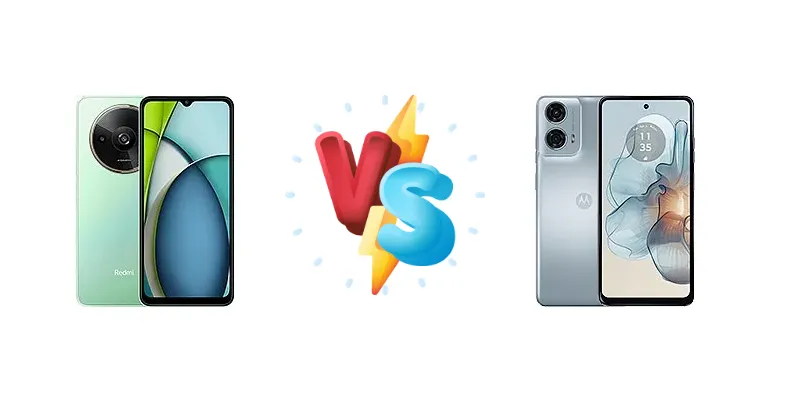
The sub-$150 smartphone market is fiercely competitive. The Xiaomi Redmi A3x and Motorola Moto G24 Power both aim to deliver essential features at an accessible price point, but they take different approaches. The A3x prioritizes a streamlined experience with a power-efficient chipset, while the Moto G24 Power focuses on faster charging and a more robust processor for demanding tasks. This comparison will dissect their key differences to help you choose the right device.
🏆 Quick Verdict
For the average user prioritizing consistent performance and faster charging, the Motorola Moto G24 Power is the better choice. Its Helio G85 chipset, built on a smaller 12nm process, offers a noticeable performance advantage over the Redmi A3x’s Unisoc T603, and the 30W charging significantly reduces downtime. However, the A3x remains a viable option for those seeking maximum battery life with minimal usage.
| Network |
|---|
| 2G bands | GSM 850 / 900 / 1800 / 1900 | GSM 850 / 900 / 1800 / 1900 |
| 3G bands | HSDPA 850 / 900 / 2100 | HSDPA 850 / 900 / 1900 / 2100 |
| 4G bands | 1, 3, 5, 7, 8, 20, 28, 38, 40, 41 | 1, 2, 3, 5, 7, 8, 20, 28, 38, 40, 41 |
| Speed | HSPA, LTE | HSPA, LTE |
| Technology | GSM / HSPA / LTE | GSM / HSPA / LTE |
| Launch |
|---|
| Announced | 2024, May 24 | 2024, January 30 |
| Status | Available. Released 2024, May 24 | Available. Released 2024, February 07 |
| Body |
|---|
| Build | Glass front (Gorilla Glass 3), glass back, plastic frame | Glass front, plastic back, plastic frame |
| Dimensions | 168.4 x 76.3 x 8.3 mm (6.63 x 3.00 x 0.33 in) | 163.5 x 74.5 x 9 mm (6.44 x 2.93 x 0.35 in) |
| SIM | Nano-SIM + Nano-SIM | Nano-SIM + Nano-SIM |
| Weight | 193 g (6.81 oz) | 197 g (6.95 oz) |
| Display |
|---|
| Protection | Corning Gorilla Glass 3 | - |
| Resolution | 720 x 1650 pixels (~268 ppi density) | 720 x 1612 pixels, 20:9 ratio (~269 ppi density) |
| Size | 6.71 inches, 106.5 cm2 (~82.9% screen-to-body ratio) | 6.56 inches, 103.4 cm2 (~84.9% screen-to-body ratio) |
| Type | IPS LCD, 90Hz, 500 nits | IPS LCD, 90Hz, 537 nits (peak) |
| Platform |
|---|
| CPU | Octa-core 1.8 GHz | Octa-core (2x2.0 GHz Cortex-A75 & 6x1.7 GHz Cortex-A55) |
| Chipset | Unisoc T603 (22 nm) | Mediatek MT6769Z Helio G85 (12 nm) |
| GPU | - | Mali-G52 MC2 |
| OS | Android 14, up to 2 major Android upgrades, MIUI | Android 14 |
| Memory |
|---|
| Card slot | microSDXC (dedicated slot) | microSDXC (dedicated slot) |
| Internal | 64GB 3GB RAM, 64GB 4GB RAM, 128GB 4GB RAM | 128GB 4GB RAM, 128GB 8GB RAM, 256GB 4GB RAM, 256GB 8GB RAM |
| Main Camera |
|---|
| Dual | - | 50 MP, f/1.8 (wide), 0.64µm, PDAF
2 MP (macro) |
| Features | LED flash, HDR | LED flash, HDR, panorama |
| Single | 8 MP, f/2.0, (wide)
Auxiliary lens | - |
| Video | 1080p@30fps | 1080p@30fps |
| Selfie camera |
|---|
| Features | HDR | - |
| Single | 5 MP, f/2.2, (wide) | 8 MP, f/2.0, (wide), 1.12µm - International version
16 MP, f/2.5, (wide), 1.0µm - India version |
| Video | 1080p@30fps | 1080p@30fps |
| Sound |
|---|
| 35mm jack | Yes | Yes |
| Loudspeaker | Yes | Yes, with stereo speakers |
| Comms |
|---|
| Bluetooth | 4.2, A2DP | 5.0, A2DP, LE |
| NFC | No | Yes (market/region dependent) |
| Positioning | GPS, GLONASS, GALILEO | GPS, GALILEO, GLONASS |
| Radio | FM radio | FM radio (market/region dependent) |
| USB | USB Type-C | USB Type-C 2.0 |
| WLAN | Wi-Fi 802.11 b/g/n | Wi-Fi 802.11 a/b/g/n/ac, dual-band |
| Features |
|---|
| Sensors | Fingerprint (side-mounted), accelerometer, compass | Fingerprint (side-mounted), accelerometer, gyro, proximity, compass |
| Battery |
|---|
| Charging | 10W wired | 30W wired |
| Type | 5000 mAh | 6000 mAh |
| Misc |
|---|
| Colors | Midnight Black, Moonlight White (Starry White), Aurora Green (Ocean Green), Olive Green | Glacier Blue, Ink Blue |
| Models | 24048RN6CG, 24048RN6CI | - |
| Price | $ 99.99 / € 85.45 / ₹ 6,428 | € 132.29 |
Xiaomi Redmi A3x
- Potentially longer battery life due to efficient chipset.
- Lower price point (likely).
- Simple and streamlined user experience.
- Significantly slower charging speed (10W).
- Less powerful processor for demanding tasks.
- Limited multitasking capabilities.
Motorola Moto G24 Power
- Faster charging (30W) for reduced downtime.
- More powerful processor (Helio G85) for smoother performance.
- Better multitasking capabilities.
- Potentially shorter battery life compared to the A3x.
- May be slightly more expensive.
- Helio G85 can generate more heat under sustained load.
Display Comparison
Neither device boasts a standout display. Both likely utilize LCD panels, common in this price bracket. However, detailed display specs (resolution, brightness, color gamut) are missing. The focus here is on internal components. The absence of high refresh rates is expected, and both will likely offer adequate, but not exceptional, viewing experiences. Bezels are likely comparable, given the similar target price points.
Camera Comparison
Camera performance is likely to be similar, relying heavily on software processing. Both phones likely feature a primary camera and potentially a depth or macro sensor. Without specific sensor size or aperture information, it’s difficult to make a definitive judgment. However, the Helio G85’s image signal processor (ISP) within the Moto G24 Power likely offers more advanced image processing capabilities, potentially resulting in better dynamic range and low-light performance. The inclusion of a 2MP macro camera on either device is largely a marketing tactic, offering limited practical benefit.
Performance
The Motorola Moto G24 Power holds a clear advantage in performance. Its MediaTek Helio G85, fabricated on a 12nm process, is significantly more efficient and powerful than the Xiaomi Redmi A3x’s Unisoc T603 (22nm). The Helio G85’s octa-core configuration, featuring two Cortex-A75 cores clocked at 2.0 GHz, provides a substantial boost in single-core and multi-core performance, crucial for smoother app launches and multitasking. The Unisoc T603, while efficient, is geared towards basic tasks. This translates to a more responsive user experience on the Moto G24 Power, particularly noticeable when switching between apps or playing graphically intensive games.
Battery Life
While both phones aim for all-day battery life, the Motorola Moto G24 Power’s 30W wired charging is a game-changer. The Redmi A3x is limited to a slow 10W charge, meaning significantly longer charging times. Even if the A3x has a slightly larger battery capacity (unspecified), the G24 Power’s faster charging will minimize downtime. A full charge on the A3x could take upwards of 3 hours, while the G24 Power should achieve a full charge in around 90-120 minutes. This difference is critical for users who rely heavily on their phones throughout the day.
Buying Guide
Buy the Xiaomi Redmi A3x if you need a phone primarily for basic communication – calls, texts, and light social media – and value extended battery life above all else. Its Unisoc T603 chipset is optimized for efficiency. Buy the Motorola Moto G24 Power if you prefer a phone capable of handling more demanding tasks like streaming video, casual gaming, and multitasking, and you appreciate the convenience of significantly faster 30W charging.
Frequently Asked Questions
❓ Will the Unisoc T603 in the Redmi A3x struggle with popular apps like Facebook and WhatsApp?
While the Unisoc T603 can handle basic apps like Facebook and WhatsApp, expect some lag when multitasking or using more demanding features within those apps. It's designed for light usage, and heavy app switching will likely result in a less fluid experience.
❓ Does the Motorola Moto G24 Power get noticeably warm during extended gaming sessions?
The Helio G85 is known to generate more heat than the Unisoc T603 under sustained load. While the Moto G24 Power likely has thermal management features, expect some warming during prolonged gaming. It shouldn't reach uncomfortable temperatures, but performance throttling is possible.
❓ Is the 30W charging on the Moto G24 Power compatible with standard USB-PD chargers?
Motorola typically uses its own charging protocol, even with USB-C ports. While the Moto G24 Power *may* charge with a USB-PD charger, it will likely charge at a slower rate than with the included 30W charger. Using the supplied charger is recommended for optimal charging speed.
❓ How does the software experience differ between the Redmi A3x and Moto G24 Power?
The Redmi A3x likely runs Xiaomi's MIUI, known for its customization options but also potential bloatware. The Moto G24 Power typically offers a cleaner, near-stock Android experience, which many users prefer for its simplicity and faster updates.