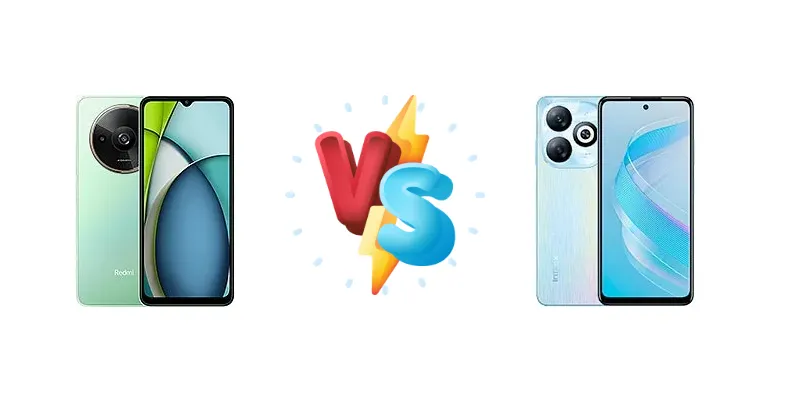
The sub-$150 smartphone market is fiercely competitive, and the Xiaomi Redmi A3x and Infinix Smart 8 Pro are two contenders vying for dominance. Both aim to deliver essential smartphone functionality at an incredibly accessible price point, but they take different approaches to achieving this. This comparison dives deep into their specifications to determine which device offers the best overall experience.
🏆 Quick Verdict
For most users, the Infinix Smart 8 Pro emerges as the slightly better choice. Its Mediatek Helio G36 chipset, built on a more efficient 12nm process, provides a noticeable performance advantage over the Redmi A3x’s Unisoc T603, particularly in multitasking and light gaming. While both offer 10W charging, the Smart 8 Pro adds reverse wired charging, a unique feature in this segment.
| Network |
|---|
| 2G bands | GSM 850 / 900 / 1800 / 1900 | GSM 850 / 900 / 1800 / 1900 |
| 3G bands | HSDPA 850 / 900 / 2100 | HSDPA 850 / 900 / 1700(AWS) / 1900 / 2100 |
| 4G bands | 1, 3, 5, 7, 8, 20, 28, 38, 40, 41 | 1, 2, 3, 4, 5, 7, 8, 20, 28, 38, 41, 40 |
| Speed | HSPA, LTE | HSPA, LTE |
| Technology | GSM / HSPA / LTE | GSM / HSPA / LTE |
| Launch |
|---|
| Announced | 2024, May 24 | 2024, January 29 |
| Status | Available. Released 2024, May 24 | Available. Released 2024, February |
| Body |
|---|
| Build | Glass front (Gorilla Glass 3), glass back, plastic frame | Glass front, plastic back, plastic frame |
| Dimensions | 168.4 x 76.3 x 8.3 mm (6.63 x 3.00 x 0.33 in) | 163.6 x 75.6 x 8.5 mm (6.44 x 2.98 x 0.33 in) |
| SIM | Nano-SIM + Nano-SIM | Nano-SIM + Nano-SIM |
| Weight | 193 g (6.81 oz) | 189 g (6.67 oz) |
| Display |
|---|
| Protection | Corning Gorilla Glass 3 | - |
| Resolution | 720 x 1650 pixels (~268 ppi density) | 720 x 1612 pixels, 20:9 ratio (~267 ppi density) |
| Size | 6.71 inches, 106.5 cm2 (~82.9% screen-to-body ratio) | 6.6 inches, 104.6 cm2 (~84.6% screen-to-body ratio) |
| Type | IPS LCD, 90Hz, 500 nits | IPS LCD, 90Hz, 500 nits (peak) |
| Platform |
|---|
| CPU | Octa-core 1.8 GHz | Octa-core (4x2.2 GHz Cortex-A53 & 4x1.6 GHz Cortex-A53) |
| Chipset | Unisoc T603 (22 nm) | Mediatek Helio G36 (12 nm) |
| GPU | - | PowerVR GE8320 |
| OS | Android 14, up to 2 major Android upgrades, MIUI | Android 13 (Go edition), XOS 13 |
| Memory |
|---|
| Card slot | microSDXC (dedicated slot) | microSDXC (dedicated slot) |
| Internal | 64GB 3GB RAM, 64GB 4GB RAM, 128GB 4GB RAM | 64GB 4GB RAM, 128GB 8GB RAM, 256GB 4GB RAM |
| Main Camera |
|---|
| Features | LED flash, HDR | Ring-LED flash, HDR, panorama |
| Single | 8 MP, f/2.0, (wide)
Auxiliary lens | 50 MP, f/1.9, (wide), AF
Auxiliary lens |
| Video | 1080p@30fps | 1080p@30fps |
| Selfie camera |
|---|
| Features | HDR | - |
| Single | 5 MP, f/2.2, (wide) | 8 MP, f/2.0, (wide) |
| Video | 1080p@30fps | Yes |
| Sound |
|---|
| 35mm jack | Yes | Yes |
| Loudspeaker | Yes | Yes |
| Comms |
|---|
| Bluetooth | 4.2, A2DP | 5.0, A2DP, LE |
| NFC | No | No |
| Positioning | GPS, GLONASS, GALILEO | GPS |
| Radio | FM radio | FM radio |
| USB | USB Type-C | USB Type-C 2.0, OTG |
| WLAN | Wi-Fi 802.11 b/g/n | Wi-Fi 802.11 a/b/g/n/ac, dual-band |
| Features |
|---|
| Sensors | Fingerprint (side-mounted), accelerometer, compass | Fingerprint (side-mounted), accelerometer, gyro, proximity, compass |
| Battery |
|---|
| Charging | 10W wired | 10W wired
Reverse wired |
| Type | 5000 mAh | 5000 mAh |
| Misc |
|---|
| Colors | Midnight Black, Moonlight White (Starry White), Aurora Green (Ocean Green), Olive Green | Rainbow Blue, Galaxy White, Shiny Gold, Timber Black |
| Models | 24048RN6CG, 24048RN6CI | X6525B |
| Price | $ 99.99 / € 85.45 / ₹ 6,428 | About 100 EUR |
Xiaomi Redmi A3x
- Simple and streamlined user experience
- Potentially lower price point
- Reliable brand reputation
- Less powerful chipset
- Less efficient processor node (22nm)
- No reverse charging
Infinix Smart 8 Pro
- More powerful Mediatek Helio G36 chipset
- More efficient 12nm process
- Reverse wired charging capability
- Infinix’s software experience can be more cluttered
- Potentially slightly higher price
Display Comparison
Neither Xiaomi nor Infinix provide detailed display specifications beyond resolution. However, both likely utilize LCD panels common in this price bracket. The key difference lies under the hood: processing power impacts UI responsiveness. While both will likely offer similar viewing angles and color reproduction, the Smart 8 Pro’s more capable chipset will contribute to smoother scrolling and transitions. Expect both to struggle in direct sunlight.
Camera Comparison
Both devices are expected to feature basic camera setups, likely with a primary sensor and potentially a depth or macro lens. Given the price point, image quality will be heavily reliant on software processing. Without specific sensor details, it’s difficult to make a definitive judgment. However, the Smart 8 Pro’s more powerful chipset could enable more sophisticated image processing algorithms, potentially resulting in slightly better photos in good lighting conditions. The inclusion of a 2MP macro lens on either device is largely a marketing tactic and offers limited practical benefit.
Performance
The core differentiator here is the chipset. The Infinix Smart 8 Pro’s Mediatek Helio G36, fabricated on a 12nm process, offers a clear advantage over the Xiaomi Redmi A3x’s Unisoc T603 (22nm). The G36’s CPU configuration – 4x2.2 GHz Cortex-A53 & 4x1.6 GHz Cortex-A53 – provides a higher peak clock speed and a more balanced core arrangement compared to the A3x’s octa-core 1.8 GHz setup. This translates to faster app loading times and improved multitasking. The 12nm process also contributes to better thermal efficiency, potentially reducing throttling during sustained use. While neither is a gaming powerhouse, the Smart 8 Pro will handle less demanding titles more comfortably.
Battery Life
Both the Redmi A3x and Smart 8 Pro feature 10W wired charging. While not fast by modern standards, it’s adequate for overnight charging. The actual battery capacity isn’t specified, but both are likely in the 5000mAh range, typical for this segment. The Smart 8 Pro gains a significant advantage with the inclusion of reverse wired charging, allowing it to function as a power bank for other devices like earbuds or smartwatches. This is a feature rarely found in this price category.
Buying Guide
Buy the Xiaomi Redmi A3x if you prioritize a simple, streamlined Android experience and are primarily focused on basic communication and light app usage. Its Unisoc T603 is adequate for these tasks. Buy the Infinix Smart 8 Pro if you need a phone capable of handling more demanding apps, occasional gaming, and appreciate the added convenience of reverse wired charging – making it a useful power bank for accessories.
Frequently Asked Questions
❓ Will the Mediatek Helio G36 in the Smart 8 Pro overheat during prolonged gaming sessions?
While the Helio G36 isn't a high-end gaming chip, its 12nm process is more efficient than the Unisoc T603’s 22nm node. This means it's less prone to overheating during moderate gaming. Expect playable frame rates in less demanding titles, but sustained performance may be limited by thermal throttling.
❓ Is the reverse wired charging on the Infinix Smart 8 Pro useful for everyday use?
Yes, the reverse wired charging is surprisingly practical. It allows you to top up accessories like Bluetooth earbuds, smartwatches, or even a friend’s phone in a pinch. While it won’t fully charge another device quickly, it provides a convenient emergency power source.
❓ How does the Unisoc T603 in the Redmi A3x handle multitasking compared to the Helio G36?
The Unisoc T603 will struggle with heavy multitasking. The Helio G36’s more powerful CPU and potentially more efficient memory management will result in smoother app switching and a more responsive experience when running multiple applications simultaneously.