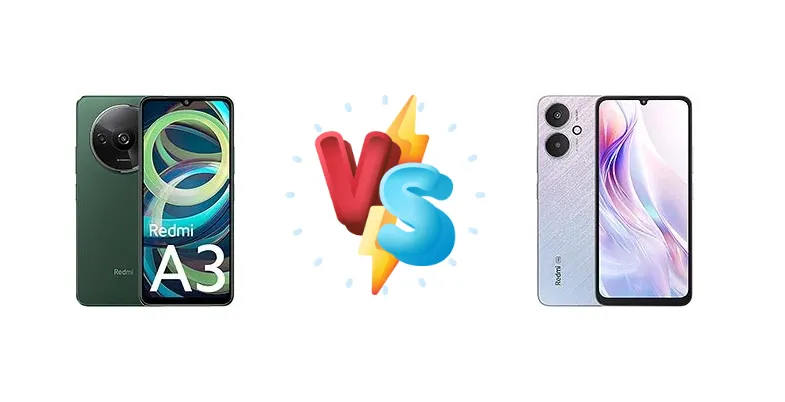
Xiaomi's Redmi series consistently delivers value, but navigating the options can be tricky. The Redmi A3 and Redmi 13C 5G represent two distinct approaches to the budget smartphone market. The A3 focuses on a streamlined experience, while the 13C 5G adds the crucial element of 5G connectivity and a more modern chipset. This comparison dissects their key differences to determine which best suits your needs.
🏆 Quick Verdict
For most users, the Xiaomi Redmi 13C 5G is the superior choice. Its Mediatek Dimensity 6100+ chipset provides a significant performance uplift over the Helio G36 in the A3, and the inclusion of 18W charging with PD support offers faster and more versatile power replenishment. While the A3 is cheaper, the 13C 5G’s benefits justify the price difference.
| Network |
|---|
| 2G bands | GSM 850 / 900 / 1800 / 1900 | GSM 850 / 900 / 1800 / 1900 |
| 3G bands | HSDPA 850 / 900 / 2100 | HSDPA 800 / 850 / 900 / 1700(AWS) / 1900 / 2100 - International |
| 4G bands | 1, 3, 5, 7, 8, 20, 28, 38, 40, 41 | 1, 2, 3, 4, 5, 7, 8, 12, 13, 17, 18, 19, 20, 26, 28, 32, 38, 40, 41, 66 - International |
| 5G bands | - | 1, 3, 5, 7, 8, 20, 28, 38, 40, 41, 66, 77, 78 SA/NSA - International |
| Speed | HSPA, LTE | HSPA, LTE, 5G |
| Technology | GSM / HSPA / LTE | GSM / HSPA / LTE / 5G |
| Launch |
|---|
| Announced | 2024, February 14 | 2023, December 06 |
| Status | Available. Released 2024, February 23 | Available. Released 2023, December 16 |
| Body |
|---|
| Build | Glass front (Gorilla Glass 3), glass back or silicone polymer back (eco leather), plastic frame | Glass front (Gorilla Glass 3), plastic frame, plastic back |
| Dimensions | 168.3 x 76.3 x 8.3 mm (6.63 x 3.00 x 0.33 in) | 168.1 x 77.9 x 8.2 mm (6.62 x 3.07 x 0.32 in) |
| SIM | Nano-SIM + Nano-SIM | Nano-SIM + Nano-SIM |
| Weight | 193 g or 199 g (6.81 oz) | 192 g or 195 g (6.77 oz) |
| Display |
|---|
| Protection | Corning Gorilla Glass 3 | Corning Gorilla Glass 3 |
| Resolution | 720 x 1650 pixels (~268 ppi density) | 720 x 1600 pixels, 20:9 ratio (~260 ppi density) |
| Size | 6.71 inches, 106.5 cm2 (~82.9% screen-to-body ratio) | 6.74 inches, 109.7 cm2 (~83.8% screen-to-body ratio) |
| Type | IPS LCD, 90Hz, 500 nits (HBM) | IPS LCD, 90Hz, 450 nits (typ), 600 nits (HBM) |
| Platform |
|---|
| CPU | Octa-core (4x2.2 GHz Cortex-A53 & 4x1.6 GHz Cortex-A53) | Octa-core (2x2.2 GHz Cortex-A76 & 6x2.0 GHz Cortex-A55) |
| Chipset | Mediatek Helio G36 (12 nm) | Mediatek Dimensity 6100+ (6 nm) |
| GPU | PowerVR GE8320 | Mali-G57 MC2 |
| OS | Android 14 or Android 14 (Go edition), upgradable to Android 15 | Android 13, MIUI 14 |
| Memory |
|---|
| Card slot | microSDXC (dedicated slot) | microSDXC (dedicated slot) |
| Internal | 64GB 2GB RAM, 64GB 3GB RAM, 64GB 4GB RAM, 128GB 3GB RAM, 128GB 4GB RAM, 128GB 6GB RAM, 128GB 8GB RAM | 64GB 4GB RAM, 128GB 4GB RAM, 128GB 6GB RAM, 256GB 8GB RAM |
| Main Camera |
|---|
| Features | LED flash, HDR | LED flash, HDR |
| Single | 8 MP, f/2.0, (wide)
Auxiliary lens | 50 MP, f/1.8, 28mm (wide), 1/2.76", 1.12µm, PDAF
Auxiliary lens |
| Video | 1080p@30fps | 1080p@30fps |
| Selfie camera |
|---|
| Features | - | HDR |
| Single | 5 MP, f/2.2, (wide) | 5 MP, f/2.2, (wide) |
| Video | 1080p@30fps | 1080p@30fps |
| Sound |
|---|
| 35mm jack | Yes | Yes |
| Loudspeaker | Yes | Yes |
| Comms |
|---|
| Bluetooth | 5.4, A2DP, LE | 5.3, A2DP, LE |
| NFC | Yes (market/region dependent) | Yes (market/region dependent) |
| Positioning | GPS, GLONASS, GALILEO, BDS | GPS, GLONASS, GALILEO, BDS |
| Radio | FM radio | FM radio |
| USB | USB Type-C 2.0 | USB Type-C 2.0, OTG |
| WLAN | Wi-Fi 802.11 a/b/g/n/ac, dual-band | Wi-Fi 802.11 a/b/g/n/ac, dual-band |
| Features |
|---|
| Sensors | Fingerprint (side-mounted), accelerometer, compass | Fingerprint (side-mounted), accelerometer, compass |
| Battery |
|---|
| Charging | 10W wired | 18W wired, PD |
| Type | 5000 mAh | 5000 mAh |
| Misc |
|---|
| Colors | Midnight Black, Forest Green (Olive Green), Star Blue (Lake Blue) | Starry Black, Twilight Blue, Starry Silver, Starlight Black, Startrail Green, Startrail Silver |
| Models | 23129RN51X, 23129RN51H | 23124RN87G, 23124RN87I, 23124RN87C |
| Price | € 74.14 / $ 70.57 / £ 53.99 / ₹ 6,995 | $ 198.99 / £ 119.00 / € 116.99 / ₹ 10,895 |
| SAR | - | 1.09 W/kg (head) 1.09 W/kg (body) |
| SAR EU | 0.92 W/kg (head) 0.99 W/kg (body) | 0.98 W/kg (head) 0.98 W/kg (body) |
Xiaomi Redmi A3
- Most affordable option
- Simple and streamlined experience
- Potentially longer battery life (depending on capacity)
- Significantly slower performance
- Slow 10W charging
- Lacks 5G connectivity
Xiaomi Redmi 13C 5G
- Faster and more efficient processor
- 18W charging with PD support
- 5G connectivity for faster data speeds
- Slightly higher price
- May not have significantly better battery life than A3
- Software experience can be cluttered
Display Comparison
Neither Xiaomi provides display specifications beyond resolution. However, the Redmi 13C 5G benefits from the more modern chipset allowing for potentially better image processing and color reproduction. The A3, with its older Helio G36, may exhibit slightly less vibrant colors. Bezels are likely comparable given the price points, and neither phone is expected to feature high refresh rate panels. The lack of detailed display specs makes a definitive comparison difficult, but the 13C 5G’s chipset gives it an edge.
Camera Comparison
Without detailed camera specs, it’s difficult to make a precise comparison. However, given the price bracket, both phones likely feature a primary camera paired with depth or macro sensors. The Redmi 13C 5G’s more powerful chipset allows for more sophisticated image processing algorithms, potentially resulting in better dynamic range and noise reduction. The A3’s Helio G36 may struggle with complex image processing tasks. The inclusion of a 2MP macro camera on either device is largely a marketing gimmick and offers limited practical benefit.
Performance
The performance gap between these two is substantial. The Redmi 13C 5G’s Mediatek Dimensity 6100+ (6nm) is a significant upgrade over the Redmi A3’s Helio G36 (12nm). The Dimensity 6100+ utilizes more efficient Cortex-A76 cores alongside Cortex-A55s, resulting in noticeably faster app loading times and smoother multitasking. The Helio G36 relies on older Cortex-A53 cores, which are less capable. The 6nm process node of the Dimensity 6100+ also translates to better thermal efficiency, reducing the likelihood of performance throttling during extended use. This benefits gamers and users who frequently run demanding applications.
Battery Life
While battery capacity isn't specified, the Redmi 13C 5G’s 18W wired charging with Power Delivery (PD) is a clear advantage. The A3 is limited to 10W charging, meaning significantly longer charge times. PD support on the 13C 5G also allows for compatibility with a wider range of chargers and potentially faster charging with compatible adapters. Even if the A3 has a slightly larger battery, the 13C 5G’s faster charging will likely result in less downtime.
Buying Guide
Buy the Xiaomi Redmi A3 if you prioritize absolute affordability and only need a phone for basic tasks like calls, messaging, and light social media. You're willing to sacrifice performance and future-proofing for the lowest possible price. Buy the Xiaomi Redmi 13C 5G if you want a phone capable of handling more demanding apps, enjoy faster download speeds with 5G, and appreciate quicker charging times. It’s the better long-term investment for most users.
Frequently Asked Questions
❓ Will the Dimensity 6100+ in the Redmi 13C 5G get noticeably hot during gaming?
The Dimensity 6100+ is built on a 6nm process, which is more efficient than the 12nm Helio G36. This means it generates less heat under load. While some warming is expected during prolonged gaming sessions, it's unlikely to experience significant throttling like the A3 might.
❓ Is the 5G connectivity on the Redmi 13C 5G actually useful for most people?
The usefulness of 5G depends on your location and carrier coverage. If you live in an area with strong 5G signals, you'll experience significantly faster download and upload speeds compared to 4G. Even if 5G isn't readily available, the 13C 5G will still fall back to 4G networks.
❓ How much faster is the charging on the Redmi 13C 5G compared to the A3?
The Redmi 13C 5G's 18W charging with PD will likely charge the phone from 0-100% in around 2-2.5 hours, assuming a compatible charger. The Redmi A3's 10W charging could take upwards of 3.5-4 hours for a full charge. This is a substantial difference in charging time.